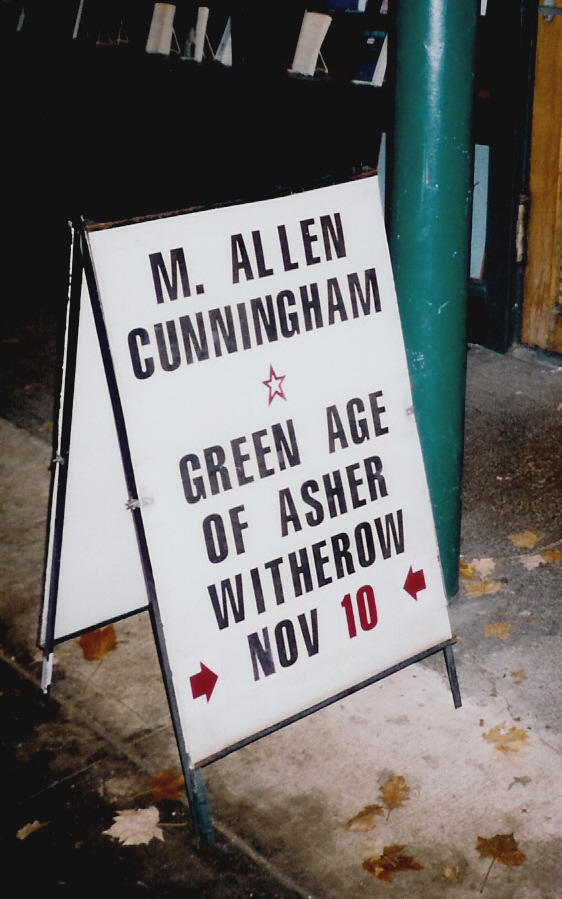
Monday, October 30, 2006

New Short Story Forthcoming...in Audio!


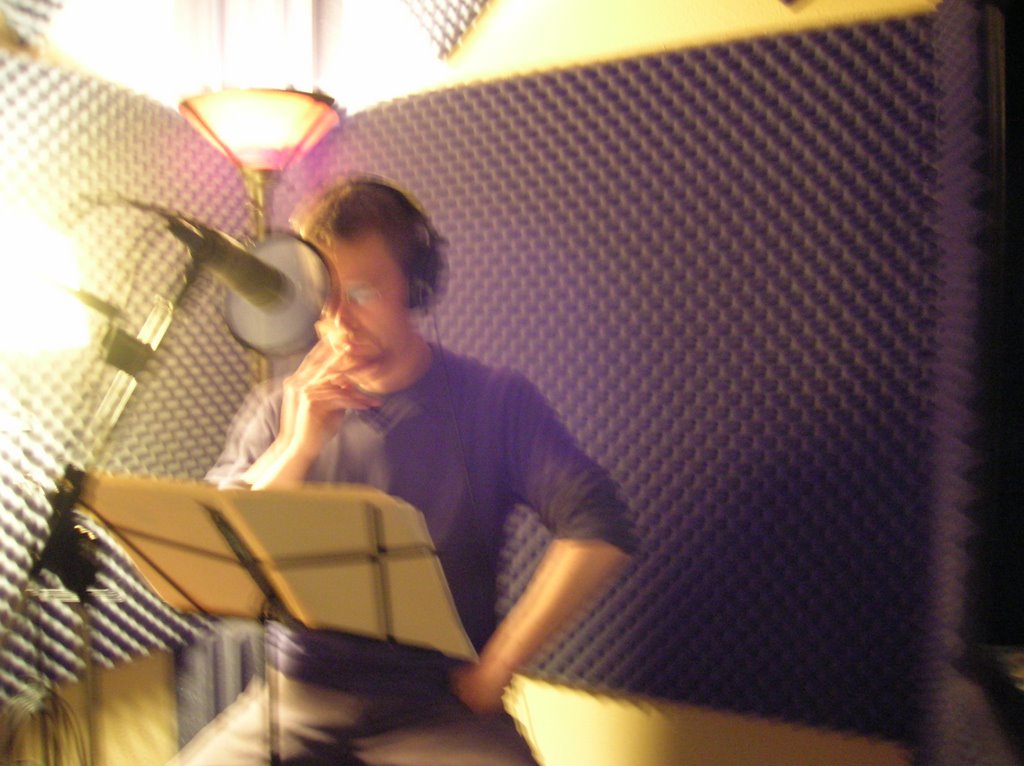
A few weeks ago, I spent a couple hours in a recording studio here in Portland, "laying down" (as they say) the audio for my short story "Date of Disappearance." The tale features one Mason Whipple in his erroneous attempts to stave off disaster in his marriage by way of "steely stirrups" and "a pinprick in a place he never hoped to sense one"... Look for it very soon in Verb Audioquarterly.

Friday, September 22, 2006

Sneak Peek (of sorts)


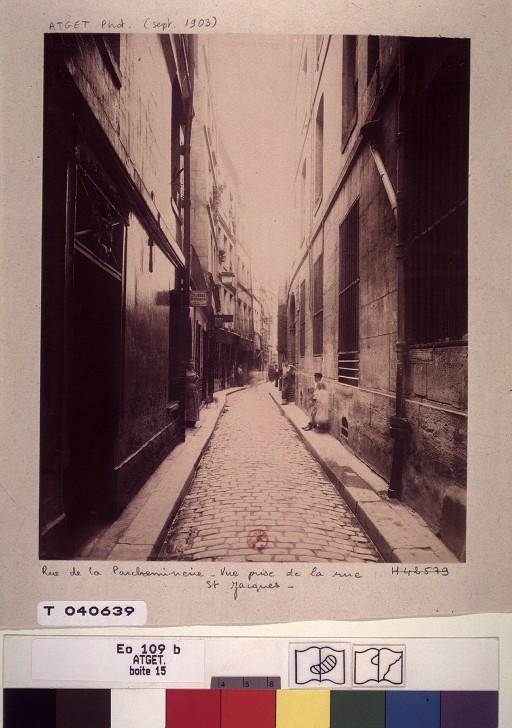
Here is a glimpse of the world of my forthcoming novel, courtesy of the great Parisian photographer Eugene Atget (and Bibliotheque Nationale de France). It's a view of a typical Latin Quarter street near the Sorbonne on a typical day in 1903. Enough said for now...

Tuesday, June 20, 2006

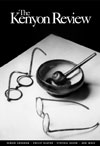
New Short Story in The Kenyon Review


The summer 2006 issue of the illustrious Kenyon Review contains my 26 page short story in 12 parts entitled "Twelve Monthly Devotions." The tale features a car-collecting preacher with a bedroom complex, a bench-pressing traveling evangelist who unsettles his whole universe, and a cameo by an excitable house cat who shows them both how it is...

Look for the issue at your local bookstore or library.

Monday, April 17, 2006

Beverly Hills Event: May 12, 2006

On Friday, May 12 2006, four of my short stories will be read aloud by professional stage & screen actors at the Beverly Hills Public Library as part of the 10th anniversary season of the New Short Fiction Series, "L.A.'s only live literary magazine!" The author will be in attendance.

The Details:
Fri. May 12, 2006 -- 8:00pm (doors at 7:30)
Things We Can't Untie -- short stories by M. Allen Cunningham
Beverly Hills Public Library Auditorium
444 N. Rexford Dr. (between Santa Monica Blvd & Burton Way)
Beverly Hills, CA
Admission $10

ABOUT THE STORIES:

"Pieta" : A diseased pelvis, a hard heart, and two estranged sisters. “...Dimension changes. Depth and distance and size seem no longer governed by any limiting force. And yet Lena is shrinking, disappearing, folding inward and backward...”

"The Next Cove"
: A survival tale (of sorts). Young man and old together in a leaky dinghy. “...Once, coming up to toss the water, he glimpses the white aureole of steam flowing from the old man’s body, rising in a perfect spectral replica to blend into the sheet of rain...”

"Windmills" : A story of two kinds of loneliness.
“...I’ve never heard him like this, though his father’s funeral comes to mind. Anthony stood at the podium and cried and cried, wiping his cheeks and trying to speak, but just kept crying and finally had to sit down...”

"Date of Disappearance" : A man's flawed and flailing attempt to save a relationship. "...He's been lying here since morning in this ransacked bedroom aswarm with bees. Trouserless, ice packed at his groin..."

Wednesday, March 08, 2006

Old John & Me, or: How Do I Get to My Own Backyard?

I was born in a small agricultural community in Northern California called Watsonville, which happens to lie adjacent to John Steinbeck’s Salinas Valley. I was always conscious, as a boy in Watsonville, that I lived in “Steinbeck country.” The famous author’s aged sister, a Mrs. Rodgers, was known to reside in the big white colonial that stood next door to Lambert’s Market on East Lake Avenue. To this day, my father, who worked at Lambert’s for nearly twenty years, likes to recall that he personally delivered groceries to the elderly Mrs. Rodgers. So it happened that long before I laid eyes upon my first Steinbeck sentence, the author’s name stood emblazoned on a monumental tablet in my mind. It wasn’t until I first read East of Eden, however, at age nineteen, that the true monumentality of Old John’s vision began to resonate within me. By that time, I had long since been displaced from Steinbeck country (my family moved 70 miles north to the Diablo Valley when I was eight), but here in the pages of this vivid, frightful novel I found the landscape of my provenance rendered to powerful effect--it’s mythic history and stoic farmsteading folk. Tones had been darkened, topography enhanced, everything transmogrified by virtue of the book’s historical setting and biblical cadences—but for me it all had the effect of immediately heightening the setting’s significance, increasing its haunting power. At one point in the novel, the villainous Cathy dispatches one of her bruisers to Watsonville. It gave me chills to read the name of my birthplace in the context of this larger-than-life tale.

In that season of my first brush with East of Eden, I had more than half-written a novel of my own. I’d set my story in London, because I’d spent a few months in that city and believed, however subconsciously, that my experience there was the single viable, write-able experience I’d had. More importantly: London was not California, that all-too-familiar state which excited me to nothing more than benign boredom. Given my great inexperience in fiction, the London novel was fated to fail. Miserably. Embarrassingly. But I coped by continuing to write, continuing to learn. About three years down the road, I found myself embarking on a whole new novel, and Steinbeck, whose works I had further explored in the meantime, became a major guiding light for my new project, the story that would become The Green Age of Asher Witherow.

I never sought to write a book set in my own locale. I guess I tended to think that setting a novel at home was like aiming for nothing higher than to get one’s name printed in the high school paper. But Steinbeck, through his uncanny talent for evincing the mythic resonance of California, helped me to see the potential for universality that lay in the land and history of my own Diablo Valley. In a letter of 1933, well before he’d started East of Eden, Steinbeck said of his native Salinas: “I would like to write the story of this whole valley, of all the little towns and all the farms and ranches in the wilder hills. I can see how I would like to do it so that it would be the valley of the world.” The grim 19th-century coal-mining history of my Diablo Valley, a history largely unknown even to most locals, seemed to me to bristle with metaphorical and mythological implications. Clearly, the story of this little village called Nortonville reached well beyond the trifles of local history into something universal, something resonant. In other words, the brief and violent existence of Nortonville seemed to provide me with a template into which a kind of modern myth might be laid. To this end, the narrator Asher Witherow holds the plight of his tiny, long-forgotten coal town against such things as a two million year-old mountain, a 10,000-year Native American heritage, and Hindu scripture from the 9th-century B.C. So Asher’s journey in his Diablo Valley takes him toward his own “valley of the world.”

To some, this sort of local focus in fiction equates to “provincialism” or “regionalism”; both terms, to my ear, have a demeaning quality. And in fact, I suspect that Steinbeck himself, who often comes in for unreasonable bruising (his fiercest detractors argue that he did not deserve his Nobel honors), elicits such disapproval largely because he dared to set the greater number of his novels and stories in a provincial corner of the western United States. Worse, he had the impertinence to handle this provincial setting, the drama of its denizens, as if it were the whole universe, or at least a clear microcosm of some universal experience. But what Steinbeck was really writing in a book like East of Eden was a First Story, in other words, a tale that consciously invokes the innocence and awe of myth (our first stories). Who are we?—beg our mythic tales, old and new. Where did we come from? Where are we going from here? Very elemental concerns, leading to explorations of such essential mysteries as love, death and God. While writing The Green Age of Asher Witherow, I liked to think of the book as a sort of First Story in its own right, because such stories mean the most to me as a reader. At the very least, I hope The Green Age is not restrained by the nature of its locale, but somehow refreshes the reader’s sense of involvement in the human adventure.

Tuesday, January 10, 2006

News: New Short Story Just Published!


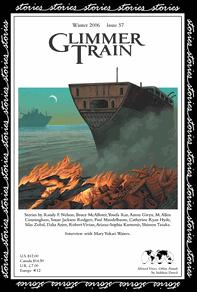
I couldn't have asked for a better welcome to my new city, Portland, Oregon, than to appear in the pages of Portland's own literary magazine, Glimmer Train Stories. America's rich array of literary magazines tends to comprise a universe unto itself, one not extensively explored by even the most voracious readers. A surprising number of fiction and poetry fans just aren't aware of the cornucopia quietly awaiting their discovery. Glimmer Train has achieved plenty of notoriety in the literary world, but if any lit-mags deserve to become household names, this is certainly one of them. I've been reading it regularly for about ten years.

You can imagine my delight, then, that Glimmer Train's Issue #57 (on stands now) contains my 24-page short story, "The Best Man," which might be described as a tale of little league debacles, adult awkwardness, wedding coordinators, pet euthanasia, and elementary school bullies.

Glimmer Train can be found for sale in most every bookstore that stocks literary journals. Issue #57 sells for $12.00, a real bargain considering it contains 13 stories (as many as a $15-$25 short story collection would contain) plus an author interview.

Consider giving Glimmer Train a look.

Thursday, October 06, 2005

In and Around Nortonville, CA Today

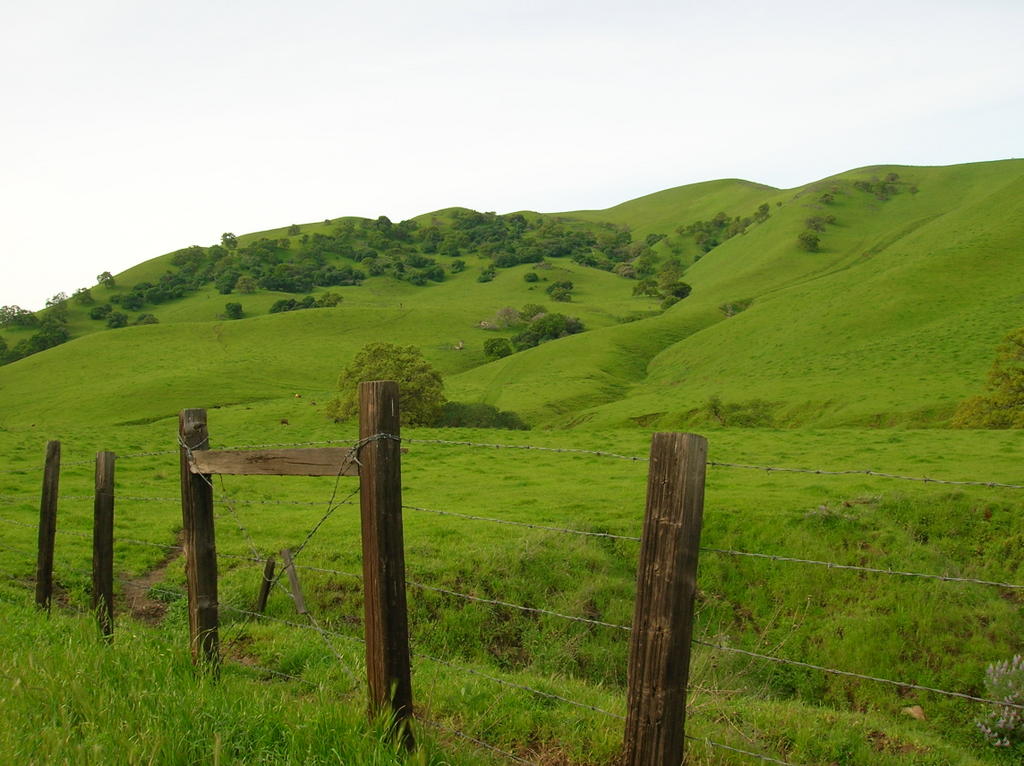
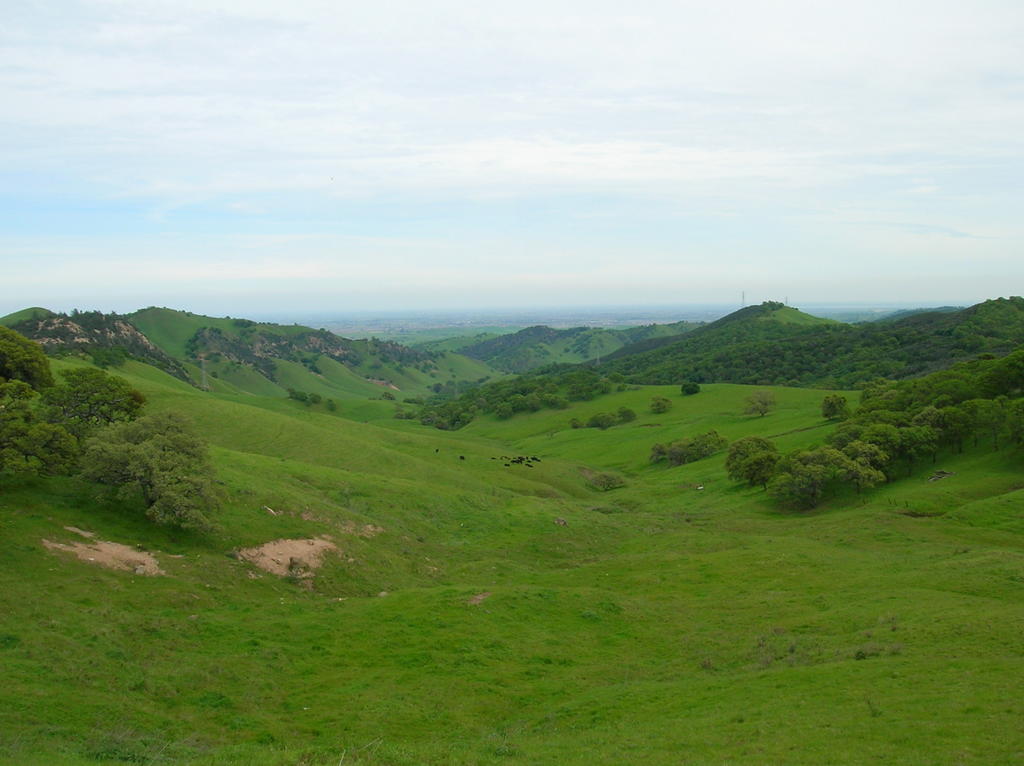
View from the Old Somersville Road on the way into the Black Diamond Mines Regional Preserve

Rose Hill Miners' Cemetery (note the cypresses), as seen from below the Somersville site

Above Nortonville, looking east to the great Central Valley

The Place the Mind Awakens

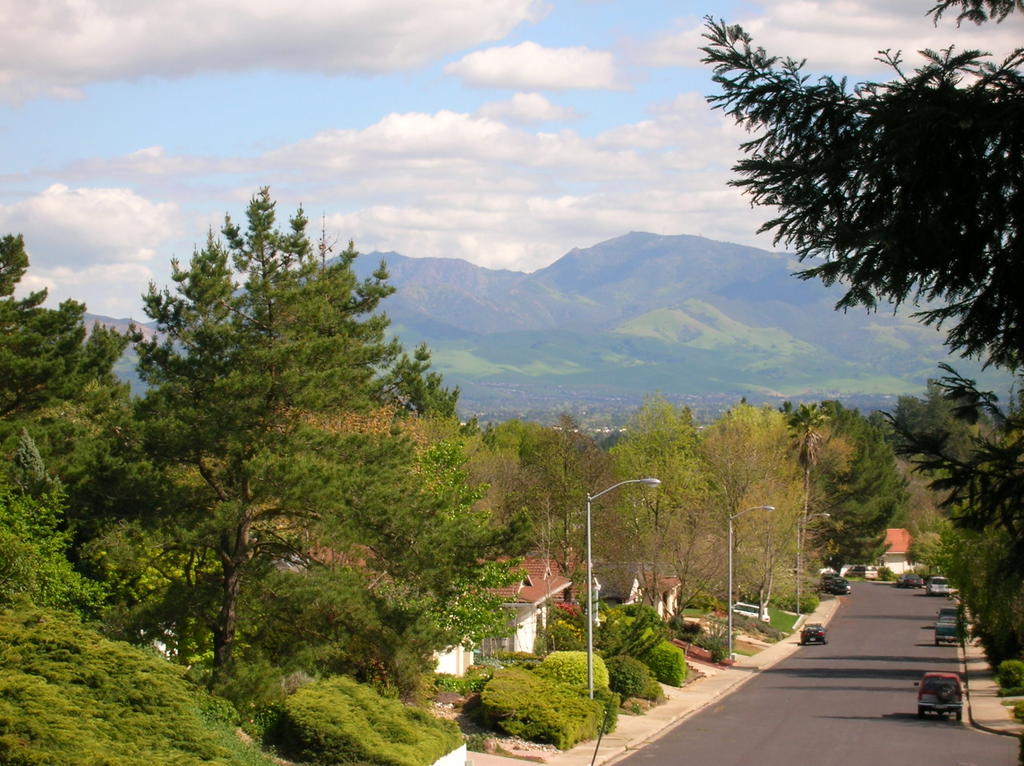
There’s a peculiar human experience that the American writer Wendell Berry beautifully describes as: “the intimacy the mind makes with the place it awakens in.” My own intellectual and creative life began in the great shadow of Mount Diablo in Northern California, and for all my fondness toward the mountain and its surrounding country, I never suspected I’d set a book there. Still, Diablo exerted its mythic force in my imagination, and I’ve now published a novel in which the mountain appears as a primary character.

The story is set in the 1860s-70s in the coal-mining village of Nortonville, once the largest community in this region, now long vanished from the earth. In the mid 1870s Nortonville was so bustling that its mines could produce more than 1 ton of coal per minute, but within 10 years fortunes changed and the town was virtually vacated. In a scene about halfway through The Green Age of Asher Witherow, the eponymous young hero observes a wild cougar “emerging” from the image of the mountain. It’s a mysterious moment, imbued with almost primal wonderment, and to me it’s the heart of the novel, because it faithfully renders the impression of bewildering immensity the mountain stirs in me.


Diablo locals are lucky to enjoy such an eminent daily centerpiece. The mountain grants us perspective, constantly reminds us where we are (in more sense than one), and thus serves the indispensable role -— the same it served the region's first Native Americans —- of world-center; one needn’t be at all religious to recognize the strange inner misgivings summoned, on a day of heavy fog or haze, when it’s blanked from sight.

I’ve long been in the habit of gazing upon Diablo from some vista point at nearby regional parks like Mount Wanda or Briones. While our highways thrum at its foot, I often reflect on the brevity of our human legacy in this valley. The transition from pastoral wilderness to today’s commuter gauntlets has occurred in little more than a hundred years -— a blink in the eye of a mountain as old as humankind. The original paradise is barely submerged, and Diablo stands above history, evidence of that paradise. As long as we wish for the mountain to remain eminent, wish that it be aproned by expansive open space, we will have held fast to the vital importance of awe and its invigorating source in our local wonders.

In the steep arc of Nortonville I see a historical allegory for us today: an era of immense growth and activity, all of it unsustainable and ultimately swallowed by the greater processes of —- first economy, and finally nature (the pristine Black Diamond hills now suggest precious little of the bleak industry they once supported). The Mount Diablo of my novel stands as a bit of eternity amidst the unstable world of Nortonville. Likewise, the true Mount Diablo continues to bear witness to the flurry of our human presence. I hope my book may inspire among its Diablo-based readers a fresh awareness of the mountain's continuing role as axis and awe-giver.

~Mark Allen Cunningham

This article was published in Diablo Watch (the newsletter produced by Save Mount Diablo) in spring, 2005.

Friday, September 16, 2005

News, September 2005: Forthcoming Fiction, etc.

Four short stories by M. Allen Cunningham will be featured in live readings by professional actors at the New Short Fiction Reading Series in Beverly Hills next May (2006). More on this performance as the date draws near...

As is noted on my "Works" page at the main website, a few new short stories are forthcoming very soon in American literary magazines:

Look for "The Best Man," a tale of little league debacles, adult awkwardness, wedding coordinators, pet euthanasia, and elementary school bullies, in Glimmer Train's winter 2005 issue, arriving on stands in November.

"Windmills," a story of two kinds of loneliness, will appear in issue Number 6 of Night Train sometime in the next few months.

And in the more distant future:
"Twelve Monthly Devotions," a near-novella starring a bench-pressing preacher, will appear in The Kenyon Review, summer 2006.

P.S. Stay tuned for some short fiction excerpts soon to appear on this page...

Consulting the Shaman


Submerged as I am in the first stages of structuring my new novel from a mass of raw manuscript material, I've spent significant time consulting the Grand Shaman of Structure--that is, the great film editor Walter Murch (The Coversation, Apocalypse Now, The Unbearable Lightness of Being, The Godfather parts I,II & III, The English Patient, The Talented Mr. Ripley).

Not consulting personally, of course, but doing perhaps the next best thing: leafing through two books that I hold to be indispensable to my creative-writing life:

The Coversations: Walter Murch and the Art of Editing Film by Michael Ondaatje (ISBN: 0-375-41386-3)

and:

Behind the Seen: How Walter Murch Edited Cold Mountain... by Charles Koppelman (ISBN: 0-7357-1426-6)

Says Master Murch (speaking, in Behind the Seen, of the editor's process in orienting oneself to a new film project. Which we might read as the author's process in orienting oneself to the structuring of a book):

"In taking editing notes the skill is to think that every line reading might have a context in which it can be good. Imagine the cuts, and the good might lie right next to the bad. Don't under any circumstances write off a take as being throughout no good. If you must, then say WHY it is no good. This sharpens your perception, as well as being a good reference later on..." (Koppelman, 169) "The first set of notes are a lover's first impression of the beloved. The second set are a surgeon's notes before making the first incision." (Koppelman, 175)

And in The Conversations (speaking about transitions and the mysterious quotient of completion):

"As I'm assembling the film, I'll be trying to find the exact moment each shot reaches its optimal maturity: I want to hold every shot on screen long enough for it to deliver the goods, but cut it off at a moment when it also has the potential to lead to something else."(Ondaatje, 238) "When you're putting a scene together, the three key things you're deciding, over and over agin, are: What shot shall I use? Where shall I begin it? Where shall I end it? An average film may have a thousand edits in it, so: three-thousand decisions. But if you can answer those questions in the most interesting, complex, musical, dramatic way, then the film will be as alive as it can be.
"For me, the most rhythmically important decision of the three is the last: Where do you end the shot? You end it at the exact moment in which it has revealed everything that it's going to reveal, in its fullness, without being overripe. If you end the shot too soon, you have the equivalent of youth cut off in its bloom. Its potential is unrealized. If you hold a shot too long, things tend to putrefy." (Ondaatje, 267)
"The decision where to cut film is very similar to the decision, in writing poetry, of where to end each line. On which word? That end point has little if anything to do with the grammar of the sentence. It's just that the line is full and ripe at that point, full of meaning and ripe with rhythm. By ending it where he does, the poet exposes that last word to the blankness of the page, which is a way of emphasizing the word. If he adds two words after it, he immerses that word within the line, and it has less visibility, less significance..."(Ondaatje, 268)
"...And one of the most fruitful paradoxes, I think, is that even when the film is finished, there should be unsolved problems. Because there's another stage, beyond the finished film: when the audience views it. You want the audience to be co-conspirators in the creation of this work, just as much as the editor or the mixers or the cameraman or the actors are...it's a wonderful dilemma: you have to acknowledge that there must be unsolved problems at each stage. As hard as you work, you must have this secret, unspoken hope that one very significant problem will remain unsolved. But you never know what that is until the film is done." (Ondaatje, 105)

Take Master Murch's filmic terminology and translate it to the novelist's lexicon by roughly the following formula: "film"=novel; "shot" or "take"=section or scene; "on the screen"=on the page -- and voila!, an abundance of inimitable novelistic wisdom has been magically distilled!

Friday, March 25, 2005

The Trifling Trinomial: In Which the Author Discloses How Arbitrary One’s Own Sobriquet Can Be


You might have noticed I publish under the slightly cryptic author name of “M. Allen Cunningham,” and you wouldn’t be the first if you happened to wonder why I went with this moniker.

The nom de plume is a funny thing. Back in 2002 my first published short story appeared (in Alaska Quarterly Review) under the name “Mark Cunningham,” and I was plenty comfortable with that designation (it’s my name after all) until two things came to my attention while perusing a handful of new literary magazines:

1. I already existed in different physical form.
2. I was apparently publishing poetry on a prolific scale.

Figuring that I wanted to continue publishing in literary magazines myself (as myself), I began to contemplate a nom de plume. My wife and I discussed it and together decided it'd be a good idea (that other guy is a really good poet. Read some of his work here). This was during a road trip around the National Parks of the western U.S. two summers ago, just after I’d received my second short fiction acceptance, so we had plenty of road-time to ponder such trifles.

How about “Marcus Cunningham”? Hmmm...would I be comfortable with people calling me Marcus?

I had a great, great grandfather named Matthias: why not just change the whole era-specific nature of my name? But Matthias wasn’t my name either, and I'd probably end up being called “Matt” anyway.

We briefly considered something like “Artist Formerly Known as Mark Cunningham,” then luckily it occured to us that we might somehow employ my middle name.

So, how about Allen? “Allen Cunningham.” Hmmm. Sounds slightly professorial.

“Mark Allen Cunningham”?—Too long.

“M. Allen Cunningham”?—Too pretentious.

Yes, pretentious. Really, how could I presume to join the legendary initialed ranks whose members included:

F. Scott Fitzgerald
T.S. Eliot
H.G. Wells
E.M. Forester
D.H. Lawrence
C.S. Lewis
W.H. Auden
J.D. Salinger
J.M. Barrie
…and the poet H.D.

Not to mention those lauded contemporary authors whose surnames are preceded by something-dot-something-or-other:

J.M. Coetzee
J.G. Ballard
T.C. Boyle…

So at some point out on Montana’s Highway 90 the vistas got the better of us and my wife and I just stopped thinking about it. A few weeks later, back at home, she approached me out of the blue and said: “I like M. Allen Cunningham.” And I said okay.

So it’s her fault, I guess is what I’m saying; I just write the fiction.

But if only she or I had had the foresight to consider the possibility of eventual book publication, the interpersonal nature of book promotion, and the incalculable number of occasions I'd have to say something like this:

“The M. is for Mark, please call me Mark. Except when it’s in print. Then use ‘M. Allen’. But I can answer to ‘Allen’ too if that’s easier for you. Ah, hell, just introduce me as ‘Mark Allen Cunningham’—-and you can drop the ‘Allen’ if you want. Or the ‘Mark.’ ”

Wednesday, December 22, 2004

Dispatch from an Upstart

(The following was my introductory post during a guest-blogging stint at The Elegant Variation on 22 October, 2004. It’s reprised here because I like its candor, and hope that it might inspire some young, as-yet-unpublished writers out there.)

Here are some funny things about myself:

-I’m a twenty-six year old writer living in a suburban outpost of the San Francisco Bay Area
-I never finished college and never formally studied writing
-Though I’m still pretty young, I’ve been married for five years to a woman who amazes me daily by the depth of the love she inspires in me
-Beginning in March, 2000, I wrote a novel set in my own backyard in the 19th-century
-It’s now October, 2004 and the novel (The Green Age of Asher Witherow) has just been published nationally by a brand new house, Unbridled Books, whose editorial team has won praise from readers, critics, and booksellers for several years, since it’s this team that founded the legendary MacMurray & Beck (publisher of William Gay’s The Long Home, Susan Vreeland’s Girl in Hyacinth Blue, Steve Yarbrough’s The Oxygen Man) and, subsequently, started the maverick Putnam imprint BlueHen (publisher of Debra Magpie Earling’s PermaRed, Marc Estrin’s Insect Dreams, and Susann Cokal’s Mirabilis)
-This publisher just so happens to function upon a belief I myself have long held: “that the highest literary standards and a relatively broad readership are not mutually exclusive”
-I now find myself consumed in the fun and frenzy of the first-novel-promotion period, but for the bulk of the past four years my days have consisted of long, solitary hours at the desk
-Or reading in a chair in a room
-Or walking in these pastoral suburban hills that surround my apartment-home
-Or watching movies with my wife
-Or receiving anonymous rejection slips in response to my endless outflow of short fiction submissions
-Or dreamily forecasting the general future date when I’d have a full-length book published under my name
-This month, I traveled to Minneapolis, 2,000 miles from my home, to give my first public reading from the novel in question, and had the pleasure—the inexpressible pleasure—of meeting folks who had read and enjoyed my words (see my tour log, forthcoming soon!)
-My book’s pre-publication reviews, with one exception, have been entirely positive (I hoped . . . . but didn’t know what to expect) and the book was selected as the #1 Booksense Pick for October
-My agent is a wonderful person as well as a dynamic professional
-My novel has a cover I’m crazy over
-My editor has my tremendous respect
-My publicist moves mountains daily on behalf of my novel . . .

To put it directly: I am an upstart. I am distinguished by neither formal education, hard life experience, or former achievement. On the strength of certifications no stronger than a high school diploma, a number of hard-won literary magazine publications, and a manuscript that was successfully alluring to the proverbial gatekeepers of modern novel publishing, I find myself embarking upon an author’s life (by no means am I financially in the clear, but how many authors are?).

How can so much good stuff happen to one unassuming, albeit hardworking guy in this dusky American era of market-driven publishing, this bookselling culture beset with corporate gluttony?

Though it would be disingenuous to deny a certain startled pride, I don’t mean to be self-adulatory here. Instead, I mean this little intro to be an encouraging dispatch from the positive realm of my positive experience in the literary domain. Before last summer, when my agent said she wanted to represent me, I had exactly zero affiliations in the world of publishing, save a few blind and brief correspondences with lit mag editors. A charmed life? Maybe. But I think there’s more to it than that.

It would be inaccurate to say that the literary universe is a completely open one, but I am living evidence that doors have been known to swing despite lack of an MFA degree, lack of a roster of distinguished associations, or lack of a friend whose friend has a friend who works with Editor A at Random House. What’s more, I am a first-hand beneficiary of the wonders of small press publication: all its glorious civility and professionalism and integrity.

So. . . I offer the foregoing for whatever inspiration it’s worth, and as a candid greeting to readers and visitors. Thanks for stopping by my website. I hope the fact that you’ve dropped in means that you’ve enjoyed my fiction or are planning to give it a gander. If you’re a reader, please consider dropping me a line by clicking on the envelope icon on my website.

Happy reading/writing/e-meandering!