Please prove you are not a robot - Say "OK, Google" - Everyone's watching - Your identity is not confirmed - Click here to agree to our terms and conditions - Right click.
Listen to "Right Click" on Spreaker.

DISPATCHES FROM M. ALLEN CUNNINGHAM: author, editor, teacher
Sunday, September 29, 2019
Friday, September 20, 2019
Prime Passage: "I am marvelously on the alert," from The Waves by Virginia Woolf
"They want a plot, do they? They want a reason? It is not enough for them, this ordinary scene. It is not enough to wait for the thing to be said as if it were written; to see the sentence lay its dab of clay precisely on the right place, making character; to perceive, suddenly, some group in outline against the sky. Yet if they want violence, I have seen death and murder and suicide all in one room. One comes in, one goes out. There are sobs on the staircase. I have heard threads broken and knots tied and the quiet stitching of white cambric going on and on on the knees of a woman. Why ask, like Louis, for a reason, or fly like Rhoda to some far grove and part the leaves of the laurels and look for statues? They say that one must beat one's wings against the storm in the belief that beyond this welter the sun shines; the sun falls sheer into pools that are fledged with willows. (Here it is November; the poor hold out matchboxes in wind-bitten fingers.) They say truth is to be found there entire, and virtue, that shuffles along here, down blind alleys, is to be had there perfect. Rhoda flies with her neck outstretched and blind fanatic eyes, past us. Louis, now so opulent, goes to his attic window among the blistered roofs and gazes where she has vanished, but must sit down in his office among the typewriters and the telephone and work it all out for our instruction, for our regeneration, and the reform of an unborn world.
"But now in this room, which I enter without knocking, things are said as if they had been written. I go to the bookcase. If I choose, I read half a page of anything. I need not speak. But I listen. I am marvelously on the alert. Certainly, one cannot read this poem without effort. The page is often corrupt and mud-stained, and torn and stuck together with faded leaves, with scraps of verbena or geranium. To read this poem one must have myriad eyes, like one of those lamps that turn on slabs of racing water at midnight in the Atlantic, when perhaps only a spray of seaweed pricks the surface, or suddenly the waves gape and up shoulders a monster. One must put aside antipathies and jealousies and not interrupt. One must have patience and infinite care and let the light sound, whether of spiders' delicate feet on a leaf or the chuckle of water in some irrelevant drainpipe, unfold too. Nothing is to be rejected in fear or horror. The poet who has written this page (what I read with people talking) has withdrawn. There are no commas or semicolons. The lines do not run in convenient lengths. Much is sheer nonsense. One must be skeptical, but throw caution to the winds and when the door opens accept absolutely. Also sometimes weep; also cut away ruthlessly with a slice of the blade soot, bark, hard accretions of all sorts. And so (while they talk) let down one's net deeper and deeper and gently draw in and bring to the surface what he said and she said and make poetry." -p.131-2
Virginia Woolf self-published The Waves through The Hogarth Press, 1931
"But now in this room, which I enter without knocking, things are said as if they had been written. I go to the bookcase. If I choose, I read half a page of anything. I need not speak. But I listen. I am marvelously on the alert. Certainly, one cannot read this poem without effort. The page is often corrupt and mud-stained, and torn and stuck together with faded leaves, with scraps of verbena or geranium. To read this poem one must have myriad eyes, like one of those lamps that turn on slabs of racing water at midnight in the Atlantic, when perhaps only a spray of seaweed pricks the surface, or suddenly the waves gape and up shoulders a monster. One must put aside antipathies and jealousies and not interrupt. One must have patience and infinite care and let the light sound, whether of spiders' delicate feet on a leaf or the chuckle of water in some irrelevant drainpipe, unfold too. Nothing is to be rejected in fear or horror. The poet who has written this page (what I read with people talking) has withdrawn. There are no commas or semicolons. The lines do not run in convenient lengths. Much is sheer nonsense. One must be skeptical, but throw caution to the winds and when the door opens accept absolutely. Also sometimes weep; also cut away ruthlessly with a slice of the blade soot, bark, hard accretions of all sorts. And so (while they talk) let down one's net deeper and deeper and gently draw in and bring to the surface what he said and she said and make poetry." -p.131-2
Virginia Woolf self-published The Waves through The Hogarth Press, 1931
Friday, September 13, 2019
Thursday, September 12, 2019
New Interview in Poets & Writers
 The current issue of Poets & Writers (Sept/Oct 2019) features my extensive interview with Ben George, Senior Editor at Little, Brown and Company.
Our wide-ranging conversation touches on the day-to-day experiences of a New York editor, the role of luck in publishing, the value of mentors, what it's like to spend an hour discussing a single paragraph, the plight of "midlist" writers, and lots more.
"In any editing experience you have to make the art the most important consideration, even as you keep the artist’s personal feelings in mind while you’re doing that. This is why I feel so privileged. As the editor, I’m being invited into the workshop, where there’s sawdust on the floor and half-finished things. It’s a delicate space for the writer. You’re being trusted, and you need to acquit yourself well." -Ben GeorgeRead the complete uncut version of the interview online HERE.

Monday, September 09, 2019
Tell Yourself the Ages Are Listening
Artists and writers: At some point, or several points,
you’re going to receive the message that your work is insignificant, that your
commitment to the work is futile, that you and what you represent as an artist
do not matter.
At some point, or several points, you’re going to wonder
what use there is in continuing to do and share your work.
It’s unlikely that
you will escape this unpleasantness. But when it arrives, remember that almost nobody escapes it
— that you’ve come to a new threshold, and this one also you can cross as
you’ve crossed other thresholds before it.
Take the upleasantness as a sign of your progress, of the
strength of your commitment to the work. Take it as a reminder of how far
you’ve gone, and as a renewal.
Face the deafening silence, let outright
rejection wash over you. Then say to yourself, if you can, "Art is freedom,
beginnings are beautiful, rebeginnings even more so," and honor your practice
by showing up even when nobody else will — especially then.
You’re strong of heart, with fire in your belly, and
you’re endowed with gifts and disciplined in the daily work, the lifelong work,
of honing these gifts.
From the start you knew this work would be one of the
hardest things you could choose to do. Stand back and realize: there’s no
surprise in this turn of events. Don’t look around for those more “lucky” than
you.
Don’t review your prior hours and days in terms of “waste.” And don’t think in terms of “arrival,” only in terms of the
work at hand. Not “accomplishments,” only beginnings.
Give yourself, if
necessary, to posterity, or to your ancestors. Tell yourself the ages are
listening. Do what you have to do to reorient yourself.
Then: notice the light in your window, the shape of the
words inside you or already there on the paper, the instructions coming through
the music even on your thousandth listen.
Ready now, enclosed in frightful
privacy, get to work again, if not for yourself then for those of us you may
never meet. We’re full of faith in you and we are waiting.
Tuesday, September 03, 2019
Prime Passage: "Good Sentences Are Why We Read" by Joe Moran
Among teachers and critics and in the community of writers, we need more advocates for attunement to the sonic properties of prose. Joe Moran's recent essay on sentence-making consoles me (and probably also the underrated writers I most admire). I immediately printed it out for use with my creative writing students. Here's a prime passage, but follow the link at the end to read the whole.
"When the writer has a tin ear for the sound of a sentence then the reader knows, just as when she hears flat or pitchy singing, that something is wrong, even if she can’t quite say why.
I can let a book fall open and tell, just from reading a few sentences, if I will like it. However compelling the subject of a book might be, I find it hard to carry on reading if its sentences are boring. I should be more forgiving, since I have written my share of boring sentences. I am not. Neither are you, even if you don’t know it yet. You think you are looking past this sentence into what it is saying—about life, love, the existence of angels, the design of the injection-molded polypropylene stacking chair, whatever it is— but no. You think you care what this is about, but really you care how it sounds. You are reading it for its sentences."
Thursday, August 29, 2019
Here's to the Small Books
As we roll toward the fall publishing season of "big" new books, big predestined bestsellers, the next big thing, etc., I would just like to say...
Here’s to the small books, the unsung writers, the unreviewed, the
unbought and unawarded, the authors and poets quietly refashioning form from
the margins and undaunted by the unlikeliness of success let alone a living.
Here’s to the denizens of the disappearing midlist and their beautiful
literary disappointments. Here’s to those at the bottom of the Bookscan barrel.
Here’s to the readers who write and who hope to write, the keepers of
commonplace books, the worried ones haunting their neighborhood independent and
holding out against Amazon.
Here’s to the editors standing sentinel for the living voice, who
circumvent or defy the deadening sales conference. Here’s to the individual
publishers carrying more than their weight in a march to keep the word alive,
even and especially where the profit potential is nil.
Here’s to the authors who help, especially the authors who have the
means or hold a megaphone and turn these to the work of encouraging,
supporting, and sustaining the less lucky.
Here’s to the writers who teach in order to instill creative freedom,
clarity of thought, a spirit of experimentation, & a fidelity to voice
& form however unconventional. Here’s to the small literary magazines &
the volunteers who produce them for the pure love of literature.
Here’s to the literary souls who staff our independent bookstores and
who, for every predestined bestseller, strive to lift up 10 small unlikely
works.
Here’s to the unnominated, the unconnected, the unincluded and
uninvited best of the best working without encouragement or reward. You’re
there, you’re for real, you keep us going.
Sunday, August 25, 2019
Honorable Obscurity, John Steinbeck Edition: "A Little Miserable Popularity"
John Steinbeck to his literary agent Elizabeth Otis, 1935:
Steinbeck to Joseph Henry Jackson, 1935. Upon learning that Tortilla Flat had won the gold metal for best novel from the Commonwealth Club of California, Steinbeck insisted that he could not attend the awards dinner:
"Curious that this second-rate book [Tortilla Flat], written for relaxation, should cause this fuss. In your dealings you need make no compromise at all for financial considerations as far as we are concerned. Too many people are trapped into promises by gaudy offers...we've gone through too damned much trying to keep the work honest and in a state of improvement to let it slip now in consideration of a little miserable popularity. I'm scared to death of popularity. It has ruined everyone I know...I suppose it is bad tactics but I am refusing the usual things--the radio talks, the autograph racket, the author's afternoons and the rest of the clutter--politely, I hope, but firmly."
Steinbeck to Joseph Henry Jackson, 1935. Upon learning that Tortilla Flat had won the gold metal for best novel from the Commonwealth Club of California, Steinbeck insisted that he could not attend the awards dinner:
"Nothing like this has ever happened to me before. The most I have had to dodge has been a literary tea or an invitation from a book shop to lecture and autograph. This is the first and God willing the last prize I shall ever win.
The whole early part of my life was poisoned with egotism, a reverse egotism, of course, beginning with self-consciousness. And then gradually I began to lose it.
In the last few books I have felt a curious richness as though my life had been multiplied through having been identified in a most real way with people who were not me. I have loved that. And I am afraid, terribly afraid, that if the bars ever go down, if I become a trade mark, I shall lose the ability to do that. When I do I shall stop working because it won't be fun anymore.
This is not clear, concise, objective thinking, but I have never been noted for any of those things. If I were a larger person I would be able to do this and come out of it untouched. But I am not...I have no social gifts and practically no social experience..."
Monday, February 11, 2019
Audio Dispatch: In Ludwig's Room (with music)
To be in these rooms with this music in your ears is to sit for at least a few moments in Beethoven's mind and body. His music seems to grow more and more miraculous.
Listen to "In Ludwig's Room" on Spreaker.
Listen to "In Ludwig's Room" on Spreaker.
Wednesday, January 09, 2019
Interview with a Recluse (with music)
We are writing it down. Always we are writing it all down.
Listen to "Interview with a Recluse by M. Allen Cunningham" on Spreaker.
Listen to "Interview with a Recluse by M. Allen Cunningham" on Spreaker.
Saturday, November 24, 2018

Portland area friends, please come on out to Powell's Hawthorne (3723 SE Hawthorne) on Monday 11/26! I will discuss the 11-year germination of Perpetua's Kin, share anecdotes from my research, and read from this novel that Powell's bookseller Dianah H. calls "Gorgeous. Devastating. Lyrical. Addictive." (There will also be cookies.)
https://www.facebook.com/events/1125532894238690/
Thursday, October 18, 2018
26 Books I Kept Close While Writing My New Novel Perpetua's Kin

Possession by
A.S. Byatt
Nearly
20 years after I first read Byatt's Booker Prize winner Possession, her
use of the epistolary form still dazzles me. She's unafraid to take up 50 to 60
pages with the "primary texts" of a correspondence. Surely she had
editors nagging her to share only "the highlights" of her characters'
letters. But that would have yielded a fundamentally different novel -- and
probably a flimsy one. Perpetua's Kin has its own lengthy
epistolary sections.
Machine Dreams by Jayne Anne Phillips
Phillips
conjures mid-century America with such tactile vividness, familial tensions
with such ease, and the scope of tragedy across 3 generations. Her structure
here inspired mine in Perpetua's Kin.
A Sudden Country by Karen Fisher
Sentence
for sentence, Fisher's narration hypnotizes. She charged my batteries at a time
early in my writing of Perpetua's Kin, when I (and the novel)
really needed it.
Voss by Patrick White
Cited
by Karen Fisher as an antecedent to A Sudden Country, the prophetic
power of White's prose is always inspiring. He won the Nobel Prize in
Literature for good reason. His depiction of landscape and the small figure a
man cuts against the earth remained luminously in my mind during my work
on Perpetua's Kin. (As noted in the acknowledgments, Perpetua's
Kin makes use of a few phrases from Voss.)
The Eighth Day by Thornton Wilder
An
epic metaphysical mystery spanning decades and continents, winner of the
National Book Award, this inimitable novel gives us the prophetic and
epigrammatic Wilder we know from The Skin of Our Teeth and Our
Town, but here he has the greater breadth of novelistic description
and frequent rhetorical passages. I studied his commanding way of depicting
small incidents within a massive canvas.
The Favorite Game by Leonard Cohen
Line
for line, Cohen's overlooked jewel of a novel (his debut) goads me on to breathe
freer, see clearer, and do and try more.
Hamlet by William Shakespeare
I
was first exposed to the immortal Dane via Franco Zeffireli's film adaptation,
which I viewed in the cinema when I was 12. I've seen innumerable versions
of Hamlet on film and stage since then, (including the Barbican's unforgettable 1997 RSC production starring Alex Jennings) and I've
never stopped returning to the original text. I've described Perpetua's
Kin as a reworking of Hamlet, and I'd wager that keen
readers will spot the many allusions and outright quotations in the text of the
novel (e.g.; Denmark has Elsinore, while my Northern California of the late
1880s has El Señor).
The Spectator Bird, Angle of Repose, and Recapitulation by Wallace Stegner
If
you live in the West, you should know and read Stegner. If you don't live in
the West, you should know and read Stegner. If you love literature, you should
know and read Stegner. National Book Award and Pulitzer Prize winner and
dedicated teacher.
The English Patient by Michael Ondaatje
Ondaatje's distillation of "big-canvas" events through intimate scenes and relationships, his use of alternating points of view, his characteristically evocative turns of phrase, and his central placement and reliance upon imagery -- these are just a few of the things that The English Patient (and, for that matter, most of Ondaatje's novels) -- exemplify for me.
Time's Arrow by Martin Amis
Time's Arrow by Martin Amis
It is no exaggeration to say that my first reading of Time’s Arrow changed my life. The sheer authorial bravura on display was like nothing I’d known in contemporary literature. Is there another contemporary work as technically daring and as gracefully executed?
The Night Inspector by Frederick Busch
The Night Inspector by Frederick Busch
Busch's masterwork. His use of nineteenth-century parlance, his facility with the violent narratives of Civil War combat, and the sustained intensity of his language, treatment, and themes are all absorbing and instructive. One of the great unsung American novels of the last 20 years.
Raising Holy Hell by Bruce Olds
Raising Holy Hell by Bruce Olds
A
precursor (by 22 years or so) to George Saunders' astonishing
experimental-dramaturgical-collagist-novelizing in Lincoln in the
Bardo. My first reading of Raising Holy Hell was
for me the beginning of a new way of looking at narrative. And Olds'
ventriloquism inspires much of Perpetua's Kin. (I thank my
friend Jon L. for introducing me to Olds' work.)
From A to X by John Berger
A
tremendously affecting epistolary novel by one of our greatest writers.
Cold Mountain by Charles Frazier
The
cool and remote evocations of the savagery of the Civil War.
I Should Be Extremely Happy in Your Company and Fall of Frost by Brian Hall
In both of these novels, Brian Hall demonstrates a breathtaking command of -- and flexibility in -- narrative voice. He is also constantly taking risks as a writer, whether inhabiting the first-person perspective of Sacagawea (and inventing a new narration technique to do so) or scrambling chronology while writing about Robert Frost.
The Journals of Lewis & Clark, edited by Bernard DeVoto
A
document of Manifest Destiny at ground level, and in the form of two unlikely
and fascinating protagonists. The scale of history is, in the end, always
human.
Amusing Ourselves to Death by Neil Postman
Postman's seminal work of cultural criticism has been on my mind for more than a decade now, and its lessons have in some way infused everything I've written in that time, fiction and nonfiction alike. "We have learned irreverence toward sun and season," Postman writes. And I put those words directly into the mouth of one of the minor characters in Perpetua's Kin.
Selves at Risk by Ihab Hassan
Selves at Risk by Ihab Hassan
"The abiding question concerns the American quester, the motive, history, and space of his journey, how that space affects him, and the nature of his own self-apprehension as an other, an American, as he moves in the contemporary world. For Otherness is not merely given, an attribute of others; it can be an attribute of ourselves, either in self-alienation or in response to the relentless gaze of another." I kept this and many other passages from Hassan's book at hand while thinking about Benjamin Lorn's journey(s) in Perpetua's Kin.
Fame & Folly, Art & Ardor, and The Din in the Head by Cynthia Ozick
Fame & Folly, Art & Ardor, and The Din in the Head by Cynthia Ozick
Ozick is our finest living literary critic and essayist. Just go read her essays, please.
The Liberal Imagination by Lionel Trilling
The Liberal Imagination by Lionel Trilling
I've been reading Trilling since first being introduced to his work via Cynthia Ozick. If you love literature, then Trilling's perspectives, and his ways of thinking about literature on the page -- free from every critical hand-me-down -- are always enriching.
The Boys' Crusade by Paul Fussell
Fussell writes as a World War II veteran committed to tearing down vainglorious delusions about the "nobility" of war. He's a staunch realist, and also an elegant writer. I gleaned so much from this book as well as Fussell's memoir Doing Battle, and I'm thankful for his voice.The Boys' Crusade by Paul Fussell
Friday, September 14, 2018
Thursday, September 13, 2018
Meine Wörter auf Deutsch
I'm very pleased to see an excerpt from Lost Son, my 2007 experimental biographical novel about Rainer Maria Rilke, included in the new issue of the International Rilke Society Journal.
Mit Dank an Erich Unglaub.


Mit Dank an Erich Unglaub.


Monday, August 06, 2018
Perpetua's Kin: Early & Late, Pt. 2
Early & Late" is a series of posts featuring texts and images that document the process of writing Perpetua's Kin, from manuscript to finished novel.
Perpetua's Kin appears in September, 2018, but you can secure an early copy now by ordering HERE. (Orders ship within 24 hours.)
Perpetua's Kin appears in September, 2018, but you can secure an early copy now by ordering HERE. (Orders ship within 24 hours.)
Early:
Manuscript page, 2007/2008

Late:
Final version, 2018

Friday, August 03, 2018
Perpetua's Kin Elicits Early Applause from Booksellers Across the U.S.

"Cunningham
has once again raised the bar on the art of the novel...exceptionally rich...a
distinctly American portrait, but the overarching themes are universal. I walk
away from a reading like this ruminating on the largeness of life and the
lasting influence that novelists can have on every one of us."
- Nancy Scheemaker
NORTHSHIRE BOOKSTORE, Saratoga Springs, NY
"Beautiful...takes the
reader right in. Cunningham gives us a book to savor -- a fulfilling,
substantial book, and a joy to read."
- Janet Boreta
founder, ORINDA
BOOKS, Orinda, CA
"I
very much hope Perpetua's Kin reaches as many readers' hands
as possible...expansive in scope and ideas...enchanting."
- Hans Weyandt
MILKWEED BOOKSTORE, Minneapolis, MN
MILKWEED BOOKSTORE, Minneapolis, MN
"A
poetic, kaleidoscopic look at intergenerational pain, love, longing, and
restlessness, through the lenses of war and telegraphy."
- Carolyn Kulog
BETTY'S BOOKS, Baker City, OR
BETTY'S BOOKS, Baker City, OR
"Expertly
imagined...from the battlefields of the Civil War to Ocean Beach in 1940s San
Francisco ... Much to contemplate in this thought-provoking novel."
-
Marion Abbott
MRS. DALLOWAY'S BOOKSTORE, Berkeley, CA
MRS. DALLOWAY'S BOOKSTORE, Berkeley, CA
Perpetua's Kin appears in September, 2018, but you can place your order now through your nearest independent bookseller, or secure an early copy through the publisher (orders ship within 24 hours)
Monday, July 30, 2018
Perpetua's Kin: Early & Late, Pt.1
"Early & Late" is a series of posts featuring texts and images that document the process of writing Perpetua's Kin, from manuscript to finished novel.
You can pre-order Perpetua's Kin HERE.
You can pre-order Perpetua's Kin HERE.
Early:
Manuscript page, 2007/2008

Final version, 2018

Thursday, May 17, 2018
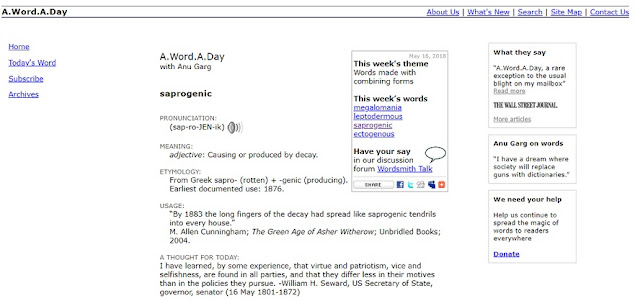
The Green Age on "A.Word.A.Day"
This week I was delighted to see that The Green Age of Asher Witherow, thanks to its use of the word "saprogenic," earned a citation in Wordsmith.org's popular "A.Word.A.Day" feature.
The New York Times has called A.Word.A.Day "the most welcomed, most enduring piece of daily mass e-mail in cyberspace."
Subscribe to:
Posts (Atom)