
DISPATCHES FROM M. ALLEN CUNNINGHAM: author, editor, teacher
Sunday, June 17, 2007
Portland Event #3 -- Powells Books
Monday June 18 -- I read from talk about Lost Son (and sign copies) at Powells Books on Hawthorne. The reading begins at 7:30 pm. This is my final Portland event for a while.

Thursday, June 14, 2007
Portland Event #2
Tonight I read from Lost Son at 23rd Avenue Books in NW Portland. The event starts at 7:30.
Saturday, June 09, 2007
Book Group Expo Tomorrow
Tomorrow, Sunday June 10, I will be in attendance at the 2nd annual BOOK GROUP EXPO in downtown San Jose, CA. At 11:30 am, I'll participate in a panel with fellow authors Nathan Englander, Michelin Marcom and Elizabeth Rosner. Our discussion will be hosted by KQED radio's Michael Krasny.
BOOK GROUP EXPO was a lot of fun last year, with a full-day schedule of author salons on intriguing subjects. If you are in a book group, or are merely a bibliophile, it could well be worth a trip to San Jose.
BOOK GROUP EXPO was a lot of fun last year, with a full-day schedule of author salons on intriguing subjects. If you are in a book group, or are merely a bibliophile, it could well be worth a trip to San Jose.
Friday, June 08, 2007
Audio Interview
I recently discussed Lost Son with Kay Callison, that should-be legendary interviewer of the American Audio Prose Library. It was a two-hour conversation, but you can listen to some parts of it, neatly edited, in a podcast here.
Wednesday, June 06, 2007
Cormac Speaks
If you happened to view the historic, first-ever TV interview with Cormac McCarthy on yesterday's Oprah Winfrey show, for godsake don't stop there. Go to Oprah's website and watch the fascinating moments that were left out of the edited conversation that aired.
Friday, June 01, 2007
Event Report: Annie Blooms Books, Portland
Last night was my inaugural Portland reading from Lost Son, held at Annie Blooms Books in Portland's charming Multnomah Village. The event was well attended, and to my delight the majority of listeners were readers of Rilke.
It was a pleasure to gather and discuss the great poet and his work. Below are some snippets from the q&a, approximately recreated (and also embellished, at points, with things I wish I had said).
Gentleman in the back row: Would you speak a little about your feelings on whether Rilke led a "healthy" life?
Me: The question of Rilke's psychological "health" is an interesting one. My novel avoids (appropriately, I believe) a Freudian approach to Rilke, so its narrative doesn't really seek to answer the question in any conclusive way. I will say, though, that Rilke himself acknowledged, through his whole adult life, his own "complexes" and emotional and spiritual dilemmas. He was such an immensely sensitive, self-aware person that it would have been impossible for him to live in any kind of denial about these things. And he was always honest, sometimes painfully so, with those around him regarding his own shortcomings. The possibility of undergoing psychoanalysis was constantly on his mind, though till the end he resisted such treatment, choosing to recognize, instead, that his art was in many ways his own method of working through things (and fearing that pyschoanalysis would "rid him of both his devils and his angels too"). Rilke cherished a quote from Rudolf Kassner, which says: "The road from intensity to greatness lies through sacrifice." So, in a very conscious way Rilke knew that he was giving up a great many things, even perhaps choosing a less-than-happy life for the sake of his work as a poet, which he felt demanded solitude -- and he emphasized that quality of sacrifice. In the end, I believe he spoke his own authentic truth when he said that he could only be a poet -- that a life committed wholly and entirely to art was the only life he could really lead.
Gentlelady in the back row: Was there ever a point during the writing of this novel when you felt overwhelmed or daunted to be writing about somebody like Rilke?
Me: Yes, yes, yes. This novel was in many moments a terrifying journey for me. I mean, here I am, a kid from the suburbs of Northern California writing a novel about one of the world's greatest poets! At many points, I had to wilfully avoid thinking about it in those exact terms, because the material itself, the sheer mass of story and fact that needed to be shaped down to a digestible narrative--that alone was almost overwhelming at times. To entertain any fears about how the finished book might be received would simply have paralyzed me. Writing a novel, after all, is one of the most personal things one can do, and yet this particular novel, given the fame of its main character and the passionate responses he arouses, really felt like a dauntingly public act. In the end, of course, Lost Son is entirely personal, as it had to be. I felt that such a story, dealing with a figure as large and legendary as Rilke, could only be handled as something personal, as an encounter of sorts. In fact, I've been referring to the book as "a letter to a ghost."
It was a pleasure to gather and discuss the great poet and his work. Below are some snippets from the q&a, approximately recreated (and also embellished, at points, with things I wish I had said).
Gentleman in the back row: Would you speak a little about your feelings on whether Rilke led a "healthy" life?
Me: The question of Rilke's psychological "health" is an interesting one. My novel avoids (appropriately, I believe) a Freudian approach to Rilke, so its narrative doesn't really seek to answer the question in any conclusive way. I will say, though, that Rilke himself acknowledged, through his whole adult life, his own "complexes" and emotional and spiritual dilemmas. He was such an immensely sensitive, self-aware person that it would have been impossible for him to live in any kind of denial about these things. And he was always honest, sometimes painfully so, with those around him regarding his own shortcomings. The possibility of undergoing psychoanalysis was constantly on his mind, though till the end he resisted such treatment, choosing to recognize, instead, that his art was in many ways his own method of working through things (and fearing that pyschoanalysis would "rid him of both his devils and his angels too"). Rilke cherished a quote from Rudolf Kassner, which says: "The road from intensity to greatness lies through sacrifice." So, in a very conscious way Rilke knew that he was giving up a great many things, even perhaps choosing a less-than-happy life for the sake of his work as a poet, which he felt demanded solitude -- and he emphasized that quality of sacrifice. In the end, I believe he spoke his own authentic truth when he said that he could only be a poet -- that a life committed wholly and entirely to art was the only life he could really lead.
Gentlelady in the back row: Was there ever a point during the writing of this novel when you felt overwhelmed or daunted to be writing about somebody like Rilke?
Me: Yes, yes, yes. This novel was in many moments a terrifying journey for me. I mean, here I am, a kid from the suburbs of Northern California writing a novel about one of the world's greatest poets! At many points, I had to wilfully avoid thinking about it in those exact terms, because the material itself, the sheer mass of story and fact that needed to be shaped down to a digestible narrative--that alone was almost overwhelming at times. To entertain any fears about how the finished book might be received would simply have paralyzed me. Writing a novel, after all, is one of the most personal things one can do, and yet this particular novel, given the fame of its main character and the passionate responses he arouses, really felt like a dauntingly public act. In the end, of course, Lost Son is entirely personal, as it had to be. I felt that such a story, dealing with a figure as large and legendary as Rilke, could only be handled as something personal, as an encounter of sorts. In fact, I've been referring to the book as "a letter to a ghost."
Thursday, May 24, 2007
Discerning Transitions
Lost Son has now appeared in most bookstores.
To mark its arrival, I post this passage from Rilke's Notebooks of Malte Laurids Brigge.
Ibsen is the writer being described here, but for me the following prose articulates my own relationship to Rilke himself, to whom I was first introduced 15 years ago, and well describes my enduring bewilderment and wonder through the years-long process of creating Lost Son.
"There I sat before your books, obstinate man, trying to understand them the way those others do who do not leave you intact, but have taken their portion and are satisfied.
For as yet I did not understand fame, that pubic destruction of one in process of becoming, into whose building-ground the mob breaks, displacing his stones...
Most lonely one, holding aloof, how they have caught up with you by reason of your fame.
But lately they were against you from the very root, and now they deal with you as with their equal.
And they carry your words with them in the cages of their presumption and exhibit them in the squares and tease them a little from their own safe distance.
All your terrible wild beasts.
Only then did I read you, when for me they broke out and fell upon me in my wilderness, desperate as they are.
Desperate, as you yourself became in the end, you whose course is wrongly entered on every chart.
Like a fissure it crosses the heavens, this hopeless hyperbola of your path, that only once curves toward us and draws off again in terror.
What did it matter to you whether a woman stays or goes and whether someone is seized with dizziness and someone else with madness and whether the dead live and the living appear to be dead: what did it matter to you?
It was all so natural for you; you passed through it, as one crosses a vestibule, and did not stop.
But yonder you lingered, stooping; where our becoming seethes and precipitates and changes color, inside.
Farther in than anyone has yet been; a door had sprung open before you, and now you were among the alembics in the firelight.
Yonder where, mistrustful, you took no one with you, yonder you sat discerning transitions."
(This comes from M.D. Herter Norton's now classic translation of Malte, first published 1949 by W.W. Norton.)
To mark its arrival, I post this passage from Rilke's Notebooks of Malte Laurids Brigge.
Ibsen is the writer being described here, but for me the following prose articulates my own relationship to Rilke himself, to whom I was first introduced 15 years ago, and well describes my enduring bewilderment and wonder through the years-long process of creating Lost Son.
"There I sat before your books, obstinate man, trying to understand them the way those others do who do not leave you intact, but have taken their portion and are satisfied.
For as yet I did not understand fame, that pubic destruction of one in process of becoming, into whose building-ground the mob breaks, displacing his stones...
Most lonely one, holding aloof, how they have caught up with you by reason of your fame.
But lately they were against you from the very root, and now they deal with you as with their equal.
And they carry your words with them in the cages of their presumption and exhibit them in the squares and tease them a little from their own safe distance.
All your terrible wild beasts.
Only then did I read you, when for me they broke out and fell upon me in my wilderness, desperate as they are.
Desperate, as you yourself became in the end, you whose course is wrongly entered on every chart.
Like a fissure it crosses the heavens, this hopeless hyperbola of your path, that only once curves toward us and draws off again in terror.
What did it matter to you whether a woman stays or goes and whether someone is seized with dizziness and someone else with madness and whether the dead live and the living appear to be dead: what did it matter to you?
It was all so natural for you; you passed through it, as one crosses a vestibule, and did not stop.
But yonder you lingered, stooping; where our becoming seethes and precipitates and changes color, inside.
Farther in than anyone has yet been; a door had sprung open before you, and now you were among the alembics in the firelight.
Yonder where, mistrustful, you took no one with you, yonder you sat discerning transitions."
(This comes from M.D. Herter Norton's now classic translation of Malte, first published 1949 by W.W. Norton.)
Ondaatje & Rilke
Reading Michael Ondaatje's glorious new novel Divisadero, which appears in stores next week, it struck me that the following passage could apply to the character of Rainer Maria Rilke in my own novel, Lost Son.
The "old writer," with his bittersweet message to the boy, seems a Rilkean figure.
"When I wrote, the man said, that was the only time I would think. I would sit down with a notebook and a pen, and I would be lost in a story. The old writer, seemingly at peace, thus casually suggested to Rafael a path he might take during his own life, and taught him how he could be alone and content, guarded from all he knew, even those he loved, and in this strange way, be fully understanding of them. It was in a sense a terrible proposal of secrecy -- what you might do with a life, with all those hours being separated from it -- that could lead somehow to intimacy. The man had made himself an example of it. The solitary in his busy and crowded world of invention. It was one of the last things the writer talked to him about."
The "old writer," with his bittersweet message to the boy, seems a Rilkean figure.
"When I wrote, the man said, that was the only time I would think. I would sit down with a notebook and a pen, and I would be lost in a story. The old writer, seemingly at peace, thus casually suggested to Rafael a path he might take during his own life, and taught him how he could be alone and content, guarded from all he knew, even those he loved, and in this strange way, be fully understanding of them. It was in a sense a terrible proposal of secrecy -- what you might do with a life, with all those hours being separated from it -- that could lead somehow to intimacy. The man had made himself an example of it. The solitary in his busy and crowded world of invention. It was one of the last things the writer talked to him about."
Wednesday, May 16, 2007
McCarthy & Rilke
While reading Cormac McCarthy's play The Stonemason yesterday, I noted this allusion to Rilke's Duino Elegies:
"BEN: The big elm tree died. The old dog died. Things that you can touch go away forever. I dont know what that means. I dont know what it means that things exist and then exist no more. Trees. Dogs. People. Will that namelessness into which we vanish then taste of us?"
Here's Rilke's Second Duino Elegy:
"Like dew from the early grass, that which is ours rises from us
...like the heat from a hot dish. O smile, where do you go? O expression in the eyes:
new warm escaping wave of the heart--;
how it hurts me; we are these very things. So does the world-space,
in which we come loose, taste of us?"
"BEN: The big elm tree died. The old dog died. Things that you can touch go away forever. I dont know what that means. I dont know what it means that things exist and then exist no more. Trees. Dogs. People. Will that namelessness into which we vanish then taste of us?"
Here's Rilke's Second Duino Elegy:
"Like dew from the early grass, that which is ours rises from us
...like the heat from a hot dish. O smile, where do you go? O expression in the eyes:
new warm escaping wave of the heart--;
how it hurts me; we are these very things. So does the world-space,
in which we come loose, taste of us?"
Friday, May 11, 2007
For the Portlanders Among Us
Lost Son is now for sale at Powells Books and Annie Blooms.
In stock at the Powells Burnside, Hawthorne, Airport and Beaverton locations.
For those outside Portland, check your local independent bookstore.
The novel will appear in the Barnes & Nobles and Borders of the world next month.
In stock at the Powells Burnside, Hawthorne, Airport and Beaverton locations.
For those outside Portland, check your local independent bookstore.
The novel will appear in the Barnes & Nobles and Borders of the world next month.
Tuesday, May 08, 2007
Six Questions About the Novel LOST SON & its Protagonist Rilke
Lost Son tells of the life of Rainer Maria Rilke. Who was Rilke?
That is a bigger question than I could pretend to answer, and Lost Son is less an authoritative portrait than it is a letter sent to a ghost. Rainer Maria Rilke is almost universally recognized as one of the world’s greatest poets. But he is perhaps best loved in the United States for the prose of his Letters to a Young Poet, a slim little volume offering some remarkable, unorthodox perspectives on such things as love, solitude, grief, art, and fate. It’s a book cherished with near religiosity by many people young and old. Rilke was born in Prague in 1875 and died at age 51 in Switzerland.
What drew you to telling Rilke’s story?
I am fascinated by how wholly and entirely Rilke lived and breathed as a poet, almost to the exclusion of everything else – and am particularly fascinated by his much-expressed conviction that living this way was his only real method of surviving in the world. One gets the sense, while reading his amazing work, that Rilke was a nerve laid bare to everything around him, that every impression and experience affected him almost physically, vibrating inside him and eventually becoming transformed to poetry. The unique way in which he “utilized” his vulnerability would ultimately take him from provincial-born, sickly, psychologically mistreated child to enduring master artist held dear by readers all across the planet. I wanted to live in, explore, and evoke that strangely inspiring, sometimes disturbing process of artistic development and all its reverberations.
Why did you choose to explore Rilke’s life in a novel rather than a biography?
It seemed that a novel would allow me to explore the poet's remarkable life at a level of intimacy that a more academic format just would not permit. For a figure of such great specialness as Rilke, the fictional form seemed appropriately special. Amidst his powerful poetic output, Rilke authored a single novel called The Notebooks of Malte Laurids Brigge. It’s an astounding book, pungent and luminous and unlike anything else in the realm of fiction that I know of. Malte is semi-autobiographical, and I’ve always been intrigued by Rilke’s urge to novelize his own life story to some degree. Likewise, I’ve always found his real biography irresistibly intriguing, and I suppose Lost Son first began with the thought, ‘why not take the actual life and novelize it in full?’ – from Rilke’s childhood being raised as a girl and then being abruptly shipped off to military school, to his passionate affair at age 21 with Lou Andreas-Salomé, a famous intellectual 14 years his senior, to his close friendship with the great sculptor Rodin. All the dramas and relationships of a strong novel were there waiting.
What sort of research went into Lost Son?
Well, aside from exploring Rilke’s body of work, I’ve read pretty much all the major titles about Rilke available in English (biographies, commentaries, etc.), but most of those I absorbed early from mere personal fascination, prior to any plan for this novel. Otherwise, I’ve done quite a bit of Rilkean traveling, visiting places of importance to the poet: Prague, Munich, the Swiss Valais, etc. Once I got well into the writing of Lost Son, I traveled to Paris and stayed for a few months in the neighborhood where Rilke lived. In Paris I did a bit of archival exploration, mainly at the Rodin Museum where a great number of Rilke’s original letters to the sculptor are kept. But my research, aside from exploring the available information relating to Rilke’s life, was largely impressionistic: traveling and observing, walking around Paris and doing lots of imagining.
Did you find yourself having to re-order, leave out, or distort biographical facts while writing Lost Son?
The material of Rilke’s life – his experiences and relationships – was so rich already that surprisingly little manipulation of fact was required in order to get to a story of great drama. Lost Son tells Rilke's story quite faithfully.
What’s your favorite work by Rilke?
I think my answer to that will change depending on when you ask me. Right now, I’m most in admiration of The Book of Hours and The Notebooks of Malte Laurids Brigge.
That is a bigger question than I could pretend to answer, and Lost Son is less an authoritative portrait than it is a letter sent to a ghost. Rainer Maria Rilke is almost universally recognized as one of the world’s greatest poets. But he is perhaps best loved in the United States for the prose of his Letters to a Young Poet, a slim little volume offering some remarkable, unorthodox perspectives on such things as love, solitude, grief, art, and fate. It’s a book cherished with near religiosity by many people young and old. Rilke was born in Prague in 1875 and died at age 51 in Switzerland.
What drew you to telling Rilke’s story?
I am fascinated by how wholly and entirely Rilke lived and breathed as a poet, almost to the exclusion of everything else – and am particularly fascinated by his much-expressed conviction that living this way was his only real method of surviving in the world. One gets the sense, while reading his amazing work, that Rilke was a nerve laid bare to everything around him, that every impression and experience affected him almost physically, vibrating inside him and eventually becoming transformed to poetry. The unique way in which he “utilized” his vulnerability would ultimately take him from provincial-born, sickly, psychologically mistreated child to enduring master artist held dear by readers all across the planet. I wanted to live in, explore, and evoke that strangely inspiring, sometimes disturbing process of artistic development and all its reverberations.
Why did you choose to explore Rilke’s life in a novel rather than a biography?
It seemed that a novel would allow me to explore the poet's remarkable life at a level of intimacy that a more academic format just would not permit. For a figure of such great specialness as Rilke, the fictional form seemed appropriately special. Amidst his powerful poetic output, Rilke authored a single novel called The Notebooks of Malte Laurids Brigge. It’s an astounding book, pungent and luminous and unlike anything else in the realm of fiction that I know of. Malte is semi-autobiographical, and I’ve always been intrigued by Rilke’s urge to novelize his own life story to some degree. Likewise, I’ve always found his real biography irresistibly intriguing, and I suppose Lost Son first began with the thought, ‘why not take the actual life and novelize it in full?’ – from Rilke’s childhood being raised as a girl and then being abruptly shipped off to military school, to his passionate affair at age 21 with Lou Andreas-Salomé, a famous intellectual 14 years his senior, to his close friendship with the great sculptor Rodin. All the dramas and relationships of a strong novel were there waiting.
What sort of research went into Lost Son?
Well, aside from exploring Rilke’s body of work, I’ve read pretty much all the major titles about Rilke available in English (biographies, commentaries, etc.), but most of those I absorbed early from mere personal fascination, prior to any plan for this novel. Otherwise, I’ve done quite a bit of Rilkean traveling, visiting places of importance to the poet: Prague, Munich, the Swiss Valais, etc. Once I got well into the writing of Lost Son, I traveled to Paris and stayed for a few months in the neighborhood where Rilke lived. In Paris I did a bit of archival exploration, mainly at the Rodin Museum where a great number of Rilke’s original letters to the sculptor are kept. But my research, aside from exploring the available information relating to Rilke’s life, was largely impressionistic: traveling and observing, walking around Paris and doing lots of imagining.
Did you find yourself having to re-order, leave out, or distort biographical facts while writing Lost Son?
The material of Rilke’s life – his experiences and relationships – was so rich already that surprisingly little manipulation of fact was required in order to get to a story of great drama. Lost Son tells Rilke's story quite faithfully.
What’s your favorite work by Rilke?
I think my answer to that will change depending on when you ask me. Right now, I’m most in admiration of The Book of Hours and The Notebooks of Malte Laurids Brigge.
Friday, April 27, 2007
Between Hope and Suspicion: a Translation From Rilke's Novel
This passage comes from Rilke's marvelously singular interpretation of the biblical story of the Lost Son (aka "Prodigal Son") at the end of Malte. My novel's title alludes to Rilke's haunting version of the old tale.
"And the house did the rest. One had merely to enter into its full smell. Already most decisions had been made. Some little thing or other might still be altered; on the whole, though, one was already that which the people here held one to be -- the one for whom they had long ago confabulated a life, from his small past and their own wishes; one who was but a confection of their spliced selves, who stood day and night under the suggestion of their love, between their hope and their suspicion, before their reproach or applause.
"So no use climbing the stairs with whatever unspeakable caution. They are all in the living room, and the door need only be nudged for their glances to find him. He stays in the dark, he will await their questions. But then comes the worst. They take him by the hands, they drag him to the table, and all of them, as many as there are, stretch themselves inquisitively before the lamp. They have it good that way, they keep themselves in the darkness, and on him alone falls, with the light, all the shame at having a face."
Die Aufzeichnungen des Malte Laurids Brigge (1910)
"And the house did the rest. One had merely to enter into its full smell. Already most decisions had been made. Some little thing or other might still be altered; on the whole, though, one was already that which the people here held one to be -- the one for whom they had long ago confabulated a life, from his small past and their own wishes; one who was but a confection of their spliced selves, who stood day and night under the suggestion of their love, between their hope and their suspicion, before their reproach or applause.
"So no use climbing the stairs with whatever unspeakable caution. They are all in the living room, and the door need only be nudged for their glances to find him. He stays in the dark, he will await their questions. But then comes the worst. They take him by the hands, they drag him to the table, and all of them, as many as there are, stretch themselves inquisitively before the lamp. They have it good that way, they keep themselves in the darkness, and on him alone falls, with the light, all the shame at having a face."
Die Aufzeichnungen des Malte Laurids Brigge (1910)
Friday, April 20, 2007
Keep Small Media in the Mail
The top folks at the U.S. Postal Service have welcomed a rather insidious proposal from one of America's top media conglomerates, Time Warner, which would saddle small publishers with substantially increased postal rates even while securing rate breaks for large media. Clearly, for the sake of free and varied information in this country, we cannot allow such inequable rate hikes to take effect. Visit the Stamp Out the Rate Hikes website to learn more and sign a petition. Congress needs to hear from you before April 25.
Monday, April 16, 2007
2007 Pulitzer Prize in Fiction
Congratulations, Mr. McCarthy. You've deserved this forever. We younger writers are filled with gratitude that you've kept the work coming. We look forward to still more.
Thursday, April 12, 2007
LOST SON Events in California, Oregon, Washington
Here's the event schedule for Lost Son, subject to additions and expansions in the coming weeks. Please check back for updates (a permanent link, "Upcoming Readings & Signings," will be found at the upper right).
Thursday, May 31, 2007—Portland, OR
7:30 p.m. reading/talk/q&A & signing
Annie Bloom’s Books
7834 SW Capitol Hwy
Portland, OR 97219
(503) 246-0053
Monday, June 4, 2007—Danville, CA
7:00 p.m. reading/talk & signing
Rakestraw Books
409 Railroad Avenue
Danville, CA 94526
(925) 837-7337
Tuesday, June 5, 2007—Clayton, CA
7:00 pm reading/talk (with a Rilke emphasis) & signing
Clayton Books
5433 Clayton Road, Suite D
Clayton, CA 94517
(925) 673-3325
June 5-9, 2007—San Francisco, CA
Drop-in stock signing
Kepler’s Books
1010 El Camino Real
Menlo Park, CA 94025
(650) 324-4321
Thursday, June 7, 2007—Orinda, CA
4:00 p.m., reading/talk & q&a
Orinda Books
276 Village Square
Orinda, CA 94563
(925) 254-7606
Sunday, June 10, 2007—San Jose, CA
Book Group Expo
*At 11:30am, Cunningham will participate in a literary salon, "Unfinished Business: the Secrets that Haunt Us" with authors Nathan Englander, Michelin Marcom, Elizabeth Rosner, and host Michael Krasny.
Cunningham will sign books, and will be hanging about the expo for a bit.
Sunday, June 10—2007—Capitola, CA
7:30 pm reading*
Capitola Book Café
1475 41st Ave
Capitola CA 95010
Store: 831.462.4415
www.capitolabookcafe.com
*this is a triple-author reading, also featuring:
Tess Uriza Holthe, author The Five-Forty-Five to Cannes & When Elephants Dance;
and Ann Cummins, author of Yellow Cake & Red Ant House
Monday, June 11, 2007—Corte Madera, CA
1:00 p.m. reading/signing
Book Passage Bookstore
51 Tamal Vista Blvd.
Corte Madera, CA 94925
(415) 927-0960 / (800) 999-7909
Tuesday, June 12, 2007--Redding, CA
6:30 p.m. reading/signing
Redding Record Searchlight Bookclub Event
Holiday Inn
1900 Hilltop Dr.
Redding, CA
Thursday, June 14, 2007—Portland, OR
7:30 p.m. reading/signing
23rd Avenue Books
1015 NW 23rd Avenue
Portland, OR 97210
(503) 224-5097
Monday, June 18, 2007—Portland, OR
7:30pm reading/talk/q&a & book signing
Powell’s on Hawthorne
3723 SE Hawthorne Blvd.
Portland, OR
(503) 228-4651
Tuesday, July 3, 2007—St. Helens, OR
7:00 p.m. book group discussion regarding The Green Age of Asher Witherow
& Reading/talk regarding LOST SON
St. Helens Book Shop
58527 Columbia River Hwy
St. Helens, OR 97051
(503) 397-4917
Saturday, July 21, 2007—Sisters, OR
6:30 p.m. talk & signing
Paulina Springs Bookstore
252 W Hood Ave
Sisters OR 9775
(541) 549-0866
Tuesday, July 24, 2007—Seattle, WA
7:30 p.m. Reading/talk/q&a &signing
Elliott Bay Book Company
101 South Main St.
Seattle, Washington 98104
(206) 624-6600 / (800) 962-5311
Thursday, July 26, 2007—Seattle, WA
7:00 p.m. Reading/talk/q&a & signing
University Bookstore
Seattle, WA (800) 335-READ
Thursday, May 31, 2007—Portland, OR
7:30 p.m. reading/talk/q&A & signing
Annie Bloom’s Books
7834 SW Capitol Hwy
Portland, OR 97219
(503) 246-0053
Monday, June 4, 2007—Danville, CA
7:00 p.m. reading/talk & signing
Rakestraw Books
409 Railroad Avenue
Danville, CA 94526
(925) 837-7337
Tuesday, June 5, 2007—Clayton, CA
7:00 pm reading/talk (with a Rilke emphasis) & signing
Clayton Books
5433 Clayton Road, Suite D
Clayton, CA 94517
(925) 673-3325
June 5-9, 2007—San Francisco, CA
Drop-in stock signing
Kepler’s Books
1010 El Camino Real
Menlo Park, CA 94025
(650) 324-4321
Thursday, June 7, 2007—Orinda, CA
4:00 p.m., reading/talk & q&a
Orinda Books
276 Village Square
Orinda, CA 94563
(925) 254-7606
Sunday, June 10, 2007—San Jose, CA
Book Group Expo
*At 11:30am, Cunningham will participate in a literary salon, "Unfinished Business: the Secrets that Haunt Us" with authors Nathan Englander, Michelin Marcom, Elizabeth Rosner, and host Michael Krasny.
Cunningham will sign books, and will be hanging about the expo for a bit.
Sunday, June 10—2007—Capitola, CA
7:30 pm reading*
Capitola Book Café
1475 41st Ave
Capitola CA 95010
Store: 831.462.4415
www.capitolabookcafe.com
*this is a triple-author reading, also featuring:
Tess Uriza Holthe, author The Five-Forty-Five to Cannes & When Elephants Dance;
and Ann Cummins, author of Yellow Cake & Red Ant House
Monday, June 11, 2007—Corte Madera, CA
1:00 p.m. reading/signing
Book Passage Bookstore
51 Tamal Vista Blvd.
Corte Madera, CA 94925
(415) 927-0960 / (800) 999-7909
Tuesday, June 12, 2007--Redding, CA
6:30 p.m. reading/signing
Redding Record Searchlight Bookclub Event
Holiday Inn
1900 Hilltop Dr.
Redding, CA
Thursday, June 14, 2007—Portland, OR
7:30 p.m. reading/signing
23rd Avenue Books
1015 NW 23rd Avenue
Portland, OR 97210
(503) 224-5097
Monday, June 18, 2007—Portland, OR
7:30pm reading/talk/q&a & book signing
Powell’s on Hawthorne
3723 SE Hawthorne Blvd.
Portland, OR
(503) 228-4651
Tuesday, July 3, 2007—St. Helens, OR
7:00 p.m. book group discussion regarding The Green Age of Asher Witherow
& Reading/talk regarding LOST SON
St. Helens Book Shop
58527 Columbia River Hwy
St. Helens, OR 97051
(503) 397-4917
Saturday, July 21, 2007—Sisters, OR
6:30 p.m. talk & signing
Paulina Springs Bookstore
252 W Hood Ave
Sisters OR 9775
(541) 549-0866
Tuesday, July 24, 2007—Seattle, WA
7:30 p.m. Reading/talk/q&a &signing
Elliott Bay Book Company
101 South Main St.
Seattle, Washington 98104
(206) 624-6600 / (800) 962-5311
Thursday, July 26, 2007—Seattle, WA
7:00 p.m. Reading/talk/q&a & signing
University Bookstore
Seattle, WA (800) 335-READ
Saturday, April 07, 2007
National Poetry Month is Here
April is National Poetry Month! Visit the Academy of American Poets to discover thirty ways you can celebrate.
And while you're there, take a look at Rainer Maria Rilke's page, complete with bio, Rilkean links, and translations by Stephen Mitchell.
And while you're there, take a look at Rainer Maria Rilke's page, complete with bio, Rilkean links, and translations by Stephen Mitchell.
Wednesday, March 21, 2007
The Rilkean Regard

The luminous new novel The Moments Lost by Bruce Olds (appearing next month from FSG) contains the following remarkable passage, worthy of any commonplace book. In addition to being some of the loveliest prose I've read in a great while, the passage includes a veiled reference to the work of Rainer Maria Rilke:
"...she presented him with the orris-work-covered notebook she had purchased for the purpose, instructing him to copy the words conscientiously twice a day, once upon waking, again at bedtime, this midnight lucubration:
'There is nothing truly beautiful but that which can never be any use whatever; everything useful is ugly, for it is the expression of some need, and man's needs are ignoble and disgusting like his own poor and infirm nature. The most useful place in a house is the water-closet.'
Gautier's words in the preface to Mademoiselle de Maupin.
And why, she quizzed him? Why was this? How so?
"Because," he intuited, "man is a creature of abject want ahead of fundamental need, base desire before necessity? Because life is a matter of aoristic excrescence? Because fantasia and phantasmagoria, reverie and dream, are more beautiful than brute experience? Because the lyric of a poem sustains life no less than a loaf of bread, and there is no place without eyes to see us. Am I close?" "
There is no place without eyes to see us: Rilke admirers will promptly recognize the antecedent of this line by Olds in the famous close of Rilke's "Archaic Torso of Apollo" in part two of New Poems:
Da ist keine Stelle / die dicht nicht sieht. Du mußt dein Leben ändern.
There is no piece of this that does not see you. You must change your life.
Tuesday, March 13, 2007
Rilke, Woody, Whoopi, DeNiro, Bono, and Bob: Addendum
Fellow writer Josh K writes in with this addendum to the list of Rilke's influences below:
In Milan Kundera's novel "Immortality" Rilke is called to the Eternal Trial of Goethe, relating to Goethe's treatment of Bettina, and Kundera quotes a passage from The Notebooks of Malte Laurids Brigge as Rilke's testimony.
Thanks, Josh.
In Milan Kundera's novel "Immortality" Rilke is called to the Eternal Trial of Goethe, relating to Goethe's treatment of Bettina, and Kundera quotes a passage from The Notebooks of Malte Laurids Brigge as Rilke's testimony.
Thanks, Josh.
Tuesday, March 06, 2007
Rilke, Woody, Whoopi, DeNiro, Bono, and Bob
The year 2007 marks the 100th anniversary of the publication of Rainer Maria Rilke’s “New Poems,” which were born of Rodin’s influence upon the poet, and in which Rilke redefined modern German poetry through his concept of the Ding-Gedicht (Thing-Poem). 'The Panther' is perhaps the most famous of the New Poems.
Today Rilke pervades many facets of our cultural consciousness in ways we might not even suspect. Noted below are just a few facts that reveal the poet's strong connection to contemporary culture:
Bob Dylan has been reading Rilke since 1966.
Actor Colin Firth (The English Patient, Bridget Jones’s Diary) has said The Notebooks of Malte Laurids Brigge is one of his favorite books.
Actress Jodie Foster adores Letters to a Young Poet. In Oprah Winfrey’s O Magazine, she says: “When I feel like a failure or have doubts about my work, this is the sacred book I take off the shelf and unwrap, very delicately.”
Actor Ethan Hawke narrated the audio edition of The Poet’s Guide to Life, a collection of new Rilke translations published last year.
Bono, lead singer of rock band U2, has launched a clothing line in which every pair of jeans comes with a poem by Rilke embroidered in the pockets.
Actor Dennis Hopper is photographed here with a volume of Rilke in hand.
Musical group New York Voices released a CD entitled "Ancient Tower" featuring actress Meryl Streep reading Rilke's poetry to music.
Classical violinist Anne Sofie-Mutter has named Rilke as a favorite poet.
Country Musician Ray Wylie Hubbard names Rilke as an inspiration in this NPR interview.
CSI actor Ed Gordon was inspired by Rilke in the creation of his recent book "Letters to a Young Brother: Manifest Your Destiny."
Peter Carey's recent novel My Life as a Fake features a Rilke enthusiast as a principal character.
Audrey Niffeneger's The Time Traveler's Wife includes Rilke allusions that are integral to the story.
In his "New Year Letter," W.H. Auden famously (and, contrary to popular belief, not disparagingly) called Rilke "The Santa Claus of lonleliness." He made another reference to Rilke in "Twenty-third Sonnet" (In Time of War):
"Let us remember all who seemed deserted. / Tonight in China let me think of one, // Who through ten years of silence worked and waited, / Until in Muzot all his powers spoke, / And everything was given once for all: // And with the gratitude of the Completed / He went out in the winter night to stroke / That little tower like a great animal."
(The following Auden quote, by the by, would serve as a very apt epigraph to Lost Son: "Art is our chief means of breaking bread with the dead.")
Rilke is the subject of an essay by J.M. Coetzee in Coetzee's book Stranger Shores.
A character reads Letters to a Young Poet in the first chapter of Chris Abani's novel, Graceland.
The first full English translation of Rilke's famous correspondence with Lou Andreas-Salomé was published by W.W. Norton last year. It is noted here in The New Yorker.
Erie Chapman cites Rilke frequently in his essays on caregiving.
In the world of film:
Rilke's poem "The Panther" is quoted in the 1990 film Awakenings (starring Robert DeNiro and based on the 1973 book by neurologist and author Oliver Sacks), expressing the emotional undertone of the story.
In the 1993 movie Sister Act 2: Back in the Habit, actress Whoopi Goldberg refers to Rilke's Letters to a Young Poet. That work is also a topic of conversation between several characters in the 2002 movie Igby Goes Down.
Rilke is quoted in Kissing Jessica Stein by a woman looking for a woman in a personal ad. This quote is what moves the main character, Jessica, to answer the ad, despite her presumed heterosexuality.
Rilke's poem "Archaic Torso of Apollo" is quoted by Miriam, played by Gena Rowlands, in Woody Allen's 1998 film Another Woman. Additionally, "Rain," the Juliette Lewis character in "Husbands and Wives" is named after Rilke.
Rilke's poem "You Who Never Arrived" is quoted by Faith, played by Marisa Tomei, in Norman Jewison's 1994 film Only You.
Today Rilke pervades many facets of our cultural consciousness in ways we might not even suspect. Noted below are just a few facts that reveal the poet's strong connection to contemporary culture:
Bob Dylan has been reading Rilke since 1966.
Actor Colin Firth (The English Patient, Bridget Jones’s Diary) has said The Notebooks of Malte Laurids Brigge is one of his favorite books.
Actress Jodie Foster adores Letters to a Young Poet. In Oprah Winfrey’s O Magazine, she says: “When I feel like a failure or have doubts about my work, this is the sacred book I take off the shelf and unwrap, very delicately.”
Actor Ethan Hawke narrated the audio edition of The Poet’s Guide to Life, a collection of new Rilke translations published last year.
Bono, lead singer of rock band U2, has launched a clothing line in which every pair of jeans comes with a poem by Rilke embroidered in the pockets.
Actor Dennis Hopper is photographed here with a volume of Rilke in hand.
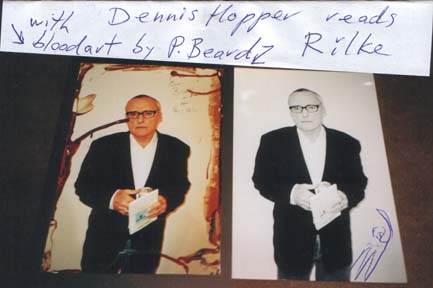
Musical group New York Voices released a CD entitled "Ancient Tower" featuring actress Meryl Streep reading Rilke's poetry to music.
Classical violinist Anne Sofie-Mutter has named Rilke as a favorite poet.
Country Musician Ray Wylie Hubbard names Rilke as an inspiration in this NPR interview.
CSI actor Ed Gordon was inspired by Rilke in the creation of his recent book "Letters to a Young Brother: Manifest Your Destiny."
Peter Carey's recent novel My Life as a Fake features a Rilke enthusiast as a principal character.
Audrey Niffeneger's The Time Traveler's Wife includes Rilke allusions that are integral to the story.
In his "New Year Letter," W.H. Auden famously (and, contrary to popular belief, not disparagingly) called Rilke "The Santa Claus of lonleliness." He made another reference to Rilke in "Twenty-third Sonnet" (In Time of War):
"Let us remember all who seemed deserted. / Tonight in China let me think of one, // Who through ten years of silence worked and waited, / Until in Muzot all his powers spoke, / And everything was given once for all: // And with the gratitude of the Completed / He went out in the winter night to stroke / That little tower like a great animal."
(The following Auden quote, by the by, would serve as a very apt epigraph to Lost Son: "Art is our chief means of breaking bread with the dead.")
Rilke is the subject of an essay by J.M. Coetzee in Coetzee's book Stranger Shores.
A character reads Letters to a Young Poet in the first chapter of Chris Abani's novel, Graceland.
The first full English translation of Rilke's famous correspondence with Lou Andreas-Salomé was published by W.W. Norton last year. It is noted here in The New Yorker.
And the following Rilke connections from Wikipedia:
Rilke has been celebrated in Thomas Pynchon's Gravity's Rainbow and William Gaddis' voluminous novel The Recognitions, and is referred to in Julia Alvarez's novel How the García Girls Lost Their Accents.
J.D. Salinger alludes to Rilke in various works, including Franny and Zooey.
Douglas Coupland quotes Rilke's Letters To A Young Poet in Generation X: Tales for an Accelerated Culture.
A Rilke translation inspired Lost in Translation, a celebrated 1974 poem by James Merrill.
Rilke has been celebrated in Thomas Pynchon's Gravity's Rainbow and William Gaddis' voluminous novel The Recognitions, and is referred to in Julia Alvarez's novel How the García Girls Lost Their Accents.
J.D. Salinger alludes to Rilke in various works, including Franny and Zooey.
Douglas Coupland quotes Rilke's Letters To A Young Poet in Generation X: Tales for an Accelerated Culture.
A Rilke translation inspired Lost in Translation, a celebrated 1974 poem by James Merrill.
Rilke is mentioned in Tennessee William's "The Two-Character Play."
German philosopher Martin Heidegger cites Rilke as an example of the highest form of thinker in his essay "What Are Poets For?" The essay's theme is largely explored through the examination of an "improvised verse" (short poem) Rilke wrote in 1924. Heidegger, sometimes considered the most influential German thinker of the 20th century, ranks Rilke in the German poetic tradition as second only to Holderlin.
Erie Chapman cites Rilke frequently in his essays on caregiving.
In the world of film:
Rilke's poem "The Panther" is quoted in the 1990 film Awakenings (starring Robert DeNiro and based on the 1973 book by neurologist and author Oliver Sacks), expressing the emotional undertone of the story.
In the 1993 movie Sister Act 2: Back in the Habit, actress Whoopi Goldberg refers to Rilke's Letters to a Young Poet. That work is also a topic of conversation between several characters in the 2002 movie Igby Goes Down.
Rilke is quoted in Kissing Jessica Stein by a woman looking for a woman in a personal ad. This quote is what moves the main character, Jessica, to answer the ad, despite her presumed heterosexuality.
Rilke's poem "Archaic Torso of Apollo" is quoted by Miriam, played by Gena Rowlands, in Woody Allen's 1998 film Another Woman. Additionally, "Rain," the Juliette Lewis character in "Husbands and Wives" is named after Rilke.
Rilke's poem "You Who Never Arrived" is quoted by Faith, played by Marisa Tomei, in Norman Jewison's 1994 film Only You.
"For the sake of a single poem," an animated short by Shamik Majumdar, a contemporary Indian Animation Film Designer, is based on an excerpt from Rilke's book, The Notebooks of Malte Laurids Brigge.
In the world of music:
The indie rock band Rainer Maria takes its name from Rilke, and at least some of their merchandise bears the poet's image.
The Cocteau Twins song "Rilkean Heart", on the 1996 album Milk and Kisses, is an homage to Jeff Buckley who was a life long lover of Rilke's work.
The Russian composer Dmitri Shostakovich set several of Rilke's poems to music in his Symphony No. 14.
In the world of music:
The indie rock band Rainer Maria takes its name from Rilke, and at least some of their merchandise bears the poet's image.
The Cocteau Twins song "Rilkean Heart", on the 1996 album Milk and Kisses, is an homage to Jeff Buckley who was a life long lover of Rilke's work.
The Russian composer Dmitri Shostakovich set several of Rilke's poems to music in his Symphony No. 14.
The American contemporary composer Morten Lauridsen set Rilke's poem "Les Chansons des Roses" to music.
Pianist Brad Mehldau and vocalist Renee Fleming released an album in which some of the songs are set to Rilke's poems in 2006.
In the world of the church:
Rilke's poem "You, Neighbour God" (from “The Book of Hours”) is included in the most commonly used edition of Liturgy of the hours.
Rilke's poetry is often referenced in the writings of contemporary spiritual teachers such as Jack Kornfield and Stephen Levine.
In the world of the church:
Rilke's poem "You, Neighbour God" (from “The Book of Hours”) is included in the most commonly used edition of Liturgy of the hours.
Rilke's poetry is often referenced in the writings of contemporary spiritual teachers such as Jack Kornfield and Stephen Levine.
Monday, February 26, 2007
What is Lost Son About? I. (Periodic Answers to an Unanswerable Question)
Beginning today, I will be posting periodic replies to the question: "What is Lost Son about?" It's a question as inevitable as it is impossible to answer definitively, because the responses it might elicit from me will change as my own relationship to the novel evolves (and as I come to better understand the book myself).
On the surface, of course, Lost Son is about Rainer Maria Rilke. His life, his work, his loves and friendships and memories and torments and triumphs. But were the question as easily answerable as this, I might not have written the novel at all. Over its five-year gestation period, Lost Son has been driven by more numerous, more elusive, and hopefully more widely resonant impulses than a wish to novelize the great poet's biography.
For this first post, Rilke's work itself provides something of a response. This quote from The Notebooks of Malte Laurids Brigge might have served as a relevant epigraph for Lost Son. In a way, the novel's dilemmas are all here: the loneliness of The Poet in this world. His somber restlessness. And a certain need for him to stand in stupefaction before his own destiny, in order to speak of it evocatively...
"And one has nobody and nothing and travels about in the world with a suitcase and with a trunk full of books and really without curiosity. What kind of life is this anyway? -- without house, without inherited things, without dogs.
"Still, if one had at least one's memories. But who has those? If a chilhood were there...it's like something buried. Perhaps one must be old in order to reach back to all that. I think it's good to be old."
On the surface, of course, Lost Son is about Rainer Maria Rilke. His life, his work, his loves and friendships and memories and torments and triumphs. But were the question as easily answerable as this, I might not have written the novel at all. Over its five-year gestation period, Lost Son has been driven by more numerous, more elusive, and hopefully more widely resonant impulses than a wish to novelize the great poet's biography.
For this first post, Rilke's work itself provides something of a response. This quote from The Notebooks of Malte Laurids Brigge might have served as a relevant epigraph for Lost Son. In a way, the novel's dilemmas are all here: the loneliness of The Poet in this world. His somber restlessness. And a certain need for him to stand in stupefaction before his own destiny, in order to speak of it evocatively...
"Und man hat niemand und nichts und fährt in der Welt
herum...
"And one has nobody and nothing and travels about in the world with a suitcase and with a trunk full of books and really without curiosity. What kind of life is this anyway? -- without house, without inherited things, without dogs.
"Was für ein Leben ist das eigentlich…
"Still, if one had at least one's memories. But who has those? If a chilhood were there...it's like something buried. Perhaps one must be old in order to reach back to all that. I think it's good to be old."
Subscribe to:
Posts (Atom)