Saturday, October 12, 2013

Notes on Art and Politics by M. Allen Cunningham


“Unless we insist that politics is imagination and mind, we will learn that imagination and mind are politics, and of a kind that we will not like.”—Lionel Trilling, The Liberal Imagination

  1. At present, politics and artistic imagination tend to stand apart in our thinking. This is an artificial polarity and a root cause of many of our civic ailments, though we have yet to admit it to ourselves.
  2.  Politics we deem serious and prosaic, a matter of “expertise” or career for the few, or else we deem them hollow and reflexive, a matter of party slogans and empty patriotism for the many. Meanwhile we tend to view art as entertainment — an activity or diversion to be valued chiefly for its “extracurricular” nature (and often for its complete unseriousness).
  3.  But art is gravely serious — which is not to say it is always and only grim. Art is serious even when amusing, in so far as it conveys us to planes of thought, engagement, and empathy that lie far beyond ordinary, prosaic experience. Art differs substantially and qualitatively from entertainment inasmuch as it provokes in us a sui generis order of reflection, and sometimes even elicits meaningful action.
  4. What we want is not increasingly politicized art, but a more artful politics — a politics spun from the fiber of a polity, a society, a demos, in which the higher orders of the arts and artistic thinking are integral, not extraneous — characteristic, not inconceivable.
  5. “Only in so far as a society is rendered sensitive by the arts do ideas become accessible to it.”—Herbert Read
  6. Artistic thinking is about being at ease with uncertainty, to the extent of accommodating unconventional solutions; it’s about adaptability, sacrifice, honesty, authenticity, and the propensity to be “in the moment,” to surprise oneself and others; it’s about taking the long view while tending to the necessary (frequently mundane) intricacies of process; it’s about the practice of re-envisioning oneself and one’s world; it’s about inspiration and excellence, memory and enterprise, invention, entrepreneurship, lineage and legacy and belief; artistic thinking, while necessarily subject to realism and practicality for the sake of execution, is never less than thoroughly optimistic.
  7. Art consists of questions and conduces to enrichment and expansion via uncertainty. This in contrast to propaganda, which concerns itself solely with “answers,” a pugnacious surety obtained via incessant repetition (sometimes dogmatic but more often enticingly disguised).
  8. Art and artistic imagination require equivocation. The shape-shifting capacity, the propensity to escape the confines of the self and the pressure of the self’s narrow needs, the empathic ability to see and feel what “others” see and feel, the power to express all these things — this honorable equivocation is endemic to artistic imagination, and it is a kind of civic virtue.
  9. Never forgetting what came before, whether in order to draw strength or outrage from it, the artistic thinker moves forever forward, and the further he or she goes, the more deeply integrated he or she becomes in the human community.
  10. Artist and statesman Václav Havel: “A better system will not automatically ensure a better life. In fact the opposite is true: only by creating a better life can a better system be developed.”
  11. The arts speak of who we are, and who we are is how we govern. Undervaluing the arts, we can’t know ourselves, and not knowing ourselves we cannot govern. We cannot properly honor one another, nor honor our mutual responsibilities.
  12. Not knowing ourselves, we cannot be unified in any special identity. Because we are not unified, our politics can reflect little beyond fragmentation, dysfunction, an incapacity to address some rottenness at our core.
  13. Deeply suspicious of one another, we begin to actively dishonor our common experience. Empathy retreats, anomie moves to the fore. We become less capable of caring for each other, first in our politics, then in our communities. Ideological entrenchment engenders violence — first violent sentiment, then violent rhetoric. Next come violent politics, and finally actual bloodshed. All the while, the increasing barbarism of our choice entertainments reflects our condition.
  14. Strongly we sense something fraying at the seams. We are anxious and alienated. Amid our threadbare civic life and the grinding gridlock of our larger politics, we nervously await improvements, feeling, because we are now so far from our own creative potential, powerless to create the improvements ourselves. Havel: “A person who has been seduced by the consumer value system, whose identity is dissolved in an amalgam of the accoutrements of mass civilization, and who has no roots in the order of being, no sense of responsibility for anything higher than his or her own personal survival, is a demoralized person.”
  15. We disparage even the age-old basis of all transformational events: inspiration. It is what we long for, and yet its primary instrument, eloquence, seems to our brutalized ears deserving of suspicion. Eloquence cannot penetrate (stirring as the speech may have been in the televised moment), so we end up deriding it: knowing how to make speeches doesn’t make you a leader, etc. “You don’t pass speeches, you pass budgets,” says Congressman Blaine Luetkemeyer.
  16. Politics having become a war, oratory feels irrelevant. Too close, to our tastes, to that other supreme irrelevancy — the after-hours, expendable, marginal, frivolous, basically embarrassing pastime deemed useful mainly as a status symbol: art.
  17. We must ask ourselves: To what extent might our lack of artistic thinking, our lack of artistically illuminated political vitality, be more than merely a symptom of our societal dysfunction, but an actual cause? That it may be a single cause among several does not diminish its significance.
  18. A five-year-old girl is busy with her blocks when her parent calls her to the dinner table: “You can play more after we’ve eaten.” The girl’s lucid response: “I’m not playing, I’m building!” 

Thursday, October 03, 2013

Wordstock!

I'll be at the Wordstock Book Fair here in Portland this Saturday and Sunday, October 5th and 6th from 10:00 a.m. to 6:00 p.m., stationed at the Atelier26 Books booth (#1007), near the McMenamin's stage.

I hope you'll consider stopping by to see what Atelier26 has on offer, which will include:

1) Hot-off-the-press copies of Harriet Scott Chessman's amazing new novel The Beauty of Ordinary Things (available for early purchase -- it won't officially be released till next month).

2) Copies of my own illustrated limited edition story collection, Date of Disappearance and nonfiction volume of solidarity and sound advice for writers and artists, The Honorable Obscurity Handbook (Atelier26 Samizdat Series).

3) Free prose samples!

4) T-shirts!

5) Literary conversation!

6) Prize drawings!

...and more!

Wordstock Book Fair
Saturday Oct. 5th and Sunday Oct. 6th from 10:00 a.m. to 6:00 p.m. 
Oregon Convention Center
777 NE Martin Luther King Jr. Blvd.
Portland, OR 97232

Tuesday, September 03, 2013

New Essay for Tin House

At the Tin House website, you can now read my essay, "Outsideness, or: My Phone Says 'Searching...'." It derives from remarks I delivered for the Oregon Legacy Author Series in Lincoln City, Oregon (a marvelous, author-supportive feat of cultural optimism).

The essay's subject: landscape and the writer. To wit:
Some friends of mine, parents of a five-year-old girl, once told me of their daughter’s confusion while driving around Pennsylvania during a family visit there. Her parents had pointed out some Pennsylvania mountains. “Where are they?” the girl kept saying. “I can’t see them. I can’t see them!” She was looking right at them. But this was a girl who had grown up in view of Mount Hood, Mount Saint Helens, Mount Adams, and Mount Rainier (11,250 feet, 8,400 feet, 12,300 feet, and 14,400 feet respectively).

The native Westerner (the one who stays anyway) enjoys a special inheritance. We tend to understand a thing or two, down in our bones, about mountains and canyons, landscapes and long views, the vastness of the natural realms. “I have never been able to refrain,” wrote Wallace Stegner, one of our greatest writers, “from telling easterners that Mount Washington, their pride, could be set down in the Grand Canyon — in a ditch — and never show above the rim. … Whatever he may not know, a Westerner is bound to know geography.”

I’d put it a little more starkly: the Westerner is well acquainted with the naked, grand, unnerving face of the earth — and what that suggests about our place in the order of things. Beyond any actual wilderness experiences (which I’d guess most of us have had in lucky abundance), we’re well acquainted with the experience of driving for five, six, ten hours and seeing out our window far more landscape (often stunningly scenic) than buildings. I remember being rightly horrified, in a deep existential way — being reduced nicely to size, you might say — the first time I crossed the agoraphobic deserts of Nevada. On Washington’s Highway 14, as you head east from the Columbia River Gorge into the forbidding glacial scablands on your way to Walla Walla, you pass a sign I particularly like: “Next gas 87 miles.” Stylistically, existentially, that’s a remarkable message: a little forlorn, but straight-up, no apologies.

“Destinies, outlined against the basic earth. That is the story we all write in the American West, whether in memory or on the white canyons of paper.” That’s Ivan Doig, another great writer from this side of the Missouri.

We live, out here, in almost daily consciousness of what you might call the irrevocable reality of human remoteness. The wildnerness, should it find you inadequately prepared, can eat you up — quite literally if you happen to be, say, in Grizzly country. After a point, it will not matter that you started out in a road-ready SUV with a full tank, a GPS, and a smartphone.
The essay entire can be read here.

Tuesday, August 13, 2013

Announcing the Beauty of Ordinary Things Pre-Order Campaign!

THE BOOK:
This November, Atelier26 will proudly publish The Beauty of Ordinary Things, the powerful new novel by acclaimed writer Harriet Scott Chessman.

The story of the unexpected love between a young Vietnam veteran and a Benedictine nun, The Beauty of Ordinary Things is a deeply felt, luminously moving book, and we know readers will love it as much as we do. Here’s what Debra Dean, celebrated author of The Madonnas of Leningrad, has to say about the novel:
“Like Annie Dillard, Chessman plumbs the mysteries of the spirit and celebrates the quiet grace notes of the earth. The Beauty of Ordinary Things is deep as a prayer, a meditation on two people seeking their right place in the world. This book speaks softly, but oh how it lingers in the mind. I can’t praise it enough.”—Debra Dean, author of The Madonnas of Leningrad and The Mirrored World
THE CAMPAIGN:
New, flexible printing technologies have made it more widely possible than ever for unconventional publishers without huge capital (that's us!) to produce finely designed paperbacks, and we’ve got a nice, practicable print-run set to go for Chessman’s novel. The challenge of monetary resources, however, is no small one for a micro-press founded on the belief that idiosyncratic works of quiet merit have an integral place in literary culture, that literary history is largely built upon such works, that independent bookstores deserve to have a hand in the game, and that print books remain relevant and irreplaceable.

We've tossed our hat in the ring for grants, etc., but in the end nothing beats the straight-up support of readers making a direct purchase. That’s why we’re hoping you’ll help us give us Harriet Chessman’s rich and moving novel the powerful launch it deserves by helping us bolster its starting print-run and our promotional capacity.

By simply pre-ordering through this campaign and receiving for your enjoyment the book itself (along with one-of-a-kind perks!), you’ll be investing in the life of a wonderfully unconventional and, yes, beautiful novel, and you’ll be helping us realize our quixotic editorial vision to bring you the finest contemporary fiction in strikingly designed paperback editions. Attaining even half of our stated goal will greatly augment the novel's launch (we make good use of all funds).

THE DEAL:
  • A pre-order of $17.00 (cost of book, plus shipping) gets you The Beauty of Ordinary Things along with a special letter-pressed excerpt from Harriet Scott Chessman’s work, signed by the author.
     
  • A pre-order of $35.00 gets you the above, plus a copy of Atelier26 publisher M. Allen Cunningham’s limited-edition short story collection Date of Disappearance, signed and numbered by the author, and featuring ten illustrations by artist Nathan Shields (this offer limited to 30 recipients).
Note: please disregard the "donate" language on the campaign page (it's a quirk of the interface we're using there). Simply click on either the $17 pre-order choice, or the $35 one.

In addition to the gifts mentioned above, everyone placing a pre-order through the campaign will be entered in regular drawings to receive any of a number of lovely and distinctive prizes throughout the life of the campaign. Follow the campaign's progress at the Atelier26 site, where we'll be posting frequent updates.

PRE-ORDER NOW
View Progress

The Beauty of Ordinary Things pre-order campaign closes on Sunday, September 8th, 2013.

Many thanks for your solidarity, and your support of independent publishing.

Viva, readers!
M. Allen Cunningham, August 14, 2013

Advance Praise for Harriet Scott Chessman’s The Beauty of Ordinary Things:
“A profoundly moving story of love’s possibilities, powers, and consolations.”—Priscilla Gilman, author of The Anti-Romantic Child

“Quite simply stunning. In an exquisite few pages, Harriet Scott Chessman delivers a gigantic story.”—Meg Waite Clayton, New York Times bestselling author of The Wednesday Daughters

“Stays with one, hauntingly, long after one finishes reading.”—Maud Carol Markson, author of Looking After Pigeon
The Atelier26 Motto: "A magnificent enthusiasm, which feels as if it never could do enough to reach the fullness of its ideal; an unselfishness of sacrifice, which would rather cast fruitless labour before the altar than stand idle in the market." --John Ruskin

Thursday, July 18, 2013

Small Press and Lauded Author Team Up for Fresh Approach to Literary Publishing

Exciting news from M. Allen Cunningham's Atelier26 Books!

(July 18, 2013, Portland, Oregon) Atelier26 Books announces the acquisition of acclaimed author Harriet Scott Chessman’s new novel, The Beauty of Ordinary Things, for publication November, 2013.

Chessman is the author of three previous novels, including the #1 Indie Next Pick and book-club favorite Lydia Cassatt Reading the Morning Paper as well as the Good Morning America Book Club selection and San Francisco Chronicle top pick Someone Not Really Her Mother. Her fiction has been translated into ten languages.
 
With The Beauty of Ordinary Things, Chessman has fashioned a powerful new story about our yearning for wholeness and the enduring weight of our briefest encounters.

Back from a tour of duty in Vietnam, Benny Finn, eldest son in a large Irish-American family, strives to find his bearings amid the everyday life of 1973 New England. At a Benedictine abbey in rural New Hampshire, Sister Clare, a young novice, confronts the day-to-day realities of a cloistered existence. Linking these two is Isabel Howell, a college student soon to discover that she must chart the course of her own life in a way she could not have imagined.
 
Deeply felt, often luminously moving, The Beauty of Ordinary Things carries forward the promise of Harriet Scott Chessman’s earlier work, revealing a writer richly aware of the range of human tragedy and tenderness.
 
Atelier26 Books, an independent press in Portland, Oregon, was founded in autumn 2011 with the aim to publish fiction by contemporary writers in fine paperback editions showcasing the highest design standards. At the core of the Atelier26 publishing philosophy are five beliefs the house seeks to boldly embody: “1) Idiosyncratic works of quiet merit have an integral place in literary culture; 2) Literary history is largely built upon such works; 3) Print books remain relevant and irreplaceable; 4) Dynamic independent booksellers across the nation are essential to a healthy publishing climate; 5) Authors deserve liberating rights agreements and royalty structures.”
 
The first Atelier26 title, Date of Disappearance: Assorted Stories by M. Allen Cunningham, appeared spring 2012 in an illustrated limited-edition of 300 copies, each signed and numbered by the author. That title and a subsequent nonfiction book were offered exclusively to independent bookstores for retail. While the house plans to widen its distribution with the release of Chessman’s novel, Atelier26 will retain its vision of “shining a light on the nation’s best indie bookstores.”
 
About her partnership with the unconventional micro-press, Chessman said, “I am honored and thrilled to be part of this new venture, Atelier26, whose mission is unsurpassed in integrity and vision.”
For more information, please contact:
Atelier26 publisher M. Allen Cunningham
atelier26books [at] gmail [dot] com

Sunday, June 23, 2013

Being Obscure

Reading (savoring!) Mary Ruefle's astonishing Madness, Rack, and Honey this morning (don't miss this book -- it's glorious), I discovered the following in the essay "I Remember, I Remember," a passage whose thought may lie nicely alongside my Honorable Obscurity Handbook:
"I remember that I did not always know authors were ordinary people leading ordinary lives, and that an ordinary life was an obscure life, if we can extend the meaning of obscure to mean covered up by dailiness, glorious dailiness, shameful dailiness, dailiness that is difficult to figure out, that is not always clear until a long time afterward. Obscure: not readily noticed, easily understood, or clearly expressed. Which is a pretty good definition of life." (p.242)
The question at the heart of The Honorable Obscurity Handbook, the question the book puts to its readers or prospective readers, is: Are you honorably obscure? At first this sounds like a provocation, a challenge; i.e., Are you above it all? And that is, of course, part of the meaning. But more importantly, "Are you honorably obscure?" is meant as an invitation, a gesture of welcome, four words preceding an embrace.

"Are you honorably obscure?"

The question bears inside it, implicitly, the inclusive affirmative: You probably are, because, after all, most of us are.  

Friday, May 31, 2013

“Cunningham Has Wrestled Alligators Professionally,” Or: Variations on My Author Bio


Gone, gone are the days when back-flap author bios were actually biographical in nature. Consider this artifact, from the rear of Cormac McCarthy’s 1965 debut, The Orchard Keeper. “Cormac McCarthy was born in Rhode Island in 1933,” it begins, “but moved to Knoxville, Tennessee, at the age of four.” We go on to learn that the author graduated high school in 1951 and then enrolled at the University of Tennessee where his performance “was so poor that he was asked not to return,” that he joined the Air Force in 1953 and spent of half of his four-year enlistment in Alaska, that he returned to university for four years but never got that degree, and that he “began work on The Orchard Keeper in 1959, but the necessities of life delayed its completion.”

From our distant vantage point in this age of “platforms” and all-encompassing commodification, doesn’t the McCarthy sketched here look distinctly, even perversely “unreliable”; i.e. unmarketable? Where are the guy’s creds? Where, for heaven’s sake, is the branding?

Today’s author bio, we all realize, is prime real estate. It is an ersatz CV precisely calibrated to persuade potential consumers of the author’s “content-providing” capacity and — more importantly — to encourage the outlay of cash in the amount of the cover price. Let us move units and never pause. Not only do I understand this, but I’ve done a great deal of market research. So today, after an in-depth comparative study of years, I’m proud to announce that I have identified each of the discrete author classifications (seven in all) that characterize contemporary publishing. I’ve done so, dear reader, in order to furnish you my own author bio in each of the seven variations! For the first time ever, the M. Allen Cunningham you prefer most can be yours, and you will, I trust, happily proceed therewith to your purchase of his latest title, The Honorable Obscurity Handbook. I am here to serve. Behold:
1)      The Author
M. Allen Cunningham is the author of two acclaimed novels, The Green Age of Asher Witherow and Lost Son, and the illustrated, limited-edition story collection Date of Disappearance. He is the co-founder of the cultural commentary blog Soul Shelter and the recipient of fellowships from the Oregon Arts Commission, Literary Arts, and Yaddo. Cunningham lives in Portland, Oregon.
2)    The Collegiate
        M. Allen Cunningham earned his MFA at the University of Long Walks and Artistic Struggle. The recipient of numerous trans-chronological fellowships, he has studied at Walden Pond with Henry Thoreau, in Northern California with John Steinbeck and Wallace Stegner, in Switzerland, Germany, and France with Rainer Maria Rilke, and in London with John Keats and William Shakespeare. He is a current Writer in Residence in the Blue Room at Powell’s Books, Portland, Oregon. He teaches writing to himself on a daily basis.

3)    The Everyman (aka The Working Stiff)
        M. Allen Cunningham has worked as a swimming instructor, a housepainter, a hospital purchasing agent, a file clerk, a commercial mortgage administrative assistant, a housepainter, a retail merchandiser, a copy-machine operator, a housepainter, a ranch caretaker, and a bookseller. He has delivered flowers in the middle of the day and newspapers in the dead of night, and he has painted houses. He’s lived in seven different apartments in six different cities and agrees that life, like housepainting, can be tough and you’ve got to be resilient. Through it all, he’s kept on writing.

4)    The Embellisher (aka The Personality)
        M. Allen Cunningham mastered the art of miming at nineteen months of age and later, a toddler runaway, supported himself as a sought-after street performer in Las Vegas. At seven he joined a cult in Delaware having to do with oven mitts, but upon his selection as the cult’s new Grand Master he elected to leave in order to devote himself to a prize career wrestling alligators. He is the founder of the Antarctic Thespian Society, is a nationally accredited porcupine-trainer, and has memorized Moby-Dick in its entirety.

5)    The Honored
        M. Allen Cunningham is President Emeritus of the American Academy of Words, Phrases, and Sentences. He is Chair of the Board of American Paragraphs, which he founded with Gore Vidal in 1958. He has received all of the highest literary honors, including the Eminently Finished Manuscript Prize, the Novelist’s Gratification Award, the Four-Hundredth Draft Literary Fellowship, and the Best Possible Book of All Books With This Particular Title Award. Just hand him the next prize, please. He will place it beside his Royal HH typewriter.
6)    The Wit
        M. Allen Cunningham gets a kick out of anagrams like Prenatal/Parental, often brings up Maslow’s Pyramid in spousal arguments, and wishes Occam’s Razor were considered more cutting edge. He lives in Portland, Oregon, in an old creaky house with fourteen cats but no mice, where he tinkers away on a Royal HH typewriter. He hopes you like the sweater vest he’s sporting semi-ironically in his author photo.  
7)    The Abbreviator
        M. Allen Cunningham is a writer.  
The Honorable Obscurity Handbook is now for sale from Atelier26 Books.

Wednesday, May 29, 2013

Prime Passage: Leon Wieseltier's Defense of the Humanities

The following comes from Wieseltier's May 19th commencement speech at Brandeis University. Read the whole speech in The New Republic.

"There is no task more urgent in American intellectual life at this hour than to offer some resistance to the twin imperialisms of science and technology, and to recover the old distinction — once bitterly contested, then generally accepted, now almost completely forgotten – between the study of nature and the study of man. As Bernard Williams once remarked, “’humanity’ is a name not merely for a species but also for a quality."  You who have elected to devote yourselves to the study of literature and languages and art and music and philosophy and religion and history — you are the stewards of that quality. You are the resistance. You have had the effrontery to choose interpretation over calculation, and to recognize that calculation cannot provide an accurate picture, or a profound picture, or a whole picture, of self-interpreting beings such as ourselves; and I commend you for it.

"Do not believe the rumors of the obsolescence of your path. If Proust was a neuroscientist, then you have no urgent need of neuroscience, because you have Proust. If Jane Austen was a game theorist, then you have no reason to defect to game theory, because you have Austen. There is no greater bulwark against the twittering acceleration of American consciousness than the encounter with a work of art, and the experience of a text or an image. You are the representatives, the saving remnants, of that encounter and that experience, and of the serious study of that encounter and that experience – which is to say, you are the counterculture. Perhaps culture is now the counterculture.

"So keep your heads. Do not waver. Be very proud. Use the new technologies for the old purposes. Do not be rattled by numbers, which will never be the springs of wisdom. In upholding the humanities, you uphold the honor of a civilization that was founded upon the quest for the true and the good and the beautiful. For as long as we are thinking and feeling creatures, creatures who love and imagine and suffer and die, the humanities will never be dispensable. From this day forward, then, act as if you are indispensable to your society, because – whether it knows it or not – you are."

Tuesday, May 14, 2013

The Honorable Obscurity Handbook Has Arrived!


NOW FOR SALE
Taking a cue from Tillie Olsen's Silences and the works of Alain de Botton, The Honorable Obscurity Handbook is novelist M. Allen Cunningham's gloriously uncynical answer to a publishing world awash in cynical careerism and bottom-line thinking. Part consoling sourcebook, part cultural commentary, part wry self-help manual, and part inspirational anthology, this slim volume is a celebration of the creative spirit. It is packed with insights relevant to any creative worker, whatever their field.

"They're out there. Day and night, in any given locale, they're hard at it. Our novelists and poets, who strive away in shabby rooms, reverse the formula daily: they live in order to work. But their work helps us to live. They win no honors and receive no grants. They hobnob with no famous elders. Yet they comprise, in their dedication and lack of 'prospects,' a force of pure, unpaid human creativity in service to something larger and more lasting than themselves. Their incentive? Destiny. Their inspiration when faced with privation and self-doubt? Bygone literary gods who struggled much the same. Their rewards: How to name them? But they more than mitigate the annoyances of thin wallets, scant praise, nonexistent reputations."
-M. Allen Cunningham, from the intro


ISBN: 978-0-9893023-0-2
Retail Price: $14.00 
218 pages (on recycled, acid-free paper) 
5.5. x 8.5

Friday, May 03, 2013

Prime Passage: Nicholas Carr's Rough Type Blog

Carr, author of the Pulitzer finalist The Shallows: What the Internet Is Doing to Our Brains (W.W. Norton, 2010), never fails to cut to the quick in the cultural commentary on his occasional "Rough Type" blog. As contemporary interpreter of the fetishism, solipsism, and pervasive absurdities that characterize the technocrats of Silicon Valley, Carr is among the best.

The following is from a very recent Rough Type post about Facebook and its new TV ad campaigns.

"...Every object, at least in our perception of it, carries its antithesis. Behind the plenitude symbolized by the vase we sense an emptiness: the wilted bouquet rotting in a landfill. And so it is with the tools of communication. When we look at them we sense not only the possibility of connection but also, as a shadow, the inevitability of loneliness. An empty mailbox. A sheet of postage stamps. A telephone in its cradle. The dial of a radio. The dark screen of a television in the corner of a room. A cell phone plugged into an outlet and recharging, like a patient in a hospital receiving a transfusion. The melancholy of communication devices is rarely mentioned, but it has always haunted our homes.

"Home and Away are the poles of our being, each exerting a magnetic pull on the psyche. We vibrate between them. Home is comforting but constraining. Away is liberating but lonely. When we’re Home, we dream of Away, and when we’re Away, we dream of Home. Communication tools have always entailed a blurring of Home and Away. Newspaper, phonograph, radio, and TV pulled a little of Away into Home, while the telephone, and before it the mail, granted us a little Home when we were Away. Some blurring is fine, but we don’t want too much of it. We don’t want the two poles to become one pole, the magnetic forces to cancel each other out. The vibration is what matters, what gives beauty to both Home and Away. Facebook Home, in pretending to give us connection without the shadow of loneliness, gives us nothing. It’s Nowheresville."

Tuesday, April 30, 2013

Prime Passage: And Our Faces, My Heart, Brief as Photos by John Berger

"Poems, even when narrative, do not resemble stories. All stories are about battles, of one kind or another, which end in victory and defeat. Everything moves towards the end, when the outcome will be known.

"Poems, regardless of any outcome, cross the battlefields, tending the wounded, listening to the wild monologues of the triumphant or the fearful. They bring a kind of peace. Not by anaesthesia or easy reassurance, but by recognition and the promise that what has been experienced cannot disappear as if it had never been. Yet the promise is not of a monument. (Who, still on a battlefield, wants monuments?) The promise is that language has acknowledged, has given shelter, to the experience which demanded, which cried out.

"Poems are nearer to prayers than stories, but in poetry there is no one behind the language being prayed to. It is the language itself which has to hear and acknowledge. For the religious poet, the Word is the first attribute of God. In all poetry words are a presence before they are a means of communication."
--pages 21-22

Saturday, April 27, 2013

Forthcoming (in print), spring 2013

More info soon...

Friday, March 29, 2013

Prime Passage: Self-Consciousness by John Updike

“My first books met with the criticism that I wrote all too well but had nothing to say: I, who seemed to myself full of things to say, who had all of Shillington to say, Shillington and Pennsylvania and the whole mass of middling, hidden, troubled America to say, and who had seen and heard things in my two childhood homes, as my parents’ giant faces revolved and spoke, achieving utterance under some terrible pressure of American disappointment, that would take a lifetime to sort out, particularize, and extol with the proper dark beauty. … What I doubted was not the grandeur and plenitude of my topic but my ability to find the words to express it; every day, I groped for the exact terms I knew were there but could not find, pawed through the thesaurus in search of them and through the dictionary in search of their correct spelling. My English language had been early bent by the German locutions of my environment, and, as my prose came to be edited by experts, I had to arbitrate between how I in my head heard a sentence go and how, evidently, it should correctly go. My own style seemed to me a groping and elemental attempt to approximate the complexity of envisioned phenomena and it surprised me to have it called luxuriant and self-indulgent; self-indulgent, surely, is exactly what it wasn’t — other-indulgent, rather. My models were the styles of Proust and Henry Green as I read them (one in translation): styles of tender exploration that tried to wrap themselves around the things, the tints and voices and perfumes, of the apprehended real. In this entwining and gently relentless effort there is no hiding that the effort is being made in language: all professorial or critical talk of inconspicuous or invisible language struck me as vapid and quite mistaken, for surely language, printed language, is what we all know we are reading and writing, just as a person looking at a painting knows he is not looking out of a window.”
(p.103-104)

Wednesday, March 27, 2013

Prime Passages: Dublinesque by Enrique Vila-Matas, and Ben Okri (impromptu)

from Vila-Matas's Dublinesque:
“He dreams of the day when the spell of the best-seller will be broken, making way for the reappearance of the talented reader, and for the terms of the moral contract between author and audience to be reconsidered. He dreams of the day when literary publishers can breathe again, those who live for an active reader, for a reader open enough to buy a book and allow a conscience radically different from his own to appear in his mind. He believes that if talent is demanded of a literary publisher or writer, it must also be demanded of a reader. Because we mustn’t deceive ourselves: on the journey of reading we often travel through difficult terrains that demand a capacity for intelligent emotion, a desire to understand the other, and to approach a language distinct from the one of our daily tyrannies. … The same skills needed for writing are needed for reading. Writers fails readers, but it also happens the other way around and readers fail writers when all they ask of them is confirmation that the world is how they see it.” (New Directions, 2012; p.51)
Ben Okri, speaking at the World Writers Festival in Edinburgh, 2012:
“My brothers and sisters in Africa, we feel that our stories have still not been told. We feel that the form of the telling of those stories has not yet been found and articulated and evolved in a way that, as it were, can be appreciated round the world. We feel that the novel is still very young. … I seem to be hearing about the exhaustion of the novel. I find that very puzzling, personally. Because I think that the novel is only 350 years old. It’s not as old as painting. It’s not as old as sculpting. And as an art form itself, I think maybe the real future of the novel lies with the fact that we, the writers, have not issued the fundamental challenge to the perception of the novel as a form. What do I mean by that? In almost all the other forms—in music, and certainly in art—the narrative tradition, the naturalistic tradition of painting, has been superseded by abstract, by many other kinds of media. And I think that we have accepted too much, as it were, the definition of the limitation of the novel. I think the real challenge is to change the form of the novel in terms of how we read it. I still think that we accept too much the beginning, middle, end.  Even where we have experiments, we have not managed, as it were, the kind of Duchampian change of game. I feel that the novel is not dead yet. I just feel like I’m at a funeral here, really. I feel like speaker after speaker has given a kind of oration to the end of the novel, as if the novel has yet begun to express all the different possibles, all the different ways in which reality can be expressed. I don’t think that reality is as homogenous as that. I think each person carries within them a special way of seeing and perceiving reality, and I think that’s what the novel does. The novel constantly challenges us to say that the way that we’re told that the world is, is not the way the world is. The world is much more mysterious than that, is much more elusive than that, and is much more magical and more challenging, and possibly even more fragmented. I just would like to propose that we talk about where we can go as novelists, where we can go as writers, and whether we accept the fact that we are really totally determined by the marketplace, which I don’t accept.”  
(Okri's remarks are transcribed from the dazzling 2-hour discussion on "the Future of the Novel," involving 50 authors from all over the world, which can be viewed in its entirety here.)


Monday, March 25, 2013

Did You Just Call Me a "Content Container"?

The amazing Melville House blog gets better and better. For a few years now I’ve greatly appreciated their relentless resistance to the civic and cultural irresponsibility, rapacity, and general megalomania of Amazon.

Now we all owe further thanks to Melville House, and to their blogger Dustin Kurtz, for brilliantly resisting “the propagation of [a] powerful and quite dangerous idiocy, the irruption of the language of venture capital into the province of the book.”
Kurtz cites Tim Sanders, of the “team publishing” website NetMinds, speaking to the New Yorker: “We believe a writer is not necessarily a writer. They are content containers.” And Peter Armstrong, founder of Leanpub, who states: “a book is a startup” and who equates the long, solitary process of writing to the “stealth mode” that precedes an entrepreneurial launch.
NetMinds and Leanpub both aim to provide writers (via social network) with early audience critiques of works in progress, in order to maximize the mass appeal/profitability of those works; i.e., to help the writer “pivot until you have the right book and build traction once you do.”   

Welcome, Ladies and Gentlemen, to the brave new world of book-via-virtual-focus-group, where the sins of idiosyncrasy, subjectivity, or good old-fashioned style are, if not expurgated altogether, then "remixed" to the mercenary end of mass appeal. (I’ve touched on aspects of this subject elsewhere. See: “There’s a Crowd on My Desk” or "Why It's Desirable to Be Eccentric".)
Kurtz:
“[Armstrong] talks about the ‘success’ of a book. What he means is that the book pays out. Many publishers might agree with that standard, but how many authors?  And that phrase ‘stealth mode?’ Are we to the point where the act of being alone, writing to an imagined audience and not a real responsive audience is akin to hiding?
“As for the real winners, the claims that made me actually clench my teeth and take a deep breath when I read them—Armstrong and his phrase about creativity, Sanders and that terrible terrible terrible sentence about ‘content containers’ what’s to be said? Anyone who could think such things is quite specifically part of The Problem in the starkest sense.”
For me, all this brings to mind these words of Stephen Spender, written back in 1949:

The general effect of increasing commercialization and of the compulsion to sell ever larger and larger quantities of a few books to a public which does not really care about them, must surely be that the position of the writer who writes as well as he possibly can ‘to please himself’, becomes less tenable. … The American malady is a spiritual one, the commercialization of spiritual goods on an enormous scale, in the same way as material goods are commercialized. … In the country where culture is ‘sold’ enormously, it is sold as something other than culture and tends to become something else in the process.”
The slogans and euphemisms that characterize what I recently heard dubbed "dot-communism" are the latest symptoms of our long-standing American malady. Kurtz beautifully articulates what's at stake when we embrace such ways of talking about creativity:
These guys are not harmful, as I say, but the spread of this type of jargon is. Language shapes, language is, thought, and the more comfortable we grow talking about nascent books as ‘content’, about drafts as ‘iterations’, the more we trivialize those books that don’t benefit from focus groups. These guys, this language, is hurting literature by changing how we think about books in general. It is a spreading disregard, not even conscious or apt enough to be malign. And I don’t think it likely to stop.”
Read the Melville House post here. And consider adding the Melville House blog to your list of essential web-reading.


Wednesday, March 20, 2013

Scribbles

1. Last spring I picked up this copy of Dillard's Pilgrim at Tinker Creek for around a dollar and a half. Only when I got home did I discover the former owner's inscription inside. As an exhibit of a peculiarly enduring stylistic mode that might be dubbed 'Teen-Scourge,' it caused me such absurd delight that I believe it's worth sharing.
 
(NB: If you happen to have small children at hand, you may wish to refrain from reading aloud.)


"Annie Dillard is the anti CHRIST!! Come Fucking On the Birds Prompt?!? What the Hell. The shear (sic) horror of this bullshit. Fuck McClure for not only making us read this shit, but write on it as well. Fuck Annie Dillard and her in tune with Nature bullshit. [heart] the haters of Annie Dillard"
 
2. A recent purchase of Six Nonlectures by e.e. cummings included the bonus, on the book's final page, of an autobiographical prose meditation in a style emulating cummings' own syntactical eccentricities -- and making explicit reference, in at least a few places, to the content of the book. As book-scribbling goes, here's an entry on a more epic scale than 'Teen-Scourge.'
 
What to make of both of these entries? Maybe the weird readerly proximity they offer is an end in itself. The transcribed outrageousness of 'Teen-Scourge,' the vulnerability of the scribble, the messy, unguarded reflexivity of the thoughts -- these are yet a few more things e-books cannot give us.   


"Here I am and I'm fairly sure I wish I wasn't. But where then? It is what it is. There are no mistakes. How can I expect those around me to grasp that when my own Is and Now seem like mistakes to me -- he who reassures myself with this Zen-ism. One minute I am the only sane/capable human in sight. But since/if that is so, then it's wrong in that sanity is an agreement -- a consensus. But what about the individual. The Who? Not the band. don't mean to babble, but I always have. Babbled or meant to? Don't know. Fuck, now I'm interrogating myself. "Finished too much for what they did." Is playing disappearing? Am I working toward playing? Does that even make sense? to Me? to the consensus? Fuck them! They do it and die unhappy. Am I sitting still to have or because I have to? Time will tell. But it whispers. And stutters. And often informs to late [sic]. Work time.
 
"I always wonder if I'm an individual or half a pair. Can one really be both? Here? Now?
 
"I've been working and waiting toward joy (?!) and now power/vengeance. Are these worthy? Or are they just them? Where does Being fit in? I haven't observed myself/felt myself doing that in so long. Is there a conflict between Being and Achieving? Happinesss [sic], Power, Contentment, Peace. Surely not but possibly so. And probably yes? Who said that?"   

Tuesday, March 12, 2013

Letterpress Business Cards!

Because Old-Fashioned is the new New!


Created on a Kelsey tabletop press with reflex blue ink.
Typeset in Corvinus Bold 24 pt, Cheltenham Bold 72 pt, and Spartan Heavy 14 pt (with accidental italics!)

Monday, February 25, 2013

"More Normal Than Other People"

The video below is an elegant mini-documentary expedition into writer Duncan Fallowell’s book-cluttered flat in upper-class London.

"I can’t stop acquiring books,” says Fallowell. “But I’m not guilty about it. It’s a kind of necessity. Books, to me, are like oxygen. I’m a fish swimming in an aquarium of the intellect. … The books demanded to be incorporated into my domestic world.”

It’s a beautiful little film, and greatly enjoyable viewing. The YouTube précis, though, is curiously inaccurate, describing Fallowell’s collection as a "library which has spilled over into every available space and become an art installation in its own right." Fallowell has a lot of books, sure, but by all appearances it amounts to nothing like, say, the apartment that houses Brazenhead Books in New York – and Fallowell’s is hardly the helter-skelter hoard of a kook. To imply that the abundance of titles signifies, in its own right, a form of eccentricity is peculiarly dispiriting. Fallowell himself seems to resist the implication at one point:

"One does need grounding in the physical world. This is why the electronic book means nothing to me. Because a book is a physical object too. And writing, to me, is a physical act. It’s a sculptural act as well as an intellectual act. The two come together. … Do you think writers are odd? I don’t know. I don’t subscribe to this idea that you’ve got to be odd to be a writer…. Perhaps you’ve got to be more normal than other people.”

Having steadily built my own home library over the last several years, I wish to happily count myself among such ‘normals.’ And I’m delighted to spot, among Fallowell’s volumes, a number of my own fondest: On Grief and Reason and Watermark by Joseph Brodsky; David Marr’s life of Patrick White; and Leon Edel’s towering biography Henry James.

Fallowell: “There’s something about the lushness, the richness, the open-door quality of a book. Open a book and you’re opening a door. All these books just remind me of worlds beyond worlds and they are an expression of freedom. As we know, the first thing dictators do is control books, control what people are allowed to read. … I’ve always wanted to wander, and I can wander very conveniently in my library…"


Saturday, February 16, 2013

Essayist Orange Deserves Your Attention


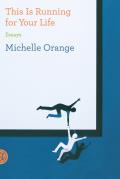
This Is Running for Your Life: Essays Cover

In this weekend's Oregonian is my review of Michelle Orange's brilliant essay collection This Is Running for Your Life, a new book that deserves the attention of anybody remotely interested in the life of the mind.

From the review:
... Michelle Orange models an ideal balance of firsthand engagement with -- and grounded criticism of -- the lightheaded culture all around us. "The new American dream," she writes, "is to build a really bitching personal brand, and the result of all that tap dancing on all those individual platforms is a pervasive kind of narrative decadence. We race to consume and regurgitate the hour's large and small events for each other like patricians in a postmodern vomitorium -- to know them first, translate them into bitter capsule form fastest, and be shocked or stirred or perceived as in any way less than totally savvy about these things the least. Even within our self-contained realities we become dulled to what's real and what's not, and further desensitized to what lies behind our fellow performers' virtual scrims." Here and elsewhere in the book, Orange's insights share their probing, persuasive rhythms with those of Susan Sontag, whose name rightfully comes up a number of times.
In the stunning chapter "Pixelation Nation," which takes its cue from Sontag's hallmark 1977 book On Photography, Orange explores the scarcely considered implications of digital imagery and dissemination in a time when every smartphone, iPad and iPod is a camera which, "with its promise of perfect recall, both reminds and relieves the shooter of the burden of being present." As we each become daily -- not to mention hourly -- publishers of images we've captured and edited for immediate upload, the images themselves take on "more of a social than a subjective or individual purpose." Our pictures have become part of a larger, ongoing self-publicizing project: "It's more about representing a certain reality than remembering it."
It's this kind of unfailingly X-ray-like inquiry into the peculiarities of our ultra-mediated world that unites Orange's 10 absorbing essays. Where Sontag's work generally took literature as the hub of its radial concerns, Orange proves herself an eloquent revealer of things more broadly socio-cultural and, as it happens, patently bizarre -- though they're the very things we refer to as "daily life." ...
 [continue reading here]