Lost Son tells of the life of Rainer Maria Rilke. Who was Rilke?
That is a bigger question than I could pretend to answer, and Lost Son is less an authoritative portrait than it is a letter sent to a ghost. Rainer Maria Rilke is almost universally recognized as one of the world’s greatest poets. But he is perhaps best loved in the United States for the prose of his Letters to a Young Poet, a slim little volume offering some remarkable, unorthodox perspectives on such things as love, solitude, grief, art, and fate. It’s a book cherished with near religiosity by many people young and old. Rilke was born in Prague in 1875 and died at age 51 in Switzerland.
What drew you to telling Rilke’s story?
I am fascinated by how wholly and entirely Rilke lived and breathed as a poet, almost to the exclusion of everything else – and am particularly fascinated by his much-expressed conviction that living this way was his only real method of surviving in the world. One gets the sense, while reading his amazing work, that Rilke was a nerve laid bare to everything around him, that every impression and experience affected him almost physically, vibrating inside him and eventually becoming transformed to poetry. The unique way in which he “utilized” his vulnerability would ultimately take him from provincial-born, sickly, psychologically mistreated child to enduring master artist held dear by readers all across the planet. I wanted to live in, explore, and evoke that strangely inspiring, sometimes disturbing process of artistic development and all its reverberations.
Why did you choose to explore Rilke’s life in a novel rather than a biography?
It seemed that a novel would allow me to explore the poet's remarkable life at a level of intimacy that a more academic format just would not permit. For a figure of such great specialness as Rilke, the fictional form seemed appropriately special. Amidst his powerful poetic output, Rilke authored a single novel called The Notebooks of Malte Laurids Brigge. It’s an astounding book, pungent and luminous and unlike anything else in the realm of fiction that I know of. Malte is semi-autobiographical, and I’ve always been intrigued by Rilke’s urge to novelize his own life story to some degree. Likewise, I’ve always found his real biography irresistibly intriguing, and I suppose Lost Son first began with the thought, ‘why not take the actual life and novelize it in full?’ – from Rilke’s childhood being raised as a girl and then being abruptly shipped off to military school, to his passionate affair at age 21 with Lou Andreas-Salomé, a famous intellectual 14 years his senior, to his close friendship with the great sculptor Rodin. All the dramas and relationships of a strong novel were there waiting.
What sort of research went into Lost Son?
Well, aside from exploring Rilke’s body of work, I’ve read pretty much all the major titles about Rilke available in English (biographies, commentaries, etc.), but most of those I absorbed early from mere personal fascination, prior to any plan for this novel. Otherwise, I’ve done quite a bit of Rilkean traveling, visiting places of importance to the poet: Prague, Munich, the Swiss Valais, etc. Once I got well into the writing of Lost Son, I traveled to Paris and stayed for a few months in the neighborhood where Rilke lived. In Paris I did a bit of archival exploration, mainly at the Rodin Museum where a great number of Rilke’s original letters to the sculptor are kept. But my research, aside from exploring the available information relating to Rilke’s life, was largely impressionistic: traveling and observing, walking around Paris and doing lots of imagining.
Did you find yourself having to re-order, leave out, or distort biographical facts while writing Lost Son?
The material of Rilke’s life – his experiences and relationships – was so rich already that surprisingly little manipulation of fact was required in order to get to a story of great drama. Lost Son tells Rilke's story quite faithfully.
What’s your favorite work by Rilke?
I think my answer to that will change depending on when you ask me. Right now, I’m most in admiration of The Book of Hours and The Notebooks of Malte Laurids Brigge.

DISPATCHES FROM M. ALLEN CUNNINGHAM: author, editor, teacher
Tuesday, May 08, 2007
Friday, April 27, 2007
Between Hope and Suspicion: a Translation From Rilke's Novel
This passage comes from Rilke's marvelously singular interpretation of the biblical story of the Lost Son (aka "Prodigal Son") at the end of Malte. My novel's title alludes to Rilke's haunting version of the old tale.
"And the house did the rest. One had merely to enter into its full smell. Already most decisions had been made. Some little thing or other might still be altered; on the whole, though, one was already that which the people here held one to be -- the one for whom they had long ago confabulated a life, from his small past and their own wishes; one who was but a confection of their spliced selves, who stood day and night under the suggestion of their love, between their hope and their suspicion, before their reproach or applause.
"So no use climbing the stairs with whatever unspeakable caution. They are all in the living room, and the door need only be nudged for their glances to find him. He stays in the dark, he will await their questions. But then comes the worst. They take him by the hands, they drag him to the table, and all of them, as many as there are, stretch themselves inquisitively before the lamp. They have it good that way, they keep themselves in the darkness, and on him alone falls, with the light, all the shame at having a face."
Die Aufzeichnungen des Malte Laurids Brigge (1910)
"And the house did the rest. One had merely to enter into its full smell. Already most decisions had been made. Some little thing or other might still be altered; on the whole, though, one was already that which the people here held one to be -- the one for whom they had long ago confabulated a life, from his small past and their own wishes; one who was but a confection of their spliced selves, who stood day and night under the suggestion of their love, between their hope and their suspicion, before their reproach or applause.
"So no use climbing the stairs with whatever unspeakable caution. They are all in the living room, and the door need only be nudged for their glances to find him. He stays in the dark, he will await their questions. But then comes the worst. They take him by the hands, they drag him to the table, and all of them, as many as there are, stretch themselves inquisitively before the lamp. They have it good that way, they keep themselves in the darkness, and on him alone falls, with the light, all the shame at having a face."
Die Aufzeichnungen des Malte Laurids Brigge (1910)
Friday, April 20, 2007
Keep Small Media in the Mail
The top folks at the U.S. Postal Service have welcomed a rather insidious proposal from one of America's top media conglomerates, Time Warner, which would saddle small publishers with substantially increased postal rates even while securing rate breaks for large media. Clearly, for the sake of free and varied information in this country, we cannot allow such inequable rate hikes to take effect. Visit the Stamp Out the Rate Hikes website to learn more and sign a petition. Congress needs to hear from you before April 25.
Monday, April 16, 2007
2007 Pulitzer Prize in Fiction
Congratulations, Mr. McCarthy. You've deserved this forever. We younger writers are filled with gratitude that you've kept the work coming. We look forward to still more.
Thursday, April 12, 2007
LOST SON Events in California, Oregon, Washington
Here's the event schedule for Lost Son, subject to additions and expansions in the coming weeks. Please check back for updates (a permanent link, "Upcoming Readings & Signings," will be found at the upper right).
Thursday, May 31, 2007—Portland, OR
7:30 p.m. reading/talk/q&A & signing
Annie Bloom’s Books
7834 SW Capitol Hwy
Portland, OR 97219
(503) 246-0053
Monday, June 4, 2007—Danville, CA
7:00 p.m. reading/talk & signing
Rakestraw Books
409 Railroad Avenue
Danville, CA 94526
(925) 837-7337
Tuesday, June 5, 2007—Clayton, CA
7:00 pm reading/talk (with a Rilke emphasis) & signing
Clayton Books
5433 Clayton Road, Suite D
Clayton, CA 94517
(925) 673-3325
June 5-9, 2007—San Francisco, CA
Drop-in stock signing
Kepler’s Books
1010 El Camino Real
Menlo Park, CA 94025
(650) 324-4321
Thursday, June 7, 2007—Orinda, CA
4:00 p.m., reading/talk & q&a
Orinda Books
276 Village Square
Orinda, CA 94563
(925) 254-7606
Sunday, June 10, 2007—San Jose, CA
Book Group Expo
*At 11:30am, Cunningham will participate in a literary salon, "Unfinished Business: the Secrets that Haunt Us" with authors Nathan Englander, Michelin Marcom, Elizabeth Rosner, and host Michael Krasny.
Cunningham will sign books, and will be hanging about the expo for a bit.
Sunday, June 10—2007—Capitola, CA
7:30 pm reading*
Capitola Book Café
1475 41st Ave
Capitola CA 95010
Store: 831.462.4415
www.capitolabookcafe.com
*this is a triple-author reading, also featuring:
Tess Uriza Holthe, author The Five-Forty-Five to Cannes & When Elephants Dance;
and Ann Cummins, author of Yellow Cake & Red Ant House
Monday, June 11, 2007—Corte Madera, CA
1:00 p.m. reading/signing
Book Passage Bookstore
51 Tamal Vista Blvd.
Corte Madera, CA 94925
(415) 927-0960 / (800) 999-7909
Tuesday, June 12, 2007--Redding, CA
6:30 p.m. reading/signing
Redding Record Searchlight Bookclub Event
Holiday Inn
1900 Hilltop Dr.
Redding, CA
Thursday, June 14, 2007—Portland, OR
7:30 p.m. reading/signing
23rd Avenue Books
1015 NW 23rd Avenue
Portland, OR 97210
(503) 224-5097
Monday, June 18, 2007—Portland, OR
7:30pm reading/talk/q&a & book signing
Powell’s on Hawthorne
3723 SE Hawthorne Blvd.
Portland, OR
(503) 228-4651
Tuesday, July 3, 2007—St. Helens, OR
7:00 p.m. book group discussion regarding The Green Age of Asher Witherow
& Reading/talk regarding LOST SON
St. Helens Book Shop
58527 Columbia River Hwy
St. Helens, OR 97051
(503) 397-4917
Saturday, July 21, 2007—Sisters, OR
6:30 p.m. talk & signing
Paulina Springs Bookstore
252 W Hood Ave
Sisters OR 9775
(541) 549-0866
Tuesday, July 24, 2007—Seattle, WA
7:30 p.m. Reading/talk/q&a &signing
Elliott Bay Book Company
101 South Main St.
Seattle, Washington 98104
(206) 624-6600 / (800) 962-5311
Thursday, July 26, 2007—Seattle, WA
7:00 p.m. Reading/talk/q&a & signing
University Bookstore
Seattle, WA (800) 335-READ
Thursday, May 31, 2007—Portland, OR
7:30 p.m. reading/talk/q&A & signing
Annie Bloom’s Books
7834 SW Capitol Hwy
Portland, OR 97219
(503) 246-0053
Monday, June 4, 2007—Danville, CA
7:00 p.m. reading/talk & signing
Rakestraw Books
409 Railroad Avenue
Danville, CA 94526
(925) 837-7337
Tuesday, June 5, 2007—Clayton, CA
7:00 pm reading/talk (with a Rilke emphasis) & signing
Clayton Books
5433 Clayton Road, Suite D
Clayton, CA 94517
(925) 673-3325
June 5-9, 2007—San Francisco, CA
Drop-in stock signing
Kepler’s Books
1010 El Camino Real
Menlo Park, CA 94025
(650) 324-4321
Thursday, June 7, 2007—Orinda, CA
4:00 p.m., reading/talk & q&a
Orinda Books
276 Village Square
Orinda, CA 94563
(925) 254-7606
Sunday, June 10, 2007—San Jose, CA
Book Group Expo
*At 11:30am, Cunningham will participate in a literary salon, "Unfinished Business: the Secrets that Haunt Us" with authors Nathan Englander, Michelin Marcom, Elizabeth Rosner, and host Michael Krasny.
Cunningham will sign books, and will be hanging about the expo for a bit.
Sunday, June 10—2007—Capitola, CA
7:30 pm reading*
Capitola Book Café
1475 41st Ave
Capitola CA 95010
Store: 831.462.4415
www.capitolabookcafe.com
*this is a triple-author reading, also featuring:
Tess Uriza Holthe, author The Five-Forty-Five to Cannes & When Elephants Dance;
and Ann Cummins, author of Yellow Cake & Red Ant House
Monday, June 11, 2007—Corte Madera, CA
1:00 p.m. reading/signing
Book Passage Bookstore
51 Tamal Vista Blvd.
Corte Madera, CA 94925
(415) 927-0960 / (800) 999-7909
Tuesday, June 12, 2007--Redding, CA
6:30 p.m. reading/signing
Redding Record Searchlight Bookclub Event
Holiday Inn
1900 Hilltop Dr.
Redding, CA
Thursday, June 14, 2007—Portland, OR
7:30 p.m. reading/signing
23rd Avenue Books
1015 NW 23rd Avenue
Portland, OR 97210
(503) 224-5097
Monday, June 18, 2007—Portland, OR
7:30pm reading/talk/q&a & book signing
Powell’s on Hawthorne
3723 SE Hawthorne Blvd.
Portland, OR
(503) 228-4651
Tuesday, July 3, 2007—St. Helens, OR
7:00 p.m. book group discussion regarding The Green Age of Asher Witherow
& Reading/talk regarding LOST SON
St. Helens Book Shop
58527 Columbia River Hwy
St. Helens, OR 97051
(503) 397-4917
Saturday, July 21, 2007—Sisters, OR
6:30 p.m. talk & signing
Paulina Springs Bookstore
252 W Hood Ave
Sisters OR 9775
(541) 549-0866
Tuesday, July 24, 2007—Seattle, WA
7:30 p.m. Reading/talk/q&a &signing
Elliott Bay Book Company
101 South Main St.
Seattle, Washington 98104
(206) 624-6600 / (800) 962-5311
Thursday, July 26, 2007—Seattle, WA
7:00 p.m. Reading/talk/q&a & signing
University Bookstore
Seattle, WA (800) 335-READ
Saturday, April 07, 2007
National Poetry Month is Here
April is National Poetry Month! Visit the Academy of American Poets to discover thirty ways you can celebrate.
And while you're there, take a look at Rainer Maria Rilke's page, complete with bio, Rilkean links, and translations by Stephen Mitchell.
And while you're there, take a look at Rainer Maria Rilke's page, complete with bio, Rilkean links, and translations by Stephen Mitchell.
Wednesday, March 21, 2007
The Rilkean Regard

The luminous new novel The Moments Lost by Bruce Olds (appearing next month from FSG) contains the following remarkable passage, worthy of any commonplace book. In addition to being some of the loveliest prose I've read in a great while, the passage includes a veiled reference to the work of Rainer Maria Rilke:
"...she presented him with the orris-work-covered notebook she had purchased for the purpose, instructing him to copy the words conscientiously twice a day, once upon waking, again at bedtime, this midnight lucubration:
'There is nothing truly beautiful but that which can never be any use whatever; everything useful is ugly, for it is the expression of some need, and man's needs are ignoble and disgusting like his own poor and infirm nature. The most useful place in a house is the water-closet.'
Gautier's words in the preface to Mademoiselle de Maupin.
And why, she quizzed him? Why was this? How so?
"Because," he intuited, "man is a creature of abject want ahead of fundamental need, base desire before necessity? Because life is a matter of aoristic excrescence? Because fantasia and phantasmagoria, reverie and dream, are more beautiful than brute experience? Because the lyric of a poem sustains life no less than a loaf of bread, and there is no place without eyes to see us. Am I close?" "
There is no place without eyes to see us: Rilke admirers will promptly recognize the antecedent of this line by Olds in the famous close of Rilke's "Archaic Torso of Apollo" in part two of New Poems:
Da ist keine Stelle / die dicht nicht sieht. Du mußt dein Leben ändern.
There is no piece of this that does not see you. You must change your life.
Tuesday, March 13, 2007
Rilke, Woody, Whoopi, DeNiro, Bono, and Bob: Addendum
Fellow writer Josh K writes in with this addendum to the list of Rilke's influences below:
In Milan Kundera's novel "Immortality" Rilke is called to the Eternal Trial of Goethe, relating to Goethe's treatment of Bettina, and Kundera quotes a passage from The Notebooks of Malte Laurids Brigge as Rilke's testimony.
Thanks, Josh.
In Milan Kundera's novel "Immortality" Rilke is called to the Eternal Trial of Goethe, relating to Goethe's treatment of Bettina, and Kundera quotes a passage from The Notebooks of Malte Laurids Brigge as Rilke's testimony.
Thanks, Josh.
Tuesday, March 06, 2007
Rilke, Woody, Whoopi, DeNiro, Bono, and Bob
The year 2007 marks the 100th anniversary of the publication of Rainer Maria Rilke’s “New Poems,” which were born of Rodin’s influence upon the poet, and in which Rilke redefined modern German poetry through his concept of the Ding-Gedicht (Thing-Poem). 'The Panther' is perhaps the most famous of the New Poems.
Today Rilke pervades many facets of our cultural consciousness in ways we might not even suspect. Noted below are just a few facts that reveal the poet's strong connection to contemporary culture:
Bob Dylan has been reading Rilke since 1966.
Actor Colin Firth (The English Patient, Bridget Jones’s Diary) has said The Notebooks of Malte Laurids Brigge is one of his favorite books.
Actress Jodie Foster adores Letters to a Young Poet. In Oprah Winfrey’s O Magazine, she says: “When I feel like a failure or have doubts about my work, this is the sacred book I take off the shelf and unwrap, very delicately.”
Actor Ethan Hawke narrated the audio edition of The Poet’s Guide to Life, a collection of new Rilke translations published last year.
Bono, lead singer of rock band U2, has launched a clothing line in which every pair of jeans comes with a poem by Rilke embroidered in the pockets.
Actor Dennis Hopper is photographed here with a volume of Rilke in hand.
Musical group New York Voices released a CD entitled "Ancient Tower" featuring actress Meryl Streep reading Rilke's poetry to music.
Classical violinist Anne Sofie-Mutter has named Rilke as a favorite poet.
Country Musician Ray Wylie Hubbard names Rilke as an inspiration in this NPR interview.
CSI actor Ed Gordon was inspired by Rilke in the creation of his recent book "Letters to a Young Brother: Manifest Your Destiny."
Peter Carey's recent novel My Life as a Fake features a Rilke enthusiast as a principal character.
Audrey Niffeneger's The Time Traveler's Wife includes Rilke allusions that are integral to the story.
In his "New Year Letter," W.H. Auden famously (and, contrary to popular belief, not disparagingly) called Rilke "The Santa Claus of lonleliness." He made another reference to Rilke in "Twenty-third Sonnet" (In Time of War):
"Let us remember all who seemed deserted. / Tonight in China let me think of one, // Who through ten years of silence worked and waited, / Until in Muzot all his powers spoke, / And everything was given once for all: // And with the gratitude of the Completed / He went out in the winter night to stroke / That little tower like a great animal."
(The following Auden quote, by the by, would serve as a very apt epigraph to Lost Son: "Art is our chief means of breaking bread with the dead.")
Rilke is the subject of an essay by J.M. Coetzee in Coetzee's book Stranger Shores.
A character reads Letters to a Young Poet in the first chapter of Chris Abani's novel, Graceland.
The first full English translation of Rilke's famous correspondence with Lou Andreas-Salomé was published by W.W. Norton last year. It is noted here in The New Yorker.
Erie Chapman cites Rilke frequently in his essays on caregiving.
In the world of film:
Rilke's poem "The Panther" is quoted in the 1990 film Awakenings (starring Robert DeNiro and based on the 1973 book by neurologist and author Oliver Sacks), expressing the emotional undertone of the story.
In the 1993 movie Sister Act 2: Back in the Habit, actress Whoopi Goldberg refers to Rilke's Letters to a Young Poet. That work is also a topic of conversation between several characters in the 2002 movie Igby Goes Down.
Rilke is quoted in Kissing Jessica Stein by a woman looking for a woman in a personal ad. This quote is what moves the main character, Jessica, to answer the ad, despite her presumed heterosexuality.
Rilke's poem "Archaic Torso of Apollo" is quoted by Miriam, played by Gena Rowlands, in Woody Allen's 1998 film Another Woman. Additionally, "Rain," the Juliette Lewis character in "Husbands and Wives" is named after Rilke.
Rilke's poem "You Who Never Arrived" is quoted by Faith, played by Marisa Tomei, in Norman Jewison's 1994 film Only You.
Today Rilke pervades many facets of our cultural consciousness in ways we might not even suspect. Noted below are just a few facts that reveal the poet's strong connection to contemporary culture:
Bob Dylan has been reading Rilke since 1966.
Actor Colin Firth (The English Patient, Bridget Jones’s Diary) has said The Notebooks of Malte Laurids Brigge is one of his favorite books.
Actress Jodie Foster adores Letters to a Young Poet. In Oprah Winfrey’s O Magazine, she says: “When I feel like a failure or have doubts about my work, this is the sacred book I take off the shelf and unwrap, very delicately.”
Actor Ethan Hawke narrated the audio edition of The Poet’s Guide to Life, a collection of new Rilke translations published last year.
Bono, lead singer of rock band U2, has launched a clothing line in which every pair of jeans comes with a poem by Rilke embroidered in the pockets.
Actor Dennis Hopper is photographed here with a volume of Rilke in hand.
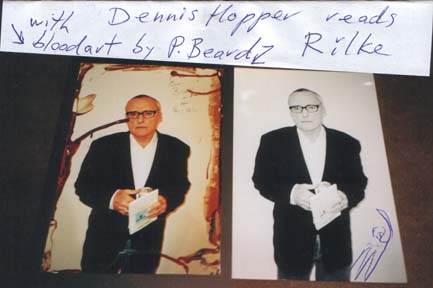
Musical group New York Voices released a CD entitled "Ancient Tower" featuring actress Meryl Streep reading Rilke's poetry to music.
Classical violinist Anne Sofie-Mutter has named Rilke as a favorite poet.
Country Musician Ray Wylie Hubbard names Rilke as an inspiration in this NPR interview.
CSI actor Ed Gordon was inspired by Rilke in the creation of his recent book "Letters to a Young Brother: Manifest Your Destiny."
Peter Carey's recent novel My Life as a Fake features a Rilke enthusiast as a principal character.
Audrey Niffeneger's The Time Traveler's Wife includes Rilke allusions that are integral to the story.
In his "New Year Letter," W.H. Auden famously (and, contrary to popular belief, not disparagingly) called Rilke "The Santa Claus of lonleliness." He made another reference to Rilke in "Twenty-third Sonnet" (In Time of War):
"Let us remember all who seemed deserted. / Tonight in China let me think of one, // Who through ten years of silence worked and waited, / Until in Muzot all his powers spoke, / And everything was given once for all: // And with the gratitude of the Completed / He went out in the winter night to stroke / That little tower like a great animal."
(The following Auden quote, by the by, would serve as a very apt epigraph to Lost Son: "Art is our chief means of breaking bread with the dead.")
Rilke is the subject of an essay by J.M. Coetzee in Coetzee's book Stranger Shores.
A character reads Letters to a Young Poet in the first chapter of Chris Abani's novel, Graceland.
The first full English translation of Rilke's famous correspondence with Lou Andreas-Salomé was published by W.W. Norton last year. It is noted here in The New Yorker.
And the following Rilke connections from Wikipedia:
Rilke has been celebrated in Thomas Pynchon's Gravity's Rainbow and William Gaddis' voluminous novel The Recognitions, and is referred to in Julia Alvarez's novel How the García Girls Lost Their Accents.
J.D. Salinger alludes to Rilke in various works, including Franny and Zooey.
Douglas Coupland quotes Rilke's Letters To A Young Poet in Generation X: Tales for an Accelerated Culture.
A Rilke translation inspired Lost in Translation, a celebrated 1974 poem by James Merrill.
Rilke has been celebrated in Thomas Pynchon's Gravity's Rainbow and William Gaddis' voluminous novel The Recognitions, and is referred to in Julia Alvarez's novel How the García Girls Lost Their Accents.
J.D. Salinger alludes to Rilke in various works, including Franny and Zooey.
Douglas Coupland quotes Rilke's Letters To A Young Poet in Generation X: Tales for an Accelerated Culture.
A Rilke translation inspired Lost in Translation, a celebrated 1974 poem by James Merrill.
Rilke is mentioned in Tennessee William's "The Two-Character Play."
German philosopher Martin Heidegger cites Rilke as an example of the highest form of thinker in his essay "What Are Poets For?" The essay's theme is largely explored through the examination of an "improvised verse" (short poem) Rilke wrote in 1924. Heidegger, sometimes considered the most influential German thinker of the 20th century, ranks Rilke in the German poetic tradition as second only to Holderlin.
Erie Chapman cites Rilke frequently in his essays on caregiving.
In the world of film:
Rilke's poem "The Panther" is quoted in the 1990 film Awakenings (starring Robert DeNiro and based on the 1973 book by neurologist and author Oliver Sacks), expressing the emotional undertone of the story.
In the 1993 movie Sister Act 2: Back in the Habit, actress Whoopi Goldberg refers to Rilke's Letters to a Young Poet. That work is also a topic of conversation between several characters in the 2002 movie Igby Goes Down.
Rilke is quoted in Kissing Jessica Stein by a woman looking for a woman in a personal ad. This quote is what moves the main character, Jessica, to answer the ad, despite her presumed heterosexuality.
Rilke's poem "Archaic Torso of Apollo" is quoted by Miriam, played by Gena Rowlands, in Woody Allen's 1998 film Another Woman. Additionally, "Rain," the Juliette Lewis character in "Husbands and Wives" is named after Rilke.
Rilke's poem "You Who Never Arrived" is quoted by Faith, played by Marisa Tomei, in Norman Jewison's 1994 film Only You.
"For the sake of a single poem," an animated short by Shamik Majumdar, a contemporary Indian Animation Film Designer, is based on an excerpt from Rilke's book, The Notebooks of Malte Laurids Brigge.
In the world of music:
The indie rock band Rainer Maria takes its name from Rilke, and at least some of their merchandise bears the poet's image.
The Cocteau Twins song "Rilkean Heart", on the 1996 album Milk and Kisses, is an homage to Jeff Buckley who was a life long lover of Rilke's work.
The Russian composer Dmitri Shostakovich set several of Rilke's poems to music in his Symphony No. 14.
In the world of music:
The indie rock band Rainer Maria takes its name from Rilke, and at least some of their merchandise bears the poet's image.
The Cocteau Twins song "Rilkean Heart", on the 1996 album Milk and Kisses, is an homage to Jeff Buckley who was a life long lover of Rilke's work.
The Russian composer Dmitri Shostakovich set several of Rilke's poems to music in his Symphony No. 14.
The American contemporary composer Morten Lauridsen set Rilke's poem "Les Chansons des Roses" to music.
Pianist Brad Mehldau and vocalist Renee Fleming released an album in which some of the songs are set to Rilke's poems in 2006.
In the world of the church:
Rilke's poem "You, Neighbour God" (from “The Book of Hours”) is included in the most commonly used edition of Liturgy of the hours.
Rilke's poetry is often referenced in the writings of contemporary spiritual teachers such as Jack Kornfield and Stephen Levine.
In the world of the church:
Rilke's poem "You, Neighbour God" (from “The Book of Hours”) is included in the most commonly used edition of Liturgy of the hours.
Rilke's poetry is often referenced in the writings of contemporary spiritual teachers such as Jack Kornfield and Stephen Levine.
Monday, February 26, 2007
What is Lost Son About? I. (Periodic Answers to an Unanswerable Question)
Beginning today, I will be posting periodic replies to the question: "What is Lost Son about?" It's a question as inevitable as it is impossible to answer definitively, because the responses it might elicit from me will change as my own relationship to the novel evolves (and as I come to better understand the book myself).
On the surface, of course, Lost Son is about Rainer Maria Rilke. His life, his work, his loves and friendships and memories and torments and triumphs. But were the question as easily answerable as this, I might not have written the novel at all. Over its five-year gestation period, Lost Son has been driven by more numerous, more elusive, and hopefully more widely resonant impulses than a wish to novelize the great poet's biography.
For this first post, Rilke's work itself provides something of a response. This quote from The Notebooks of Malte Laurids Brigge might have served as a relevant epigraph for Lost Son. In a way, the novel's dilemmas are all here: the loneliness of The Poet in this world. His somber restlessness. And a certain need for him to stand in stupefaction before his own destiny, in order to speak of it evocatively...
"And one has nobody and nothing and travels about in the world with a suitcase and with a trunk full of books and really without curiosity. What kind of life is this anyway? -- without house, without inherited things, without dogs.
"Still, if one had at least one's memories. But who has those? If a chilhood were there...it's like something buried. Perhaps one must be old in order to reach back to all that. I think it's good to be old."
On the surface, of course, Lost Son is about Rainer Maria Rilke. His life, his work, his loves and friendships and memories and torments and triumphs. But were the question as easily answerable as this, I might not have written the novel at all. Over its five-year gestation period, Lost Son has been driven by more numerous, more elusive, and hopefully more widely resonant impulses than a wish to novelize the great poet's biography.
For this first post, Rilke's work itself provides something of a response. This quote from The Notebooks of Malte Laurids Brigge might have served as a relevant epigraph for Lost Son. In a way, the novel's dilemmas are all here: the loneliness of The Poet in this world. His somber restlessness. And a certain need for him to stand in stupefaction before his own destiny, in order to speak of it evocatively...
"Und man hat niemand und nichts und fährt in der Welt
herum...
"And one has nobody and nothing and travels about in the world with a suitcase and with a trunk full of books and really without curiosity. What kind of life is this anyway? -- without house, without inherited things, without dogs.
"Was für ein Leben ist das eigentlich…
"Still, if one had at least one's memories. But who has those? If a chilhood were there...it's like something buried. Perhaps one must be old in order to reach back to all that. I think it's good to be old."
Wednesday, February 21, 2007
Tuesday, February 20, 2007
Du Einsamster: You Lonely One -- (A Translation from Rilke's The Notebooks of Malte Laurids Brigge)
"Young man anywhere, in whom something is rising up that causes you to shiver, make use of the fact that no one knows you.
And if they contradict you -- those who take you for a nobody; and if they give you up completely -- those with whom you would associate; and if they pretend you don't exist on account of your dear ideas: what is this clear danger, which holds you together inside yourself, compared to the cunning hostilty of later fame, which makes you impotent by scattering you.
Beg no one to speak of you, not even contemptuously.
And when time goes by and you mark your name coming around amongst people, take it no more seriously than everything else you find in their mouths. Think: it has become poorly. And put it away from you. Take another name, any, so that God can call you in the night. And hide it from everyone."
Die Aufzeichnungen des Malte Laurids Brigge (1910)
Junger Mensch irgendwo, in dem etwas aufsteigt, was ihn erschauern macht, nütz es, daß dich keiner kennt...
And if they contradict you -- those who take you for a nobody; and if they give you up completely -- those with whom you would associate; and if they pretend you don't exist on account of your dear ideas: what is this clear danger, which holds you together inside yourself, compared to the cunning hostilty of later fame, which makes you impotent by scattering you.
Beg no one to speak of you, not even contemptuously.
Bitte keinen, daß er von dir spräche, nicht einmal verächtlich...
And when time goes by and you mark your name coming around amongst people, take it no more seriously than everything else you find in their mouths. Think: it has become poorly. And put it away from you. Take another name, any, so that God can call you in the night. And hide it from everyone."
Die Aufzeichnungen des Malte Laurids Brigge (1910)
Tuesday, February 06, 2007
Letters to A Young Poet, Letters to a Ghost
I was fourteen years old when my mother, somehow recognizing my writerly inclinations in a way I could not, put into my hands a copy of Rainer Maria Rilke’s Letters to a Young Poet. It was a thin, feather-light edition of Stephen Mitchell’s marvelous English translation. I didn’t like the cover with its bright colors and gaudy font, but upon opening to the first letter of February 1903 I promptly experienced what nearly three generations of readers had experienced before me: the unshakable sense that this missive was addressed directly to me. Come twilight I’d finished the book, and already I wanted to learn more about this letter-writer from ninety years past who seemed to know so much about me and the counsel I so desperately needed in my current day. I could not have known what a lasting presence this literary specter would become in my life, nor how he would haunt my decision to become a writer.
Now, fourteen years and several thousands of travel-miles later, I find I’m the author of a novel about Rainer Maria Rilke’s troubled, triumphant life. Lost Son depicts Rilke in the drive of his all-consuming art as it carries him back and forth across western Europe over the course of fifteen intensely restless years. Perhaps more than any poet of the western world, Rilke was incapable of living one life as a man, another as a poet. Here was a soul who completely lacked the useful mechanism most of us employ to close ourselves off from certain experiences or stimuli for our own well-being. Uncontrollably, every impression penetrated him to his core and became an almost physical vibration within him. It’s as if he was genetically predisposed to poetry--to those profound resonances of which poetry is made. But this resulted in an extreme, at times incapacitating vulnerability to the outer world, and Rilke soon discovered that his sole method of self-preservation would be to control his environment and withdraw into his work as much as possible. Rilke's need to live and breathe his art rendered his loyalties to family and friends extremely complex, and kept him perpetually unprotected, homeless, and poor. It gave him, however, his best poetic works—not a few of which are held to be among the greatest in the world today.
Rilke’s writings, in their powerful and pungent synthesis of mystery, terror, and praise, hold a resonance like no other literary work I know of. The life behind the work tells its own strange, troubling and inspiring story of long sacrifice and sudden moments of transcendence. Rilke’s figure continues to haunt me. Lost Son is the novel I felt I most needed to write in these initial years of my own life as an artist. The book is in many ways the result of a long conversation with a master, a ghost. A reply, perhaps, to those letters I first read at fourteen and felt to be written to me across the span of a century. And hopefully Lost Son is a story of deep, multidimensional humanity.
Now, fourteen years and several thousands of travel-miles later, I find I’m the author of a novel about Rainer Maria Rilke’s troubled, triumphant life. Lost Son depicts Rilke in the drive of his all-consuming art as it carries him back and forth across western Europe over the course of fifteen intensely restless years. Perhaps more than any poet of the western world, Rilke was incapable of living one life as a man, another as a poet. Here was a soul who completely lacked the useful mechanism most of us employ to close ourselves off from certain experiences or stimuli for our own well-being. Uncontrollably, every impression penetrated him to his core and became an almost physical vibration within him. It’s as if he was genetically predisposed to poetry--to those profound resonances of which poetry is made. But this resulted in an extreme, at times incapacitating vulnerability to the outer world, and Rilke soon discovered that his sole method of self-preservation would be to control his environment and withdraw into his work as much as possible. Rilke's need to live and breathe his art rendered his loyalties to family and friends extremely complex, and kept him perpetually unprotected, homeless, and poor. It gave him, however, his best poetic works—not a few of which are held to be among the greatest in the world today.
Rilke’s writings, in their powerful and pungent synthesis of mystery, terror, and praise, hold a resonance like no other literary work I know of. The life behind the work tells its own strange, troubling and inspiring story of long sacrifice and sudden moments of transcendence. Rilke’s figure continues to haunt me. Lost Son is the novel I felt I most needed to write in these initial years of my own life as an artist. The book is in many ways the result of a long conversation with a master, a ghost. A reply, perhaps, to those letters I first read at fourteen and felt to be written to me across the span of a century. And hopefully Lost Son is a story of deep, multidimensional humanity.
Lost Son on MySpace
Visit the new MySpace page for Lost Son (if you can stand the flashing advertisements).
Friday, February 02, 2007
Paris Notes: Rilke, Malte Laurids Brigge, and the Latin Quarter Today
As noted in my previous blog post, Lost Son began as a series of journals in which I often directly addressed my main character, Rainer Maria Rilke. Here follows another entry from those journals. In this one, I began addressing Rilke's imaginary character Malte Laurids Brigge. The entry reveals a little about my process of imagining my way through contemporary Paris into the city Rilke (and Malte) knew, namely: Paris between 1902 and 1909, the years during which Rilke wrote Malte's story in the great novel, The Notebooks of Malte Laurids Brigge. Though this and other such entries do not appear in Lost Son, I feel that they somehow continue to permeate the book...
Paris: the word has now become an insignia on a postcard, a cliché, a simple idiom for earthly pleasure. But what of Paris as you knew it? Can one even see that world in this one?—this city of innumerable camera flashes and riverboat dinners and mid-bridge kisses, city whose only sighs are those of the soon-to-depart. Do the poor, the hopeful and hopeless destitute, still find themselves packed into the cramped hostelries along the river?
The streets are not acrawl with them these days, at least not within a mile or so radius of the Ile de la Cité (though walk out along the Canal Saint Martin, as I did yesterday, and you might reconsider). Here in your Latin Quarter, they sometimes proclaim themselves with signs—black letters smudged onto flaps of cardboard; and sometimes one sees them dragging about the sidewalks or lurking in doorways, asking for nothing. But the boulevard Saint Michel, in its new sterilized brightness, only reluctantly yields up its memory of the man with the Saint Vitus’ Dance, that ragdoll figure whom you watched with gorgonized awe and later gave to your fictional second self, Malte Laurids Brigge, to evoke in his troubled notebooks.
No, one no longer sees such figures as if seeing a great scream personified. But such figures do remain, just beneath the surface dignity of these clean-swept boulevards, beneath Haussmann’s elegant housefronts. And they are most definitely to be found, like the wastage of long-since defeated, long-since scattered armies, in the twisting streets set back from the river and confettied with rubbish. They’re in every city, no doubt, shall always be. Malte’s disgraced kin—the poor and cursed urbanites who occasioned him to anoint the first blank page of his notebook with those agitated words:
“So, people do come here to live. I would have sooner thought that this is where one dies.”
Already I’ve seen much of these figures—and the conditions on these city streets have greatly improved since yours and Malte’s arrival one hundred years ago, so I can only imagine the things you saw then.
May I tell Malte what I’ve seen in a month’s time, and thereby reveal to him something?…something. Perhaps he’d like to know that the grim spectacles he beheld daily were more than the phantasms of his dark soul. That even today one may witness such things in Paris. So Malte, I hope you’ll find it assuring that I have seen:
…the graying slack-sided man who appeared to suffer so much in the mere act of motion. He seemed to have lost his cane or leg-braces. He was just outside the gate of the Hôtel des Invalides when I saw him. Groping along the wall with splayed hands, his spine bowing backward in the effort to free himself of the wall. To walk.
He wasn’t an extremely old man—just gray-haired, like many not-so-old men. His stiffness seemed to be coming from somewhere outside or just above him; it seemed he was hemmed in by some invisible man-size flange made of most inflexible rubber. A number of people streamed past him and crossed the expansive front grounds to the church door. He hardly noticed them. All his focus was fixed in that labor of getting to the gate—the gate through which those others glided like birds.
I asked myself what you might have asked, Malte. Can it be that some persons, some very small number, are cursed by an imbalance of the blood or the brain or the inner ear to bear gravity’s effect at a volume exponentially greater than most? Because it was something like that with this man.
And then it struck me that the man might well be significantly younger than he looked, but the pressure, the incessant pressure, was speeding the clockworks inside him. I’d been waiting for a traffic light to change and now it was time to cross. In a final glimpse I saw him unmooring himself from the wall and starting forward with tiny, slow, hard-won steps. Before him lay the vast open grounds of the Invalides complex, and high above him the gilded dome stood up in mute and grand neutrality.
There was also this, Malte:
...the man with jowls as loose and pendulous as a winded dog’s. He was crossing the pretty little Place Maubert where the pretty fountain patters, and beyond his slightly disheveled jacket and shirt he was perfectly unremarkable. But when he came closer I saw the white, beaded strings of slaver swaying from his unfurled bottom lip. He brushed past me with a glazed stare toward the gutters, a stare that might—to somebody not looking very closely—appear pensive.
And this:
...the brawny balding man with the sunned skull and the heavy, very capable hands, lying unconscious on his back on the clean sidewalk in the rue de l’Estrapade. Flat on his back in front of the artful ironwork gates of that one bright patrician house, the one that looks like a guidebook photograph. And he wasn’t sidled up to the gate, either—no, he was sprawled at the center of the pavement, a great X of a body, like someone who had fallen from some unreckonable height....
(continue reading this entry in Part II, "Paris Notes Continued," below)
“It ripped me out of myself and put me into their lives, through all their lives, through and through all their beleaguered lives. Often I had to say aloud to myself: I am not one of them, I am going to leave this frightful city in which they will die.”
Rainer Maria Rilke to Lou Andreas-Salomé – July 18, 1903
… Rue Linné, Paris V: the presentRainer Maria Rilke to Lou Andreas-Salomé – July 18, 1903
Paris: the word has now become an insignia on a postcard, a cliché, a simple idiom for earthly pleasure. But what of Paris as you knew it? Can one even see that world in this one?—this city of innumerable camera flashes and riverboat dinners and mid-bridge kisses, city whose only sighs are those of the soon-to-depart. Do the poor, the hopeful and hopeless destitute, still find themselves packed into the cramped hostelries along the river?
The streets are not acrawl with them these days, at least not within a mile or so radius of the Ile de la Cité (though walk out along the Canal Saint Martin, as I did yesterday, and you might reconsider). Here in your Latin Quarter, they sometimes proclaim themselves with signs—black letters smudged onto flaps of cardboard; and sometimes one sees them dragging about the sidewalks or lurking in doorways, asking for nothing. But the boulevard Saint Michel, in its new sterilized brightness, only reluctantly yields up its memory of the man with the Saint Vitus’ Dance, that ragdoll figure whom you watched with gorgonized awe and later gave to your fictional second self, Malte Laurids Brigge, to evoke in his troubled notebooks.
No, one no longer sees such figures as if seeing a great scream personified. But such figures do remain, just beneath the surface dignity of these clean-swept boulevards, beneath Haussmann’s elegant housefronts. And they are most definitely to be found, like the wastage of long-since defeated, long-since scattered armies, in the twisting streets set back from the river and confettied with rubbish. They’re in every city, no doubt, shall always be. Malte’s disgraced kin—the poor and cursed urbanites who occasioned him to anoint the first blank page of his notebook with those agitated words:
“So, people do come here to live. I would have sooner thought that this is where one dies.”
Already I’ve seen much of these figures—and the conditions on these city streets have greatly improved since yours and Malte’s arrival one hundred years ago, so I can only imagine the things you saw then.
May I tell Malte what I’ve seen in a month’s time, and thereby reveal to him something?…something. Perhaps he’d like to know that the grim spectacles he beheld daily were more than the phantasms of his dark soul. That even today one may witness such things in Paris. So Malte, I hope you’ll find it assuring that I have seen:
…the graying slack-sided man who appeared to suffer so much in the mere act of motion. He seemed to have lost his cane or leg-braces. He was just outside the gate of the Hôtel des Invalides when I saw him. Groping along the wall with splayed hands, his spine bowing backward in the effort to free himself of the wall. To walk.
He wasn’t an extremely old man—just gray-haired, like many not-so-old men. His stiffness seemed to be coming from somewhere outside or just above him; it seemed he was hemmed in by some invisible man-size flange made of most inflexible rubber. A number of people streamed past him and crossed the expansive front grounds to the church door. He hardly noticed them. All his focus was fixed in that labor of getting to the gate—the gate through which those others glided like birds.
I asked myself what you might have asked, Malte. Can it be that some persons, some very small number, are cursed by an imbalance of the blood or the brain or the inner ear to bear gravity’s effect at a volume exponentially greater than most? Because it was something like that with this man.
And then it struck me that the man might well be significantly younger than he looked, but the pressure, the incessant pressure, was speeding the clockworks inside him. I’d been waiting for a traffic light to change and now it was time to cross. In a final glimpse I saw him unmooring himself from the wall and starting forward with tiny, slow, hard-won steps. Before him lay the vast open grounds of the Invalides complex, and high above him the gilded dome stood up in mute and grand neutrality.
There was also this, Malte:
...the man with jowls as loose and pendulous as a winded dog’s. He was crossing the pretty little Place Maubert where the pretty fountain patters, and beyond his slightly disheveled jacket and shirt he was perfectly unremarkable. But when he came closer I saw the white, beaded strings of slaver swaying from his unfurled bottom lip. He brushed past me with a glazed stare toward the gutters, a stare that might—to somebody not looking very closely—appear pensive.
And this:
...the brawny balding man with the sunned skull and the heavy, very capable hands, lying unconscious on his back on the clean sidewalk in the rue de l’Estrapade. Flat on his back in front of the artful ironwork gates of that one bright patrician house, the one that looks like a guidebook photograph. And he wasn’t sidled up to the gate, either—no, he was sprawled at the center of the pavement, a great X of a body, like someone who had fallen from some unreckonable height....
(continue reading this entry in Part II, "Paris Notes Continued," below)
Paris Notes Continued
(continued from above, Paris Notes: Rilke, Malte Laurids Brigge, and the Latin Quarter Today)
A drizzle had started: sidewalks and cobblestones all splattered with dark, ponderous droplets. There was no getting past the man except by crossing the street; he lay completely in my path, face-up in the drizzle with his big workman’s hands flung out at both sides and rain falling into the blemished palms. He didn’t appear to stir in the least to that coolness on his face. Next to the blue number of a house three or four doors down an engraved plaque was hung which reported, with nearly implausible irrelevance: “Denis Diderot, that great mind of the French Enlightenment, lived here at such-and-such a date.”
What more? There were many…
…the little dark-skinned man whose upper body was disfigured to the shape of a crescent moon. He was at the corner of the rue Cardinal Lemoine and the boulevard Saint Germain when I saw him. Pacing back and forth with a cigarette in his hand. He kept turning and turning on mincing feet: two tentative steps this way, two that way—as though confined in the tiny box of pain that each movement erected around him, as though expecting again and again to find the pain diminished by a simple about-face, again and again coming hard against the pain. The stubby cigarette kept jumping to his lips—quick pert little puff, then down again. He was neatly dressed: a good thick shirt well fitted to his scoliotic trunk and tucked smartly into his trousers. But he looked confused, seized by that distinctive confusion of people lost within themselves. He was still moving back and forth with those little satyr-like steps when I reached the quay two blocks ahead and rounded the corner.
And this, just last night:
...the tawny man on the Pont de la Tournelle: dressed all in brown, and brown himself, his pale skin seized in filth as in tarnished copper.
He was standing against the stone wall of the bridge with one shrunken hand cupped before him—not held forth in confident need—no, but kept close against his jacket, the fingers curled, the plea of the concave palm barely apparent. At his back was Notre Dame. I was watching the vaporous twilight behind the cathedral towers and didn’t notice the man till I’d passed within a few feet of him. He was standing extremely erect, as if rigid with an effort to press himself out of sight, to blend into the waist-high stone wall. Yet his need remained. His need kept his hand aloft in its dimly remembered gesture. There was a tall streetlamp beside him. It flickered aglow with all the other ones along the quay and with those huge nightlamps that enhalo the great cathedral—flickered just as I was going by him. I saw the shapeless bulk of his face: the knife-thin slits where he’d squeezed shut his eyes. He could no longer so much as look to see who his benefactors might be. He was far inside himself and it was purely obligatory to stand there in accord with his body’s need, to permit the hand to importune; he had no part in it. His lips were drawn back, his teeth bared in a deep-breathing grimace. And this was the most painful part of it: he was snuffling, or panting, or giggling—I couldn’t tell which. Sharp spasmodic sibilations almost like words, but not words. None of these people use mere words; Malte, you know this only too well.
I went past the man (just like everyone went past him) and down the stone stairs to the quay where twilight people were loitering in the mild river air. I sat down and watched the boats go by. Sat for an hour or so. And the man remained on the bridge above me. I kept looking up and seeing his brown back and inert shoulders, his brown head turning neither left nor right. The colored lights had come on in the arches of the bridge: bright colors, but they somehow shed a tainted haze. The man stood motionless in the urinous gleam. People went by him. At length I looked up again and he was gone.
But Malte, I may wonder in my time as you did in yours: in what niche does such a man carve his bed by night? Where is the place he returns to? We wonder because wondering gains us a share in the destinies of strangers—and what could better suit the work we do?
Or maybe the man hadn’t gone. Maybe he’d just lain down below the wall where I couldn’t see.
Goodnight, Paris. Goodnight city toward which so much envy flows from all corners of the earth. Again your streets will coil in their knotted courses around me as I sleep. But I am hindered by the labyrinth no more; I’ve long since surrendered. Tomorrow I’ll tarry again. It need not matter that I am lost.
A drizzle had started: sidewalks and cobblestones all splattered with dark, ponderous droplets. There was no getting past the man except by crossing the street; he lay completely in my path, face-up in the drizzle with his big workman’s hands flung out at both sides and rain falling into the blemished palms. He didn’t appear to stir in the least to that coolness on his face. Next to the blue number of a house three or four doors down an engraved plaque was hung which reported, with nearly implausible irrelevance: “Denis Diderot, that great mind of the French Enlightenment, lived here at such-and-such a date.”
What more? There were many…
…the little dark-skinned man whose upper body was disfigured to the shape of a crescent moon. He was at the corner of the rue Cardinal Lemoine and the boulevard Saint Germain when I saw him. Pacing back and forth with a cigarette in his hand. He kept turning and turning on mincing feet: two tentative steps this way, two that way—as though confined in the tiny box of pain that each movement erected around him, as though expecting again and again to find the pain diminished by a simple about-face, again and again coming hard against the pain. The stubby cigarette kept jumping to his lips—quick pert little puff, then down again. He was neatly dressed: a good thick shirt well fitted to his scoliotic trunk and tucked smartly into his trousers. But he looked confused, seized by that distinctive confusion of people lost within themselves. He was still moving back and forth with those little satyr-like steps when I reached the quay two blocks ahead and rounded the corner.
And this, just last night:
...the tawny man on the Pont de la Tournelle: dressed all in brown, and brown himself, his pale skin seized in filth as in tarnished copper.
He was standing against the stone wall of the bridge with one shrunken hand cupped before him—not held forth in confident need—no, but kept close against his jacket, the fingers curled, the plea of the concave palm barely apparent. At his back was Notre Dame. I was watching the vaporous twilight behind the cathedral towers and didn’t notice the man till I’d passed within a few feet of him. He was standing extremely erect, as if rigid with an effort to press himself out of sight, to blend into the waist-high stone wall. Yet his need remained. His need kept his hand aloft in its dimly remembered gesture. There was a tall streetlamp beside him. It flickered aglow with all the other ones along the quay and with those huge nightlamps that enhalo the great cathedral—flickered just as I was going by him. I saw the shapeless bulk of his face: the knife-thin slits where he’d squeezed shut his eyes. He could no longer so much as look to see who his benefactors might be. He was far inside himself and it was purely obligatory to stand there in accord with his body’s need, to permit the hand to importune; he had no part in it. His lips were drawn back, his teeth bared in a deep-breathing grimace. And this was the most painful part of it: he was snuffling, or panting, or giggling—I couldn’t tell which. Sharp spasmodic sibilations almost like words, but not words. None of these people use mere words; Malte, you know this only too well.
I went past the man (just like everyone went past him) and down the stone stairs to the quay where twilight people were loitering in the mild river air. I sat down and watched the boats go by. Sat for an hour or so. And the man remained on the bridge above me. I kept looking up and seeing his brown back and inert shoulders, his brown head turning neither left nor right. The colored lights had come on in the arches of the bridge: bright colors, but they somehow shed a tainted haze. The man stood motionless in the urinous gleam. People went by him. At length I looked up again and he was gone.
But Malte, I may wonder in my time as you did in yours: in what niche does such a man carve his bed by night? Where is the place he returns to? We wonder because wondering gains us a share in the destinies of strangers—and what could better suit the work we do?
Or maybe the man hadn’t gone. Maybe he’d just lain down below the wall where I couldn’t see.
Goodnight, Paris. Goodnight city toward which so much envy flows from all corners of the earth. Again your streets will coil in their knotted courses around me as I sleep. But I am hindered by the labyrinth no more; I’ve long since surrendered. Tomorrow I’ll tarry again. It need not matter that I am lost.
Friday, January 19, 2007
Rilke's Sanctuary: Gaining Entry
Last week found me in Seattle for a stay of several days, during which time I got to spend a good many hours in the surreal, steely grandeur of the new King County Central Library.
 It started me thinking about libraries (which I try to visit whenever I find myself in a new city), and about one great European library in particular.
 Lost Son began as a series of journals in which I sought to dream up the particularities of Rilke’s life, reaching for an approximation of the workings of his everyday consciousness, noting down important facts and details regarding the historical moment of my story, the poet’s biography, or the character of a place. This free-form notebook process resulted in a number of first-person journal entries in which I addressed the poet directly, imagining myself in conversation with him, even fictionalizing myself to a great degree in order to get as close as possible to the fictional Rilke I was creating -- as close as possible to the tiniest, most personal ramifications of an experience had by Rilke, which my novel might dramatize.
I was afraid they wouldn’t let me in. Weren’t you, also, afraid when you first came here in that disturbed Autumn of 1902? Weren’t you submerged by the institutional grandeur, the stony inner-dusk of the reception hall?—afraid the library wardens would find you, despite the purity of your aims, ineligible for access?
You would explain that you were doing research for a monograph about their great sculptor, but maybe even that would not suffice, for you clearly lacked the brio, the forceful élan of an academic. But thank God: your publisher had written you a letter; your intentions were certified, rendered official.
And how would you have comported yourself in the absence of a letter?
It’s important, for one like me, to wonder such things from this obscure future of mine…
For I was intimidated, yes. How could I explain that I had no very particular use for this library, nothing particular to research?—that all I really wanted was time in this great reading room? Your reading room. Malte’s…Well, maybe I encouraged them to believe I had specific scholarly objectives, or at least did nothing to dispel the impression.
Anyway, they’ve let me in. I have been given leave to sit here like Malte, like you before him, and to read a poet. You and he read Francis Jammes, but I am reading you. What would you think of that?—that I’ve been sitting here in this enormous vaulted chamber in the center of Paris on a day more than a century after you first sat here, under the same opaque oval skylight of the ceiling, and have been reading my English translation of your wonderful, terrible book?
The novel lies close at hand now, its titled cover bared to the ceiling’s natural light, displayed for anyone to see. And who among these many ‘lecteurs’ will recognize the title as they pass along the aisle behind me? Who among them will suffer the quiet unsettlement of recognizing this name, Malte, this book whose existence owes much to this room, this old salle de références? For it was here that an obscure young foreigner, an empty-pocketed poet of twenty-six, was given leave to linger amongst piles and piles of books. (“Probably the most extensive in the world” says your Baedeker of this bibliothèque.) How does that change a place?—that it became a place where an artist with few other hopes, an artist destined to long struggle and distant achievement, found harbor for a while?
Here is Malte:
It started me thinking about libraries (which I try to visit whenever I find myself in a new city), and about one great European library in particular.While working in Paris on Lost Son, my new novel about Rainer Maria Rilke, I had occasion to visit the elegant old Bibliothèque Nationale in the rue de Richelieu on the Right Bank. This was a place of great importance to Rilke in his critical days as a poor, struggling, unknown poet and foreigner in Paris. The reading room here became his sanctuary amidst the oppressive squalor and anonymity of the city. And in his novel, The Notebooks of Malte Laurids Brigge, Rilke made the reading room just as important to his poor, struggling alter ego, Malte.
Lost Son began as a series of journals in which I sought to dream up the particularities of Rilke’s life, reaching for an approximation of the workings of his everyday consciousness, noting down important facts and details regarding the historical moment of my story, the poet’s biography, or the character of a place. This free-form notebook process resulted in a number of first-person journal entries in which I addressed the poet directly, imagining myself in conversation with him, even fictionalizing myself to a great degree in order to get as close as possible to the fictional Rilke I was creating -- as close as possible to the tiniest, most personal ramifications of an experience had by Rilke, which my novel might dramatize.Most of those first-person notebook sections were excised from the material that made up the final manuscript of Lost Son. But they were an important part of my process, and I believe they helped create a powerful sense of intimacy in the finished novel. Often, too, these entries first delineated the questions that remain at the heart of Lost Son. Here’s one such notebook entry dealing with Rilke’s—and Malte’s—Paris library in its present day. I found it to be no simple task gaining admittance to the reading room, which is open only to serious researchers…
... Bibliothèque Nationale ...
I was afraid they wouldn’t let me in. Weren’t you, also, afraid when you first came here in that disturbed Autumn of 1902? Weren’t you submerged by the institutional grandeur, the stony inner-dusk of the reception hall?—afraid the library wardens would find you, despite the purity of your aims, ineligible for access?
You would explain that you were doing research for a monograph about their great sculptor, but maybe even that would not suffice, for you clearly lacked the brio, the forceful élan of an academic. But thank God: your publisher had written you a letter; your intentions were certified, rendered official.
And how would you have comported yourself in the absence of a letter?
It’s important, for one like me, to wonder such things from this obscure future of mine…
For I was intimidated, yes. How could I explain that I had no very particular use for this library, nothing particular to research?—that all I really wanted was time in this great reading room? Your reading room. Malte’s…Well, maybe I encouraged them to believe I had specific scholarly objectives, or at least did nothing to dispel the impression.
Anyway, they’ve let me in. I have been given leave to sit here like Malte, like you before him, and to read a poet. You and he read Francis Jammes, but I am reading you. What would you think of that?—that I’ve been sitting here in this enormous vaulted chamber in the center of Paris on a day more than a century after you first sat here, under the same opaque oval skylight of the ceiling, and have been reading my English translation of your wonderful, terrible book?
The novel lies close at hand now, its titled cover bared to the ceiling’s natural light, displayed for anyone to see. And who among these many ‘lecteurs’ will recognize the title as they pass along the aisle behind me? Who among them will suffer the quiet unsettlement of recognizing this name, Malte, this book whose existence owes much to this room, this old salle de références? For it was here that an obscure young foreigner, an empty-pocketed poet of twenty-six, was given leave to linger amongst piles and piles of books. (“Probably the most extensive in the world” says your Baedeker of this bibliothèque.) How does that change a place?—that it became a place where an artist with few other hopes, an artist destined to long struggle and distant achievement, found harbor for a while?
Here is Malte:
“I sit and read a poet. There are many people in the hall, but one doesn’t feel them. They are in the books…And I sit and have a poet. How’s that for a destiny. There are now perhaps three hundred people in the hall, reading. But it is impossible that each and every one has a poet (God knows what they have). Three hundred poets there are not. But see now—how’s this for a destiny—I, perhaps the most dejected of these readers, an outlander: I have a poet. Even though I am poor…”
The domed room is amurmur just now with vast cathedral-like noises that somehow help one to a restful state. For several hours already I’ve been awash in the luminous light from the panels overhead. Every few moments the light has changed character very slightly—from a clear bath-like tone to a flatter, bluish monochrome. If my notebook were an eye it would see me bent in this ellipsoidal surface of light, and around my skull the ageless names of cities twirling like a crown of thoughts. They are inscribed up there in an ornamental wreath. Clockwise, they read: Alexandrie ~ Londres ~ Babylone ~ Vienne ~ Thebes ~ Rome ~ Pekin ~ Jerusalem ~ Paris ~ Byzance ~ Washington ~ Florence ~ Athens ~ Nineve ~ Berlin ~ Alexandrie …
In the end my one book spoke for me and the library wardens gave me admittance in spite of my obvious trepidation, which might have caused them doubt. And what a marvel that was: to have a book and to let it speak!
But why do I feel afraid even now?—afraid they’ll discover I’m guilty of wanting so very little, wanting to just sit here and think on you and Malte and all these things and see how such thoughts help one who hopes to create.
In order to guard myself from undue scrutiny, Malte’s Notebooks are not the sole volume I’ve displayed on the table. For good measure I’ve emptied my bag of all three of its books: one of them an irreproachable hardcover opened to pages with sentences darkly underlined, margins annotated. In plain view amongst the books I’ve also laid my Bibliothèque Nationale researcher’s card. This bright yellow card bears a tiny color photo of me, taken at my researcher’s interview and reproduced instantaneously by computer. What a strange, stern image it is. I see locked in that face (a face surprisingly adult-like) the careful, guarded readiness of one prepared to prove himself. So much anticipative pressure still tense in those features, though the greatest trial—the trial of explaining oneself and one’s intentions (in halting French, of course)—had just been overcome, and leave to enter had been granted, and this picture was but a formality no different than my subsequent payment of researcher’s fees (4.5euro), in order for the coveted entrance to be made at last.
How do we explain ourselves? Perhaps that is the question I wanted most to explore in seeking access to this monumental reading room. Where is the place, the outer everyday place, in which young obscure ones can state simply their desires, their hopes, and find those things legitimized, let alone understood?
Do I overstate the predicament? Surely you wouldn’t think so. The universities that cherish you today, after all, were never your home. You lacked the distinction automatically conferred by scholarly achievements; lacked the fame that alone is the badge of an artist’s relevance in the world. Lacked, often, the proper citizenship…
Where are such a worker’s ‘salles de sanctuaire,’ his by-admittance-only zones—he who lacks this or that institution’s card? Lonely unratified one dressed again in yesterday’s clothing, he who has no name and carries no credentials, he whose shoes, like Malte’s, “are left in objectionable condition”, whose “beard looks somewhat neglected.”
Monday, December 04, 2006
Birthday of Rainer Maria Rilke (and where the new novel begins)
Today marks the 131st anniversary of the birth of Rainer Maria Rilke. I thought this would be an appropriately auspicious date to announce here that my new novel, Lost Son (forthcoming in May 2007), explores and evokes this magnificent poet's life.  Below are a few photos I took in the course of my early research for Lost Son. I started writing the novel in the summer of 2001, during some extensive European travel that I tailored as a Rilke pilgrimage of kinds. At the midpoint of my trip I arrived in Prague, the poet's birthplace.
 Above: a view of the Tyn Church, which towers above the old Staromĕstské Square, the throbbing center of the city. Below: the ancient Charles Bridge spanning the River Vltava.
 After my first full day spent wandering Prague, I wrote in my journal:


 Given the extremely restless spirit that kept Rilke in a state of wanderlust most of his life, it's no real surprise that one should have trouble "finding" him in any single location (particularly in our contemporary Europe) the way one "finds" Faulkner at Rowan Oak or Jane Austen in Bath. So as I traveled country to country in the poet's footsteps, I often found my research centering upon impressionistic stimuli: the character of a place or the quality of its light or the very specific sense that would be stirred in a sheltered little boy while, clinging to his mother's hand, he walked past these innumerable stone-carved faces of Prague.
Below are a few photos I took in the course of my early research for Lost Son. I started writing the novel in the summer of 2001, during some extensive European travel that I tailored as a Rilke pilgrimage of kinds. At the midpoint of my trip I arrived in Prague, the poet's birthplace.Above: a view of the Tyn Church, which towers above the old Staromĕstské Square, the throbbing center of the city. Below: the ancient Charles Bridge spanning the River Vltava.After my first full day spent wandering Prague, I wrote in my journal:"The streets are mad with tourists. Restless tangles of people. Strange smattering of sounds, sights, music, settings: pop songs in English blaring everywhere; Czech and German writing all over; Parisian-like cafe tables arranged before towering Bohemian edifices. The ancient, the modern, the provincial, the cosmopolitan, the charming and the tasteless all shoulder to shoulder here. It is hard to find Rilke in all the crush. But everywhere is the dogged fear that seems to have haunted his childhood. It is in the scrutiny of those contorted stone faces which peer silently, constantly, from the walls and high cornices of countless buildings."
Given the extremely restless spirit that kept Rilke in a state of wanderlust most of his life, it's no real surprise that one should have trouble "finding" him in any single location (particularly in our contemporary Europe) the way one "finds" Faulkner at Rowan Oak or Jane Austen in Bath. So as I traveled country to country in the poet's footsteps, I often found my research centering upon impressionistic stimuli: the character of a place or the quality of its light or the very specific sense that would be stirred in a sheltered little boy while, clinging to his mother's hand, he walked past these innumerable stone-carved faces of Prague.In a very important way, this more subtle form of research became extremely fruitful in my five-year process of writing Lost Son because it engendered a closeness to my main character, a personal experience, an intimacy of a kind that might have been precluded had my research placed me before this or that definitive, heavily trafficked monument. In the end, this very process of imaginative identification has become a major note in the chords that ring through Lost Son. I wanted the novel, more than being a book about a poet, to be a book about those delicate, mysterious processes that inform poetry or art in general. In other words: the processes that inform a peculiar and potent re-creation of feeling or experience. In Lost Son this carries over, even, into an exploration of how one goes about re-imagining the life of an artist who stands at the other side of a gaping century. How does one create and inhabit that past? I know of no figure who embodies these processes of imagination and re-creation more purely than Rainer Maria Rilke.
My travels in Europe that summer brought me at last to Rilke's final residence, the ancient Tower of Muzot in the Valais (Rhone Valley) of Switzerland. By then I had spent so much time dwelling upon the poet's strange, precarious existence that I actually did feel I had "found" him in this place.
 One night during my stay in the Valais, I drove from my hotel in the nearby village of Sierre out through the vineyards to Muzot. I parked and walked up and down the road, staring through the darkness at the tower. It was the third time in two days that I had driven there for no other reason than to walk about and stare, but it was my first time coming by night, and there was something very special about being at Muzot in the dark. In that night-graced tower Rilke had crowned his lifelong poetic accomplishment with the completion, during a single month, of the marvelous Sonnets to Orpheus and the mystic Duino Elegies. Muzot is still a private residence, owned by descendants of the Rilke patron who purchased the place for the poet in 1922. Inside, the tiny rooms remain furnished exactly as Rilke left them. The sutural windows glowed yellow that night.
Back at my hotel in Sierre I opened the shutters, sat down at a small round table, and wrote: "By silent evening I drive down the vineyard road to Muzot."
And now, five years later, that is how Lost Son begins.
Please check back here at Dispatches between now and publication date (May 20, 2007), as I post more about the novel and my journeys while writing it.
For now, in honor of the poet's birthday, here is Edward Snow's remarkable English rendition of Rilke's poem "From a Childhood" (The Book of Images, North Point Press, 1991):
The darkening was like treasures in the room
in which the boy, so deeply hidden, sat.
And when his mother entered as in a dream,
a glass trembled on the silent shelf.
She felt how the room was giving her away,
and kissed her boy: Are you here?...
Then both gazed fearfully toward the piano,
for many an evening she had a song
in which the child got strangely, deeply caught.
He sat stock still. His wide gaze hung
upon her hand, which, all weighed down by the ring,
as if it trudged through deep snowdrifts,
traveled over the white keys.
Friday, December 01, 2006
Indelible Moments in My Reading This Year
In light of the spate of "Best of 2006" lists now appearing throughout the literary world, I thought I’d put together my own more personal list. Here follow a few of my favorite things from the new, recent, and classic works I read this year. Twenty or so indelible beauties big and small...
*The man with the spike in his head in E.L. Doctorow’s The March.
*The stolen stocking and “The Exact Reminiscences of Emma Ruth Ross” in Karen Fisher’s A Sudden Country.
*The plague of locusts in Lloyd Zimpel’s A Season of Fire & Ice:
*The man with the spike in his head in E.L. Doctorow’s The March.
*The stolen stocking and “The Exact Reminiscences of Emma Ruth Ross” in Karen Fisher’s A Sudden Country.
*The plague of locusts in Lloyd Zimpel’s A Season of Fire & Ice:
 “The first of our visitors descend, no more than we might see on a normal summer’s day. They gaily leap, not so much flying as gliding for great distance: another leap, another glide. But behind these few scouts, the cloud unfolds, expands, becomes black as prairie smoke, as massive as the throngs of pigeons I have seen back East, spreads itself down on us; a crashing deluge, like buckets of hail crackling down. We have not finished tying cords around our sleeves and pants cuffs before they seethe over us, clinging for an instant and dropping away. The cowhides go thick with them, in overlapping layers, those on top covering those beneath, and another layer smothering those. Ma’s quilts seem to change colors as the insects swarm across.”
*Moths trapped in the muslin skirts of female harvesters in Thomas Hardy’s Tess of the D’Urbervilles.
*The disenfranchised Major and his wife in Henry James’ hilarious and heart-rending story “The Real Thing.”
*Friedrich Nietzsche sharing a rowboat with his boyhood self in Lance Olsen’s Nietzsche’s Kisses.
 *The Butler Stevens’ aim for greatness in Kazuo Ishiguro’s Remains of the Day.
*The gentle kindness shown by Edgar Degas to a dying Lydia Cassatt in Harriet Scott Chessman’s Lydia Cassatt Reading the Morning Paper: “ “How do you know you don’t?” he asks with quick urgency, his voice low. “How do you know you don’t labor towards something? You seem like one who must know about such effort.”
“I’m dying.”
“Oui. I know.”
“And I haven’t created anything. I have nothing to leave behind me.”
“But you allow yourself to be in the picture.” "
*Sylvia Plath’s hallucinatory dream sequence in the chapter, ‘Death & Co,’ in Kate Moses’ Wintering:
 “The line goes emphatically dead, blood bursting like a tomato out of the receiver, wetting her ear. She holds the phone away, horrified, as worms begin to rice out of the mouthpiece, flabby and flaccid, flapping in unison: pink fringe.”
*The sinister bathtub in Kassten Alonso’s Core. 
*The slow, savored soulfood meal administered by a black man of God to a reluctant and nihilistic white professor in Cormac McCarthy’s The Sunset Limited.
*The discovery by father and son of an old derelict diesel train long since stopped in its tracks in Cormac McCarthy’s The Road:
“They pushed into the cab and he blew away the ash from the engineer’s seat and put the boy at the controls. The controls were very simple. Little to do but push the throttle level forward. He made train noises and diesel horn noises but he wasn’t sure what these might mean to the boy. After a while they just looked out through the silted glass to where the track curved away in the waste of weeds. If they saw different worlds what they knew was the same. That the train would sit there slowly decomposing for all eternity and that no train would ever run again.”
*The inescapable nature of Barney in Adam Gopnik’s Paris to the Moon.
*Tonio’s lack of a passport, and his sole evidence of identity being proof sheets that bear his name in Thomas Mann’s Tonio Kröger.
*The entire intimate and sweeping tale of William Boyd’s Any Human Heart.
*The two drowned horses in Ivan Doig’s Dancing at the Rascal Fair.
*A troubled young man’s obsession with the mathematical question of imaginary numbers in Robert Musil’s Young Törless.
*The concentration camp scenes in reverse in Martin Amis’ Time’s Arrow.
*The house cut in half and rafted downriver in Jake Hawkes’ story, “Salvage” in Glimmer Train issue #61 (winter 2007)
 *The umbrella-powered rowboat as a means of escape from Italy to Switzerland in Ernest Hemingway’s A Farewell to Arms.
*The haunting passivity of Europeans during the Nazi rise to power in Mareille Marokvia’s Sins of the Innocent.
*Kellie Wells’ fabulous essay “Skirls and Skreaks: About Style and my Abiding Affection for Stanley Elkin” at the litblog co-op:
"This was, as I said, the era of minimalism, dirty (and otherwise) realism, and a lot of time was spent discussing the merits of letting a simple story tell itself, a story about the workaday travails of everyday people, spoken in a wallflower language that wouldn't draw attention to itself and certainly in a voice free of the falsifying adornment of free-wheeling, swaggering, rococo verbiage. There were two of us linguistic delinquents in that workshop at whom this weekly catechism was aimed and we politely listened to the tutorial, but despite the ongoing efforts of these earnest reformers to rein in our most unforgiving excesses, to purify our polluted aesthetics, we remained recalicitrant heathens to the end."
Monday, October 30, 2006
New Short Story Forthcoming...in Audio!
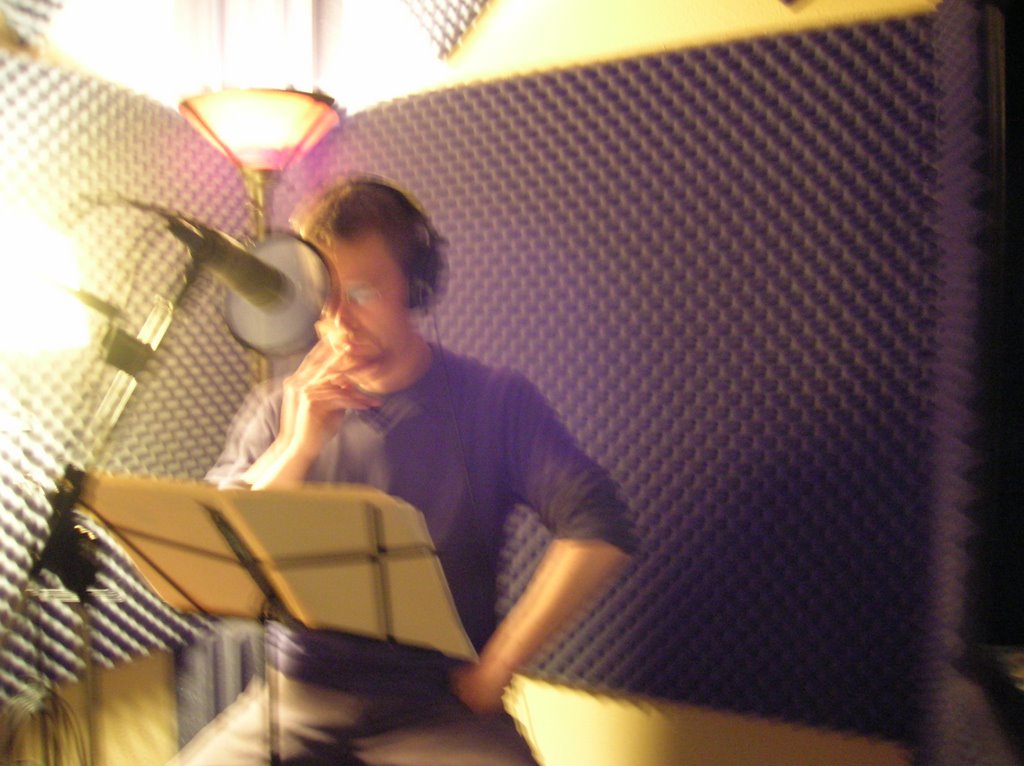
A few weeks ago, I spent a couple hours in a recording studio here in Portland, "laying down" (as they say) the audio for my short story "Date of Disappearance." The tale features one Mason Whipple in his erroneous attempts to stave off disaster in his marriage by way of "steely stirrups" and "a pinprick in a place he never hoped to sense one"... Look for it very soon in Verb Audioquarterly.
Friday, September 22, 2006
Sneak Peek (of sorts)
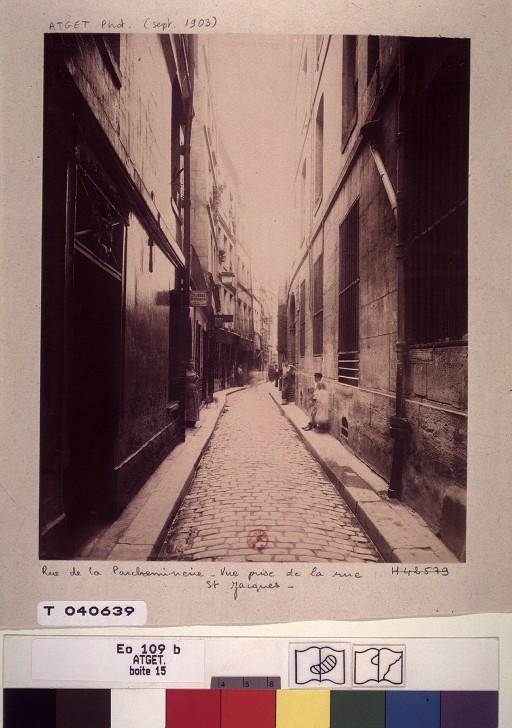
Here is a glimpse of the world of my forthcoming novel, courtesy of the great Parisian photographer Eugene Atget (and Bibliotheque Nationale de France). It's a view of a typical Latin Quarter street near the Sorbonne on a typical day in 1903. Enough said for now...
Tuesday, June 20, 2006
New Short Story in The Kenyon Review
The summer 2006 issue of the illustrious Kenyon Review contains my 26 page short story in 12 parts entitled "Twelve Monthly Devotions." The tale features a car-collecting preacher with a bedroom complex, a bench-pressing traveling evangelist who unsettles his whole universe, and a cameo by an excitable house cat who shows them both how it is...
Look for the issue at your local bookstore or library.
Monday, April 17, 2006
Beverly Hills Event: May 12, 2006
On Friday, May 12 2006, four of my short stories will be read aloud by professional stage & screen actors at the Beverly Hills Public Library as part of the 10th anniversary season of the New Short Fiction Series, "L.A.'s only live literary magazine!" The author will be in attendance.
The Details:
Fri. May 12, 2006 -- 8:00pm (doors at 7:30)
Things We Can't Untie -- short stories by M. Allen Cunningham
Beverly Hills Public Library Auditorium
444 N. Rexford Dr. (between Santa Monica Blvd & Burton Way)
Beverly Hills, CA
Admission $10
ABOUT THE STORIES:
"Pieta" : A diseased pelvis, a hard heart, and two estranged sisters. “...Dimension changes. Depth and distance and size seem no longer governed by any limiting force. And yet Lena is shrinking, disappearing, folding inward and backward...”
"The Next Cove" : A survival tale (of sorts). Young man and old together in a leaky dinghy. “...Once, coming up to toss the water, he glimpses the white aureole of steam flowing from the old man’s body, rising in a perfect spectral replica to blend into the sheet of rain...”
"Windmills" : A story of two kinds of loneliness.
“...I’ve never heard him like this, though his father’s funeral comes to mind. Anthony stood at the podium and cried and cried, wiping his cheeks and trying to speak, but just kept crying and finally had to sit down...”
"Date of Disappearance" : A man's flawed and flailing attempt to save a relationship. "...He's been lying here since morning in this ransacked bedroom aswarm with bees. Trouserless, ice packed at his groin..."
The Details:
Fri. May 12, 2006 -- 8:00pm (doors at 7:30)
Things We Can't Untie -- short stories by M. Allen Cunningham
Beverly Hills Public Library Auditorium
444 N. Rexford Dr. (between Santa Monica Blvd & Burton Way)
Beverly Hills, CA
Admission $10
ABOUT THE STORIES:
"Pieta" : A diseased pelvis, a hard heart, and two estranged sisters. “...Dimension changes. Depth and distance and size seem no longer governed by any limiting force. And yet Lena is shrinking, disappearing, folding inward and backward...”
"The Next Cove" : A survival tale (of sorts). Young man and old together in a leaky dinghy. “...Once, coming up to toss the water, he glimpses the white aureole of steam flowing from the old man’s body, rising in a perfect spectral replica to blend into the sheet of rain...”
"Windmills" : A story of two kinds of loneliness.
“...I’ve never heard him like this, though his father’s funeral comes to mind. Anthony stood at the podium and cried and cried, wiping his cheeks and trying to speak, but just kept crying and finally had to sit down...”
"Date of Disappearance" : A man's flawed and flailing attempt to save a relationship. "...He's been lying here since morning in this ransacked bedroom aswarm with bees. Trouserless, ice packed at his groin..."
Wednesday, March 08, 2006
Old John & Me, or: How Do I Get to My Own Backyard?
I was born in a small agricultural community in Northern California called Watsonville, which happens to lie adjacent to John Steinbeck’s Salinas Valley. I was always conscious, as a boy in Watsonville, that I lived in “Steinbeck country.” The famous author’s aged sister, a Mrs. Rodgers, was known to reside in the big white colonial that stood next door to Lambert’s Market on East Lake Avenue. To this day, my father, who worked at Lambert’s for nearly twenty years, likes to recall that he personally delivered groceries to the elderly Mrs. Rodgers. So it happened that long before I laid eyes upon my first Steinbeck sentence, the author’s name stood emblazoned on a monumental tablet in my mind. It wasn’t until I first read East of Eden, however, at age nineteen, that the true monumentality of Old John’s vision began to resonate within me. By that time, I had long since been displaced from Steinbeck country (my family moved 70 miles north to the Diablo Valley when I was eight), but here in the pages of this vivid, frightful novel I found the landscape of my provenance rendered to powerful effect--it’s mythic history and stoic farmsteading folk. Tones had been darkened, topography enhanced, everything transmogrified by virtue of the book’s historical setting and biblical cadences—but for me it all had the effect of immediately heightening the setting’s significance, increasing its haunting power. At one point in the novel, the villainous Cathy dispatches one of her bruisers to Watsonville. It gave me chills to read the name of my birthplace in the context of this larger-than-life tale.
In that season of my first brush with East of Eden, I had more than half-written a novel of my own. I’d set my story in London, because I’d spent a few months in that city and believed, however subconsciously, that my experience there was the single viable, write-able experience I’d had. More importantly: London was not California, that all-too-familiar state which excited me to nothing more than benign boredom. Given my great inexperience in fiction, the London novel was fated to fail. Miserably. Embarrassingly. But I coped by continuing to write, continuing to learn. About three years down the road, I found myself embarking on a whole new novel, and Steinbeck, whose works I had further explored in the meantime, became a major guiding light for my new project, the story that would become The Green Age of Asher Witherow.
I never sought to write a book set in my own locale. I guess I tended to think that setting a novel at home was like aiming for nothing higher than to get one’s name printed in the high school paper. But Steinbeck, through his uncanny talent for evincing the mythic resonance of California, helped me to see the potential for universality that lay in the land and history of my own Diablo Valley. In a letter of 1933, well before he’d started East of Eden, Steinbeck said of his native Salinas: “I would like to write the story of this whole valley, of all the little towns and all the farms and ranches in the wilder hills. I can see how I would like to do it so that it would be the valley of the world.” The grim 19th-century coal-mining history of my Diablo Valley, a history largely unknown even to most locals, seemed to me to bristle with metaphorical and mythological implications. Clearly, the story of this little village called Nortonville reached well beyond the trifles of local history into something universal, something resonant. In other words, the brief and violent existence of Nortonville seemed to provide me with a template into which a kind of modern myth might be laid. To this end, the narrator Asher Witherow holds the plight of his tiny, long-forgotten coal town against such things as a two million year-old mountain, a 10,000-year Native American heritage, and Hindu scripture from the 9th-century B.C. So Asher’s journey in his Diablo Valley takes him toward his own “valley of the world.”
To some, this sort of local focus in fiction equates to “provincialism” or “regionalism”; both terms, to my ear, have a demeaning quality. And in fact, I suspect that Steinbeck himself, who often comes in for unreasonable bruising (his fiercest detractors argue that he did not deserve his Nobel honors), elicits such disapproval largely because he dared to set the greater number of his novels and stories in a provincial corner of the western United States. Worse, he had the impertinence to handle this provincial setting, the drama of its denizens, as if it were the whole universe, or at least a clear microcosm of some universal experience. But what Steinbeck was really writing in a book like East of Eden was a First Story, in other words, a tale that consciously invokes the innocence and awe of myth (our first stories). Who are we?—beg our mythic tales, old and new. Where did we come from? Where are we going from here? Very elemental concerns, leading to explorations of such essential mysteries as love, death and God. While writing The Green Age of Asher Witherow, I liked to think of the book as a sort of First Story in its own right, because such stories mean the most to me as a reader. At the very least, I hope The Green Age is not restrained by the nature of its locale, but somehow refreshes the reader’s sense of involvement in the human adventure.
In that season of my first brush with East of Eden, I had more than half-written a novel of my own. I’d set my story in London, because I’d spent a few months in that city and believed, however subconsciously, that my experience there was the single viable, write-able experience I’d had. More importantly: London was not California, that all-too-familiar state which excited me to nothing more than benign boredom. Given my great inexperience in fiction, the London novel was fated to fail. Miserably. Embarrassingly. But I coped by continuing to write, continuing to learn. About three years down the road, I found myself embarking on a whole new novel, and Steinbeck, whose works I had further explored in the meantime, became a major guiding light for my new project, the story that would become The Green Age of Asher Witherow.
I never sought to write a book set in my own locale. I guess I tended to think that setting a novel at home was like aiming for nothing higher than to get one’s name printed in the high school paper. But Steinbeck, through his uncanny talent for evincing the mythic resonance of California, helped me to see the potential for universality that lay in the land and history of my own Diablo Valley. In a letter of 1933, well before he’d started East of Eden, Steinbeck said of his native Salinas: “I would like to write the story of this whole valley, of all the little towns and all the farms and ranches in the wilder hills. I can see how I would like to do it so that it would be the valley of the world.” The grim 19th-century coal-mining history of my Diablo Valley, a history largely unknown even to most locals, seemed to me to bristle with metaphorical and mythological implications. Clearly, the story of this little village called Nortonville reached well beyond the trifles of local history into something universal, something resonant. In other words, the brief and violent existence of Nortonville seemed to provide me with a template into which a kind of modern myth might be laid. To this end, the narrator Asher Witherow holds the plight of his tiny, long-forgotten coal town against such things as a two million year-old mountain, a 10,000-year Native American heritage, and Hindu scripture from the 9th-century B.C. So Asher’s journey in his Diablo Valley takes him toward his own “valley of the world.”
To some, this sort of local focus in fiction equates to “provincialism” or “regionalism”; both terms, to my ear, have a demeaning quality. And in fact, I suspect that Steinbeck himself, who often comes in for unreasonable bruising (his fiercest detractors argue that he did not deserve his Nobel honors), elicits such disapproval largely because he dared to set the greater number of his novels and stories in a provincial corner of the western United States. Worse, he had the impertinence to handle this provincial setting, the drama of its denizens, as if it were the whole universe, or at least a clear microcosm of some universal experience. But what Steinbeck was really writing in a book like East of Eden was a First Story, in other words, a tale that consciously invokes the innocence and awe of myth (our first stories). Who are we?—beg our mythic tales, old and new. Where did we come from? Where are we going from here? Very elemental concerns, leading to explorations of such essential mysteries as love, death and God. While writing The Green Age of Asher Witherow, I liked to think of the book as a sort of First Story in its own right, because such stories mean the most to me as a reader. At the very least, I hope The Green Age is not restrained by the nature of its locale, but somehow refreshes the reader’s sense of involvement in the human adventure.
Tuesday, January 10, 2006
News: New Short Story Just Published!

I couldn't have asked for a better welcome to my new city, Portland, Oregon, than to appear in the pages of Portland's own literary magazine, Glimmer Train Stories. America's rich array of literary magazines tends to comprise a universe unto itself, one not extensively explored by even the most voracious readers. A surprising number of fiction and poetry fans just aren't aware of the cornucopia quietly awaiting their discovery. Glimmer Train has achieved plenty of notoriety in the literary world, but if any lit-mags deserve to become household names, this is certainly one of them. I've been reading it regularly for about ten years.
You can imagine my delight, then, that Glimmer Train's Issue #57 (on stands now) contains my 24-page short story, "The Best Man," which might be described as a tale of little league debacles, adult awkwardness, wedding coordinators, pet euthanasia, and elementary school bullies.
Glimmer Train can be found for sale in most every bookstore that stocks literary journals. Issue #57 sells for $12.00, a real bargain considering it contains 13 stories (as many as a $15-$25 short story collection would contain) plus an author interview.
Consider giving Glimmer Train a look.
Thursday, October 06, 2005
In and Around Nortonville, CA Today
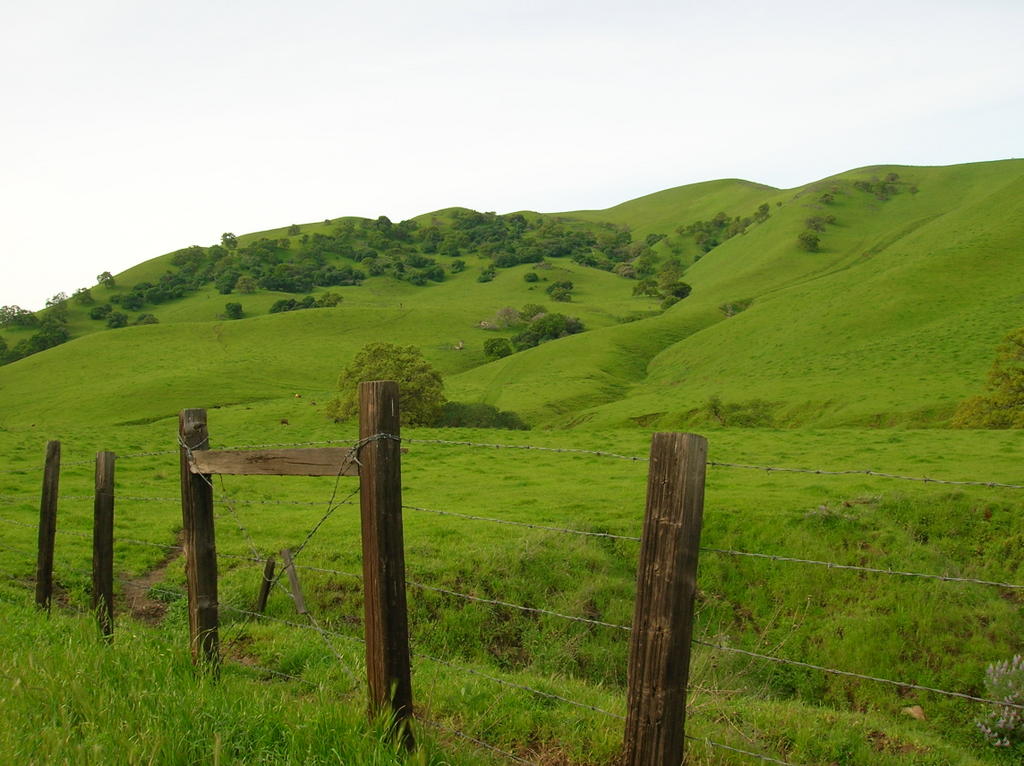 View from the Old Somersville Road on the way into the Black Diamond Mines Regional Preserve
 Rose Hill Miners' Cemetery (note the cypresses), as seen from below the Somersville site
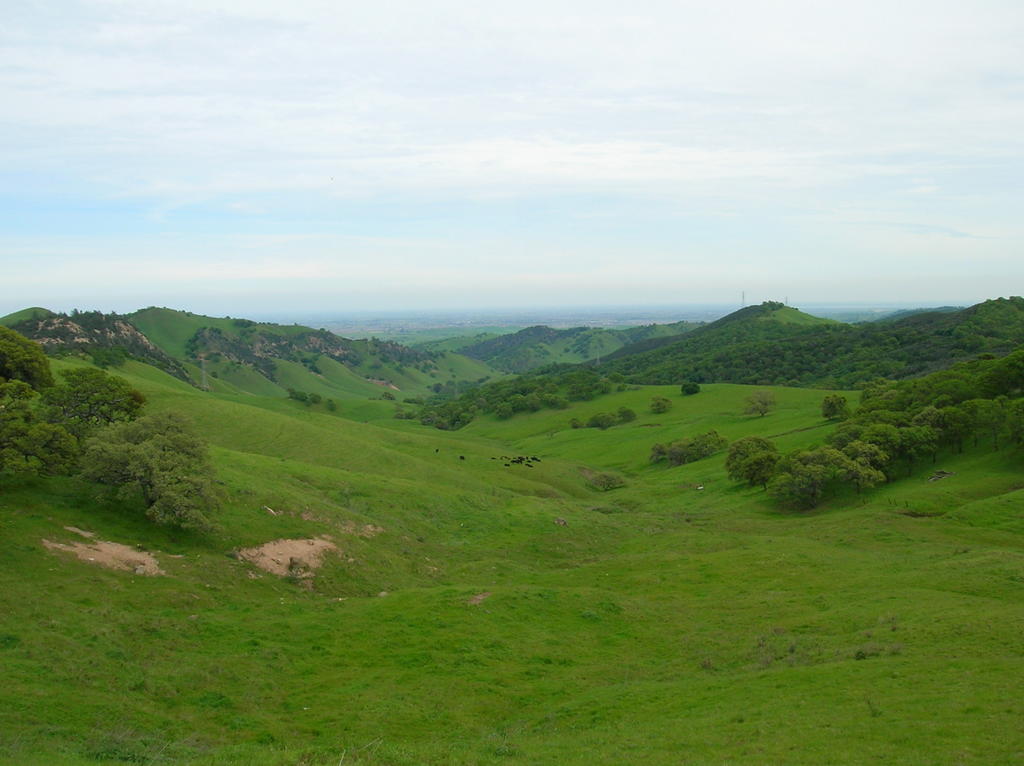 Above Nortonville, looking east to the great Central Valley
The Place the Mind Awakens
There’s a peculiar human experience that the American writer Wendell Berry beautifully describes as: “the intimacy the mind makes with the place it awakens in.” My own intellectual and creative life began in the great shadow of Mount Diablo in Northern California, and for all my fondness toward the mountain and its surrounding country, I never suspected I’d set a book there. Still, Diablo exerted its mythic force in my imagination, and I’ve now published a novel in which the mountain appears as a primary character.
The story is set in the 1860s-70s in the coal-mining village of Nortonville, once the largest community in this region, now long vanished from the earth. In the mid 1870s Nortonville was so bustling that its mines could produce more than 1 ton of coal per minute, but within 10 years fortunes changed and the town was virtually vacated. In a scene about halfway through The Green Age of Asher Witherow, the eponymous young hero observes a wild cougar “emerging” from the image of the mountain. It’s a mysterious moment, imbued with almost primal wonderment, and to me it’s the heart of the novel, because it faithfully renders the impression of bewildering immensity the mountain stirs in me.
Diablo locals are lucky to enjoy such an eminent daily centerpiece. The mountain grants us perspective, constantly reminds us where we are (in more sense than one), and thus serves the indispensable role -— the same it served the region's first Native Americans —- of world-center; one needn’t be at all religious to recognize the strange inner misgivings summoned, on a day of heavy fog or haze, when it’s blanked from sight.
I’ve long been in the habit of gazing upon Diablo from some vista point at nearby regional parks like Mount Wanda or Briones. While our highways thrum at its foot, I often reflect on the brevity of our human legacy in this valley. The transition from pastoral wilderness to today’s commuter gauntlets has occurred in little more than a hundred years -— a blink in the eye of a mountain as old as humankind. The original paradise is barely submerged, and Diablo stands above history, evidence of that paradise. As long as we wish for the mountain to remain eminent, wish that it be aproned by expansive open space, we will have held fast to the vital importance of awe and its invigorating source in our local wonders.
In the steep arc of Nortonville I see a historical allegory for us today: an era of immense growth and activity, all of it unsustainable and ultimately swallowed by the greater processes of —- first economy, and finally nature (the pristine Black Diamond hills now suggest precious little of the bleak industry they once supported). The Mount Diablo of my novel stands as a bit of eternity amidst the unstable world of Nortonville. Likewise, the true Mount Diablo continues to bear witness to the flurry of our human presence. I hope my book may inspire among its Diablo-based readers a fresh awareness of the mountain's continuing role as axis and awe-giver.
~Mark Allen Cunningham
This article was published in Diablo Watch (the newsletter produced by Save Mount Diablo) in spring, 2005.
The story is set in the 1860s-70s in the coal-mining village of Nortonville, once the largest community in this region, now long vanished from the earth. In the mid 1870s Nortonville was so bustling that its mines could produce more than 1 ton of coal per minute, but within 10 years fortunes changed and the town was virtually vacated. In a scene about halfway through The Green Age of Asher Witherow, the eponymous young hero observes a wild cougar “emerging” from the image of the mountain. It’s a mysterious moment, imbued with almost primal wonderment, and to me it’s the heart of the novel, because it faithfully renders the impression of bewildering immensity the mountain stirs in me.
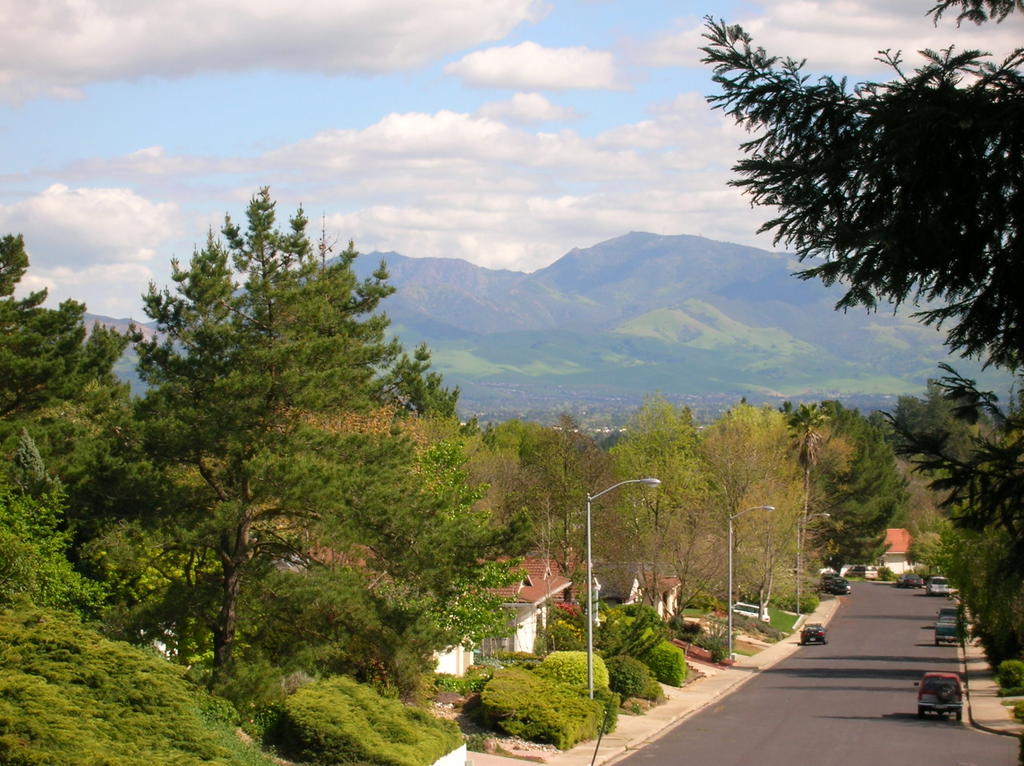
Diablo locals are lucky to enjoy such an eminent daily centerpiece. The mountain grants us perspective, constantly reminds us where we are (in more sense than one), and thus serves the indispensable role -— the same it served the region's first Native Americans —- of world-center; one needn’t be at all religious to recognize the strange inner misgivings summoned, on a day of heavy fog or haze, when it’s blanked from sight.
I’ve long been in the habit of gazing upon Diablo from some vista point at nearby regional parks like Mount Wanda or Briones. While our highways thrum at its foot, I often reflect on the brevity of our human legacy in this valley. The transition from pastoral wilderness to today’s commuter gauntlets has occurred in little more than a hundred years -— a blink in the eye of a mountain as old as humankind. The original paradise is barely submerged, and Diablo stands above history, evidence of that paradise. As long as we wish for the mountain to remain eminent, wish that it be aproned by expansive open space, we will have held fast to the vital importance of awe and its invigorating source in our local wonders.
In the steep arc of Nortonville I see a historical allegory for us today: an era of immense growth and activity, all of it unsustainable and ultimately swallowed by the greater processes of —- first economy, and finally nature (the pristine Black Diamond hills now suggest precious little of the bleak industry they once supported). The Mount Diablo of my novel stands as a bit of eternity amidst the unstable world of Nortonville. Likewise, the true Mount Diablo continues to bear witness to the flurry of our human presence. I hope my book may inspire among its Diablo-based readers a fresh awareness of the mountain's continuing role as axis and awe-giver.
~Mark Allen Cunningham
This article was published in Diablo Watch (the newsletter produced by Save Mount Diablo) in spring, 2005.
Friday, September 16, 2005
News, September 2005: Forthcoming Fiction, etc.
Four short stories by M. Allen Cunningham will be featured in live readings by professional actors at the New Short Fiction Reading Series in Beverly Hills next May (2006). More on this performance as the date draws near...
As is noted on my "Works" page at the main website, a few new short stories are forthcoming very soon in American literary magazines:
Look for "The Best Man," a tale of little league debacles, adult awkwardness, wedding coordinators, pet euthanasia, and elementary school bullies, in Glimmer Train's winter 2005 issue, arriving on stands in November.
"Windmills," a story of two kinds of loneliness, will appear in issue Number 6 of Night Train sometime in the next few months.
And in the more distant future:
"Twelve Monthly Devotions," a near-novella starring a bench-pressing preacher, will appear in The Kenyon Review, summer 2006.
P.S. Stay tuned for some short fiction excerpts soon to appear on this page...
As is noted on my "Works" page at the main website, a few new short stories are forthcoming very soon in American literary magazines:
Look for "The Best Man," a tale of little league debacles, adult awkwardness, wedding coordinators, pet euthanasia, and elementary school bullies, in Glimmer Train's winter 2005 issue, arriving on stands in November.
"Windmills," a story of two kinds of loneliness, will appear in issue Number 6 of Night Train sometime in the next few months.
And in the more distant future:
"Twelve Monthly Devotions," a near-novella starring a bench-pressing preacher, will appear in The Kenyon Review, summer 2006.
P.S. Stay tuned for some short fiction excerpts soon to appear on this page...
Consulting the Shaman

Submerged as I am in the first stages of structuring my new novel from a mass of raw manuscript material, I've spent significant time consulting the Grand Shaman of Structure--that is, the great film editor Walter Murch (The Coversation, Apocalypse Now, The Unbearable Lightness of Being, The Godfather parts I,II & III, The English Patient, The Talented Mr. Ripley).
Not consulting personally, of course, but doing perhaps the next best thing: leafing through two books that I hold to be indispensable to my creative-writing life:
The Coversations: Walter Murch and the Art of Editing Film by Michael Ondaatje (ISBN: 0-375-41386-3)
and:
Behind the Seen: How Walter Murch Edited Cold Mountain... by Charles Koppelman (ISBN: 0-7357-1426-6)
Says Master Murch (speaking, in Behind the Seen, of the editor's process in orienting oneself to a new film project. Which we might read as the author's process in orienting oneself to the structuring of a book):
"In taking editing notes the skill is to think that every line reading might have a context in which it can be good. Imagine the cuts, and the good might lie right next to the bad. Don't under any circumstances write off a take as being throughout no good. If you must, then say WHY it is no good. This sharpens your perception, as well as being a good reference later on..." (Koppelman, 169) "The first set of notes are a lover's first impression of the beloved. The second set are a surgeon's notes before making the first incision." (Koppelman, 175)
And in The Conversations (speaking about transitions and the mysterious quotient of completion):
"As I'm assembling the film, I'll be trying to find the exact moment each shot reaches its optimal maturity: I want to hold every shot on screen long enough for it to deliver the goods, but cut it off at a moment when it also has the potential to lead to something else."(Ondaatje, 238) "When you're putting a scene together, the three key things you're deciding, over and over agin, are: What shot shall I use? Where shall I begin it? Where shall I end it? An average film may have a thousand edits in it, so: three-thousand decisions. But if you can answer those questions in the most interesting, complex, musical, dramatic way, then the film will be as alive as it can be.
"For me, the most rhythmically important decision of the three is the last: Where do you end the shot? You end it at the exact moment in which it has revealed everything that it's going to reveal, in its fullness, without being overripe. If you end the shot too soon, you have the equivalent of youth cut off in its bloom. Its potential is unrealized. If you hold a shot too long, things tend to putrefy." (Ondaatje, 267)
"The decision where to cut film is very similar to the decision, in writing poetry, of where to end each line. On which word? That end point has little if anything to do with the grammar of the sentence. It's just that the line is full and ripe at that point, full of meaning and ripe with rhythm. By ending it where he does, the poet exposes that last word to the blankness of the page, which is a way of emphasizing the word. If he adds two words after it, he immerses that word within the line, and it has less visibility, less significance..."(Ondaatje, 268)
"...And one of the most fruitful paradoxes, I think, is that even when the film is finished, there should be unsolved problems. Because there's another stage, beyond the finished film: when the audience views it. You want the audience to be co-conspirators in the creation of this work, just as much as the editor or the mixers or the cameraman or the actors are...it's a wonderful dilemma: you have to acknowledge that there must be unsolved problems at each stage. As hard as you work, you must have this secret, unspoken hope that one very significant problem will remain unsolved. But you never know what that is until the film is done." (Ondaatje, 105)
Take Master Murch's filmic terminology and translate it to the novelist's lexicon by roughly the following formula: "film"=novel; "shot" or "take"=section or scene; "on the screen"=on the page -- and voila!, an abundance of inimitable novelistic wisdom has been magically distilled!
Friday, March 25, 2005
The Trifling Trinomial: In Which the Author Discloses How Arbitrary One’s Own Sobriquet Can Be
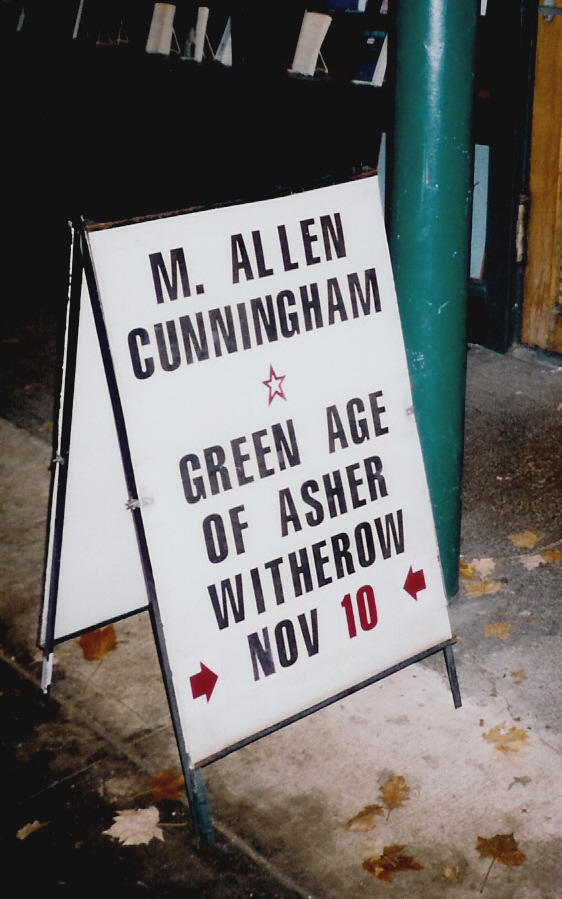
You might have noticed I publish under the slightly cryptic author name of “M. Allen Cunningham,” and you wouldn’t be the first if you happened to wonder why I went with this moniker.
The nom de plume is a funny thing. Back in 2002 my first published short story appeared (in Alaska Quarterly Review) under the name “Mark Cunningham,” and I was plenty comfortable with that designation (it’s my name after all) until two things came to my attention while perusing a handful of new literary magazines:
1. I already existed in different physical form.
2. I was apparently publishing poetry on a prolific scale.
Figuring that I wanted to continue publishing in literary magazines myself (as myself), I began to contemplate a nom de plume. My wife and I discussed it and together decided it'd be a good idea (that other guy is a really good poet. Read some of his work here). This was during a road trip around the National Parks of the western U.S. two summers ago, just after I’d received my second short fiction acceptance, so we had plenty of road-time to ponder such trifles.
How about “Marcus Cunningham”? Hmmm...would I be comfortable with people calling me Marcus?
I had a great, great grandfather named Matthias: why not just change the whole era-specific nature of my name? But Matthias wasn’t my name either, and I'd probably end up being called “Matt” anyway.
We briefly considered something like “Artist Formerly Known as Mark Cunningham,” then luckily it occured to us that we might somehow employ my middle name.
So, how about Allen? “Allen Cunningham.” Hmmm. Sounds slightly professorial.
“Mark Allen Cunningham”?—Too long.
“M. Allen Cunningham”?—Too pretentious.
Yes, pretentious. Really, how could I presume to join the legendary initialed ranks whose members included:
F. Scott Fitzgerald
T.S. Eliot
H.G. Wells
E.M. Forester
D.H. Lawrence
C.S. Lewis
W.H. Auden
J.D. Salinger
J.M. Barrie
…and the poet H.D.
Not to mention those lauded contemporary authors whose surnames are preceded by something-dot-something-or-other:
J.M. Coetzee
J.G. Ballard
T.C. Boyle…
So at some point out on Montana’s Highway 90 the vistas got the better of us and my wife and I just stopped thinking about it. A few weeks later, back at home, she approached me out of the blue and said: “I like M. Allen Cunningham.” And I said okay.
So it’s her fault, I guess is what I’m saying; I just write the fiction.
But if only she or I had had the foresight to consider the possibility of eventual book publication, the interpersonal nature of book promotion, and the incalculable number of occasions I'd have to say something like this:
“The M. is for Mark, please call me Mark. Except when it’s in print. Then use ‘M. Allen’. But I can answer to ‘Allen’ too if that’s easier for you. Ah, hell, just introduce me as ‘Mark Allen Cunningham’—-and you can drop the ‘Allen’ if you want. Or the ‘Mark.’ ”

Subscribe to:
Posts (Atom)